
Long Live the International Space Station
Overview
The International Space Station (ISS) has been home to crew and scientific experiments for over 13 years. However, the structure was certified for only 15 years. The Loads & Dynamics Team at NASA Johnson Space Center has been working to extend the structural life to reach 2020 and beyond. The team uses flight data to reconstruct past load-producing events and analyzes future events to minimize fatigue cycles on the ISS.
Project Details
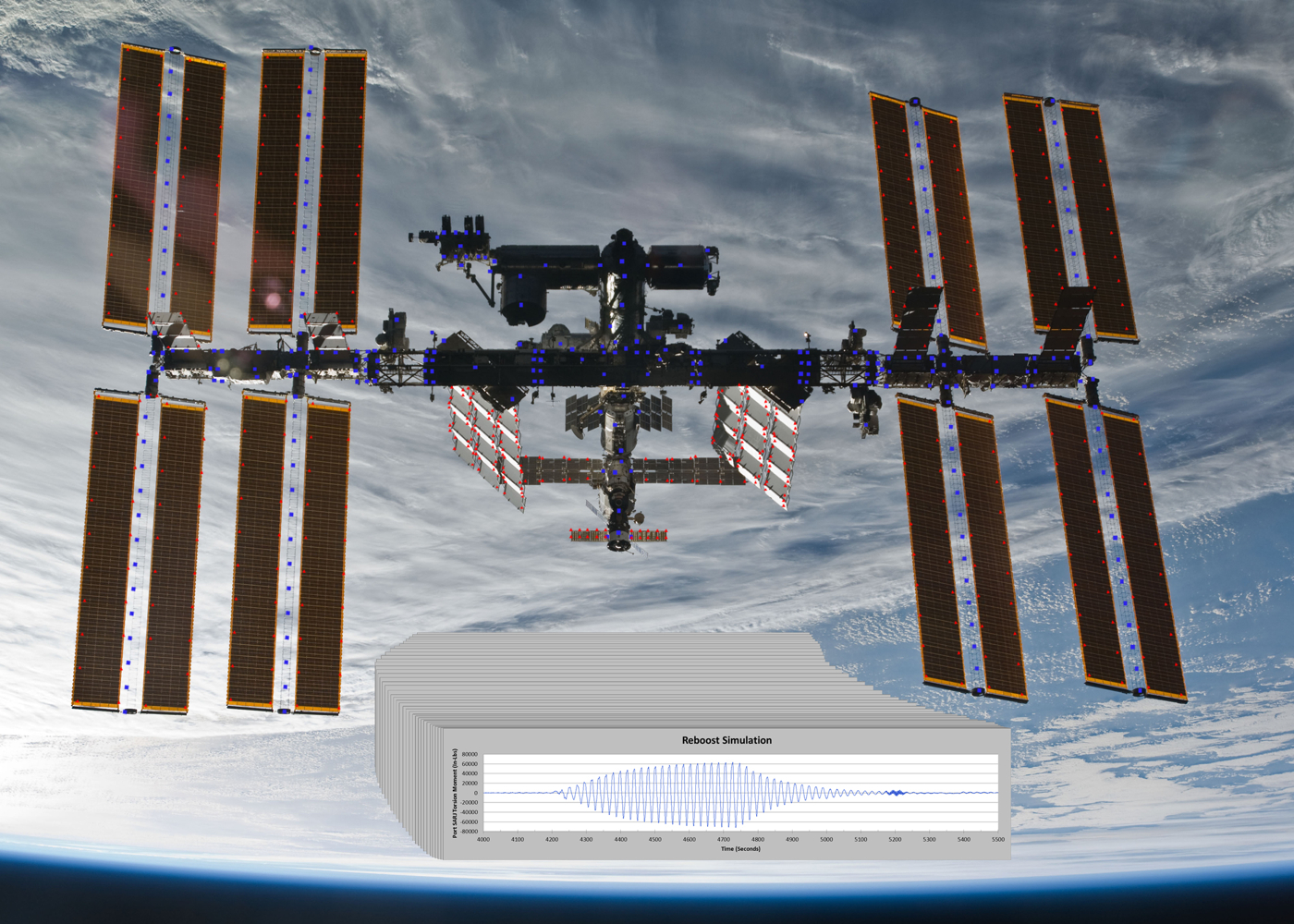
The ISS is the largest human-made object ever built in space. It currently contains over 300 major structural interfaces. For each predicted loading event, a set of structural dynamic simulations is run to determine the loads on all of these major structural interfaces.
Sources of loads on the ISS structures include thruster firings, visiting vehicle dockings, crew exercise and motions, and robotic arm operations. For each event, hundreds to thousands of simulation runs are generated and analyzed for loads. If these simulations show the potential for high loads, then means are devised to limit the operations surrounding the event in order to reduce load levels.
Recently, the team devised new flight control software to limit potential high-loading events during attitude maneuvers. The new software mitigates loading by both limiting the total time thrusters can fire and controlling the timing of repeated firings needed to complete a maneuver. If allowed to tune into certain modes of vibration within the ISS structure, these repeated firings can produce very high loads. The new software has many different input parameters to control the firings. Many permutations of loads simulations needed to be assessed in order to find the right combination of parameters that will produce the lowest loads while also still meeting the requirements to maneuver and control the entire station.
Results and Impact
Using NASA's Pleiades supercomputer, the ISS Loads & Dynamics Team was able to complete the following key ISS loads simulations:
- Analyses to determine parameters for ISS attitude control maneuvers for the new flight software version.
- Solar Array Keep-Out-Zone calculations for ISS maneuvers, reboosts, and visiting vehicle proximity operations.
- Verification Loads Analysis for the SpaceX-2, H-II Transfer Vehicle 4, and Orbital Demo 1 missions.
- Special studies for the Stratospheric Aerosol and Gas Experiment 3 (SAGE-3) and Multiple User System for Earth Sensing (MUSES) payloads.
Role of High-End Computing Resources
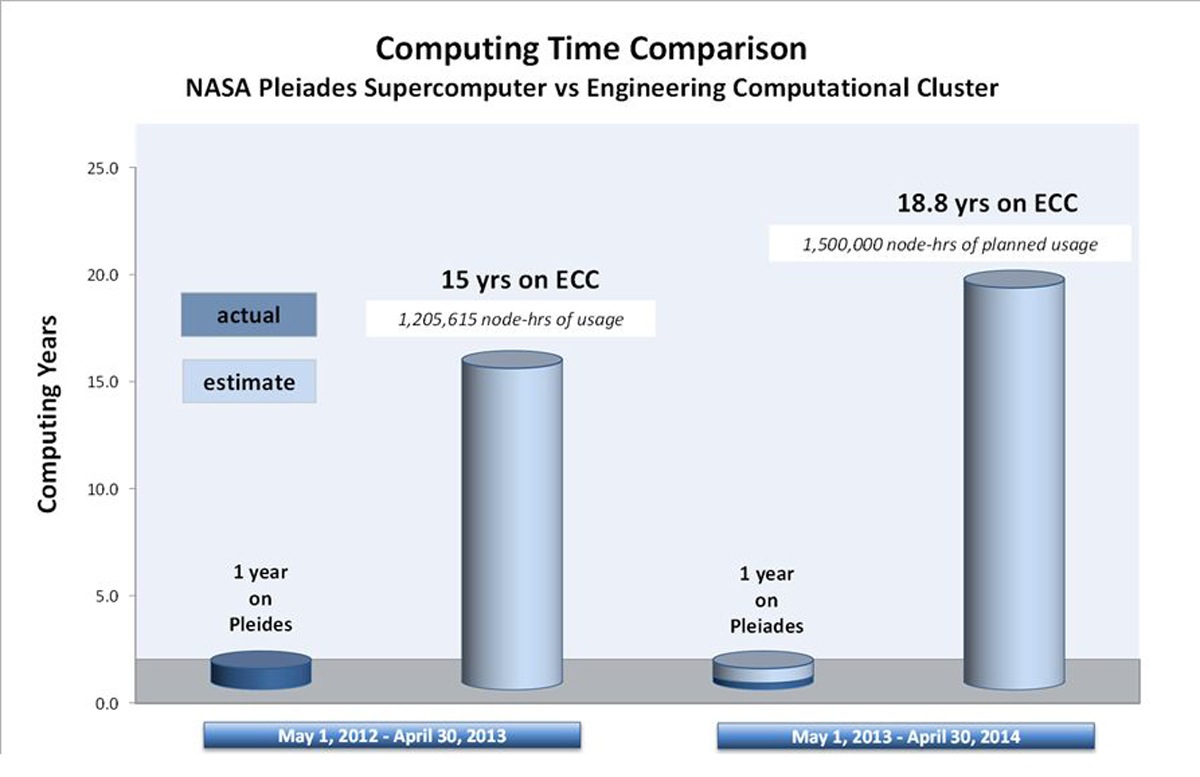
Each ISS loads simulation is performed on a structural dynamics model with over 35,000 degrees of freedom and over 1,000 vibrational modes below 5 hertz. Tens of thousands of cases need to be run for a comprehensive loads analysis. NASA's Pleiades supercomputer enabled the ISS Loads & Dynamics Team to complete this high volume of ISS loads simulations on time. Running all the simulations on the local Engineering Computational Cluster (ECC) would have delayed the completion of the loads work and resulted in increased operational risks or constraints for the ISS.
Michael Grygier, NASA Johnson Space Centermichael.s.grygier@nasa.gov