
Our Nearest Star: The Enigmatic Sun
Overview
For centuries, the Sun was thought to be a constant source of heat and light. This view has changed as modern satellite observations have shown that the Sun is a source of highly variable ultraviolet radiation, X-rays, and high-energy charged particles. Solar variability determines space weather, which greatly impacts Earth's environment, life, and modern society. Significant progress towards achieving a quantitative understanding of the Sun's dynamics—along with predictive capabilities for solar activity and space weather—requires large-scale, integrated modeling of physical conditions in subsurface layers of the Sun. We can now achieve realistic numerical simulations of subsurface dynamics and magnetic structures by using efficient parallel analysis codes on NASA's Pleiades supercomputer. This capability has led to substantial breakthroughs in our understanding of solar variability.
Project Details
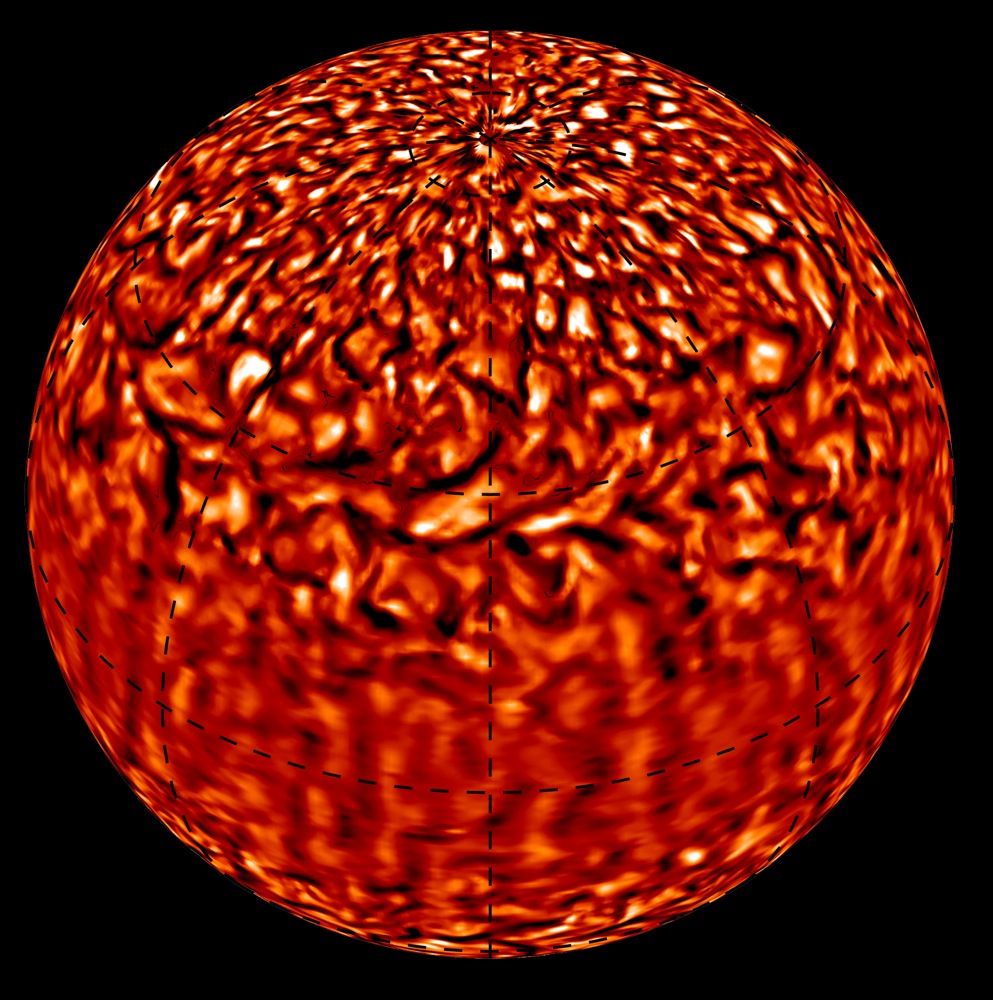
Magnetohydrodynamic (MHD) processes in the Sun are governed by the interaction of convection and dynamo-generated magnetic fields. These processes lead to the formation of sunspots, which are concentrations of strong magnetic fields that generate twisting and shearing motions, triggering magnetic reconnection and energy releases in the form of flares and coronal mass ejections. There are two ways to investigate MHD processes below the visible surface on the Sun: observationally, by local helioseismology, and theoretically, by numerical simulations. Because of the complexity of turbulent convection, progress can only be achieved by developing a synergy between the two methods. Observations are made using space- and ground-based telescopes, and supercomputer simulations then guide the interpretation and understanding of the observations. The multi-scale nature of solar dynamics requires us to study the Sun using both global-scale simulations and local, smaller-scale simulations of the upper convection zone and atmosphere.
Results and Impact
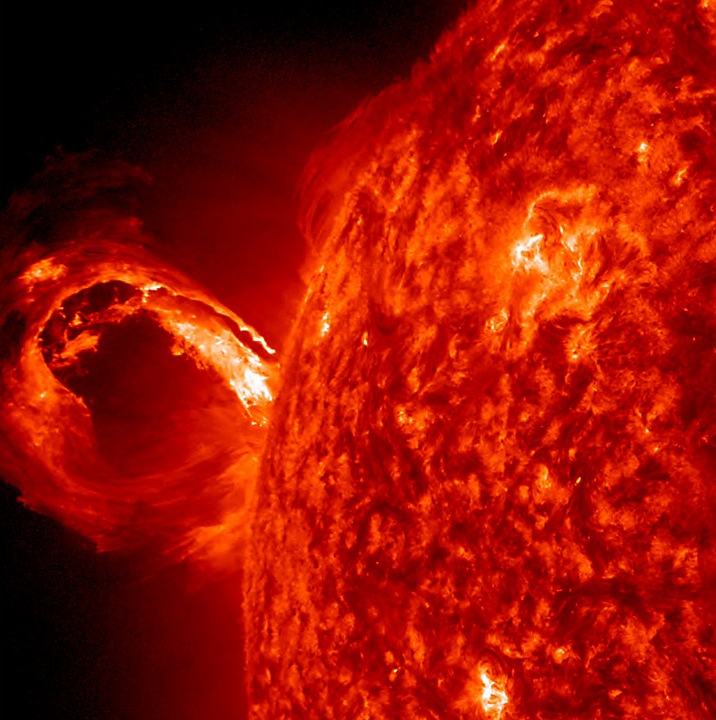
Realistic multi-scale simulations are extremely important for probing the complicated physics of the turbulent convection zone and atmosphere of the Sun. Interpreting the dynamics of this zone is critical to understanding phenomena such as solar differential rotation, meridional circulation, solar magnetic field generation by dynamo, and the formation and activity of magnetic regions on the Sun. The dynamics change dramatically in magnetic field regions, causing plasma eruptions and magnetic energy release events. Supercomputer simulations have provided critical data for analyzing and interpreting observations from NASA's solar space missions—the Solar & Heliospheric Observatory (SOHO), the Interface Region Imaging Spectrograph (IRIS), the Solar Dynamics Observatory (SDO), and the Hinode Observatory. In particular, realistic numerical simulations provide important insights into the origin of solar differential rotation and dynamo, the multi-scale nature of solar convection (in both the quiet areas of the Sun and in magnetic regions), the formation and dynamics of magnetic flux tubes, the structure of sunspots, the excitation of solar oscillations, and other solar dynamics problems.
Role of High-End Computing Resources
Simulations performed on the Pleiades supercomputer at the NASA Advanced Supercomputing (NAS) Division demonstrate high efficiency for massive parallel computations using up to 8,000 processors. The 3D visualizations provided by NAS experts significantly aid our interpretations, greatly contributing to the success of this project.
Alexander Kosovichev, New Jersey Institute of Technologysasha@bbso.njit.edu Nagi Mansour, NASA Ames Research Center
nagi.n.mansour@nasa.gov