
Exciting Waves in Accretion Disk Boundary Layers
Overview
Accretion is the process by which matter around massive astrophysical objects—such as neutron stars, white dwarfs, and growing protoplanets—flows radially inward toward the central body. The accreting material typically forms a disk as it spirals inward, and a boundary layer will form where the disk interfaces with the solid or fluid outer edge of the central object. The boundary layer is observationally significant because it generates up to half of the total luminosity produced by the accretion disk. Additionally, it is associated with periodic variability, such as dwarf nova oscillations in accreting white dwarf systems.
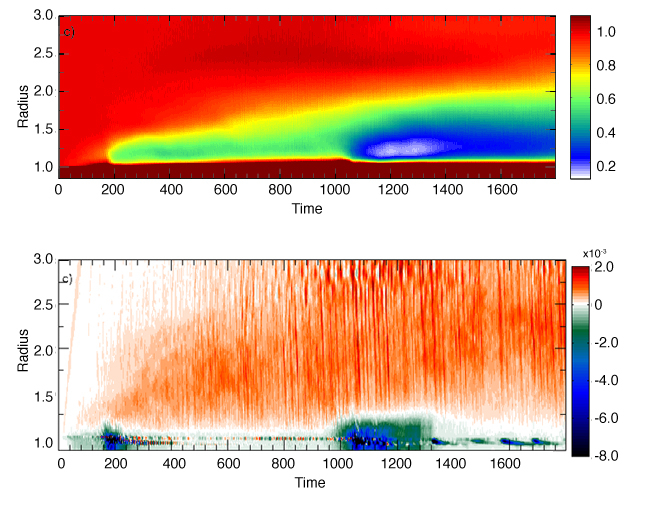
We have performed analyses and simulations of boundary layer dynamics to investigate the physical mechanisms that drive accretion of material through the boundary layer. Our results have revealed an acoustic instability that excites waves in the boundary layer, which play a key role in accretion phenomena.
Project Details
We used both analytic methods and the magnetohydrodynamic Godunov code, Athena, to study the dynamics of the boundary layer. We performed 2D and 3D cylindrical simulations of boundary layer dynamics with magnetic field effects. The project was supported by a NASA Origins grant.
Results and Impact
We have discovered a new acoustic instability that drives accretion by robbing the fluid in the boundary layer of angular momentum. Because this instability controls mass accretion through the boundary layer, it has ramifications for boundary layer structure and emissions.

We found that the interaction between the boundary layer bulk flow and sound waves excited at a co-rotation resonance drives mass accretion and angular momentum transport. This result is significant for semi-analytic spectral models of the boundary layer, which typically assume a local effective viscosity due to turbulence. If angular momentum is transported by waves in the boundary layer, as we have shown, then it cannot be simply parameterized by a local effective viscosity. This is because waves are inherently nonlocal and are capable of transporting angular momentum long distances.
The boundary layer waves excited by the instability also have a well-defined structure and frequency. The time-periodic nature of these waves provides an intriguing mechanism for explaining the periodic variability associated with the boundary layer.
Future research will focus on incorporating multidimensional radiative transfer into the simulations and connecting simulation results directly to observations.
Role of High-End Computing Resources
Immense computational horsepower was needed to tackle the complex 3D magnetohydrodynamic equations, gravitational effects, and multi-scale nature of the boundary layer problem in our simulations. Our project utilized over 7 million processor-hours on the Pleiades supercomputer, which was instrumental to our success.
Mikhail Belyaev, Princeton Universitymbelyaev@astro.princeton.edu Roman Rafikov, Princeton University
rrr@astro.princeton.edu