
Exploring Nonlinear Slosh Damping in Propellant Tanks
Overview
Analyses of launch vehicle Guidance, Navigation and Control (GN&C) capabilities must take into account propellant tank slosh dynamics. These slosh dynamics are typically represented by a mechanical model of a spring mass damper, which is then included in the equation of motion for the entire vehicle. For a partially filled, smooth-wall propellant tank, the critical slosh damping value based on classical empirical correlation can be as low as 0.05%. This low damping value means that propellant slosh could critically disturb the stability of launch and space vehicles.

We postulate that the slosh damping values based on the common mechanical models are valid only under the linear regime, where slosh amplitudes are small. With an increase of slosh amplitude, the critical damping value should also increase. Confirmation of this nonlinear damping behavior would enable significant improvement of slosh stability margins and reduction of the level of conservatism maintained in GN&C analyses. In this study, we perform multi-phase computational fluid dynamics (CFD) simulations of propellant slosh in smooth-wall tanks to explore and quantify the dependence of slosh damping on slosh amplitude.
Project Details
Accurately predicting the extremely low slosh damping value for a smooth-wall tank is very challenging for any CFD tool. The analysis must resolve thin boundary layers near the wall and minimize numerical damping. In this study, we linked a volume-of-fluid analysis module to the Loci/STREAM CFD solver developed at NASA Marshall Space Flight Center. This new program enables fast turnaround times and lower numerical damping by using high-resolution computational meshes. For this project, we first validated the CFD program against experimental data for linear slosh damping within various tank sizes. We then computed slosh damping values at larger slosh amplitudes.
Results and Impact
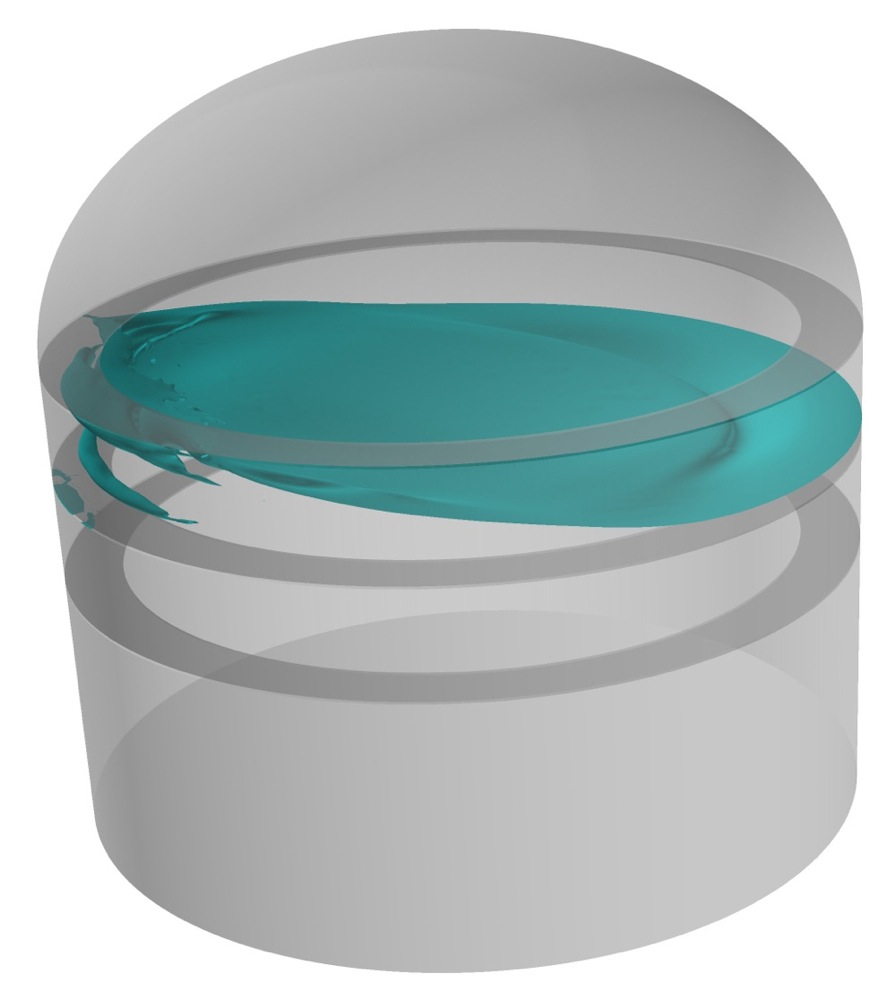
Our simulation results demonstrate that, with proper grid resolutions, CFD analyses can accurately predict the low damping physics for smooth tank walls under the linear regime. The damping values computed for different tank sizes show very good agreement with experimental data. The simulation results confirm that slosh damping is indeed a function of slosh amplitude. When slosh amplitude is low, the damping ratio is essentially constant, which is consistent with empirical correlation methods. Once the amplitude reaches a critical value, however, the damping ratio begins to increase linearly as a function of the slosh amplitude. This discovery could lead to significant savings in launch vehicle development by reducing the number and size of slosh baffles needed in liquid propellant tanks.
Role of High-End Computing Resources
Very fine grid resolutions are needed to capture the thin boundary profile of propellant slosh waves and the associated low fluid damping. Performing analyses at these high resolutions requires large amounts of computational power and memory. The present simulations would not have been possible without the use of NASA's Pleiades supercomputer, which allows us to solve complex, multi-phase flow problems using high-bandwidth, low-latency networking and highly parallel processing capabilities. Each simulation took 1 to 3 days to complete using 500 - 1,000 processors on Pleiades.
H. Q. Yang, NASA Marshall Space Flight Centerhong.q.yang@nasa.gov Jeff West, NASA Marshall Space Flight Center
jeffrey.s.west@nasa.gov