
Kepler Lives On: It's All in the Data
Overview
NASA's Kepler mission has captivated science enthusiasts and astronomers from around the world in its mission to find Earth-sized and smaller planets around other Sun-like stars. After its launch in March 2009, the Kepler spacecraft continuously measured dips in the brightness of more than 150,000 stars to search for transiting planets. While Kepler can no longer attain the necessary pointing precision to search for planets, the mission lives on through a major effort to completely analyze the data collected by the spacecraft, with the end goal of understanding our place in the universe.
Project Details

Each month for the last four years, the Kepler team downloaded and transferred science data from the spacecraft to the Kepler Science Operations Center (SOC) at NASA's Ames Research Center. Researchers used custom software to calibrate pixels, combine them to form light curves, correct for systematic errors introduced by the instrument, and then search for transiting planets signals. The data was automatically copied between the Kepler SOC and the Pleiades supercomputer at Ames.
In keeping with the mission's data-centric focus, this year the team completed the transfer of the entire Kepler Data Processing Pipeline to Pleiades. New features and improvements made to the pipeline software will improve search sensitivity, and the software has been mirrored on Pleiades.
Results and Impact
As of November 2013, the Kepler team has found 3,548 planet candidates orbiting 2,165 host stars with 151 confirmed planets—an increase of 20% over the previous year. Among the latest findings:
- The largest population increases are in Earth and super Earth-sized planet candidates, with over 1,700 planetary candidates close to the size of Earth.
- At least one in five stars in the population has planet up to twice the size of Earth and orbiting within its star's habitable zone.
- Four new planet candidates, each less than twice the size of Earth—and orbiting within the habitable zone—with one orbiting a Sun-like star.
- 43% of planet candidates are in multiple planet systems.
More exciting discoveries are expected as the Kepler SOC team continues to tease out weaker transit signals, associated with smaller planets, from the data.
Role of High-End Computing Resources
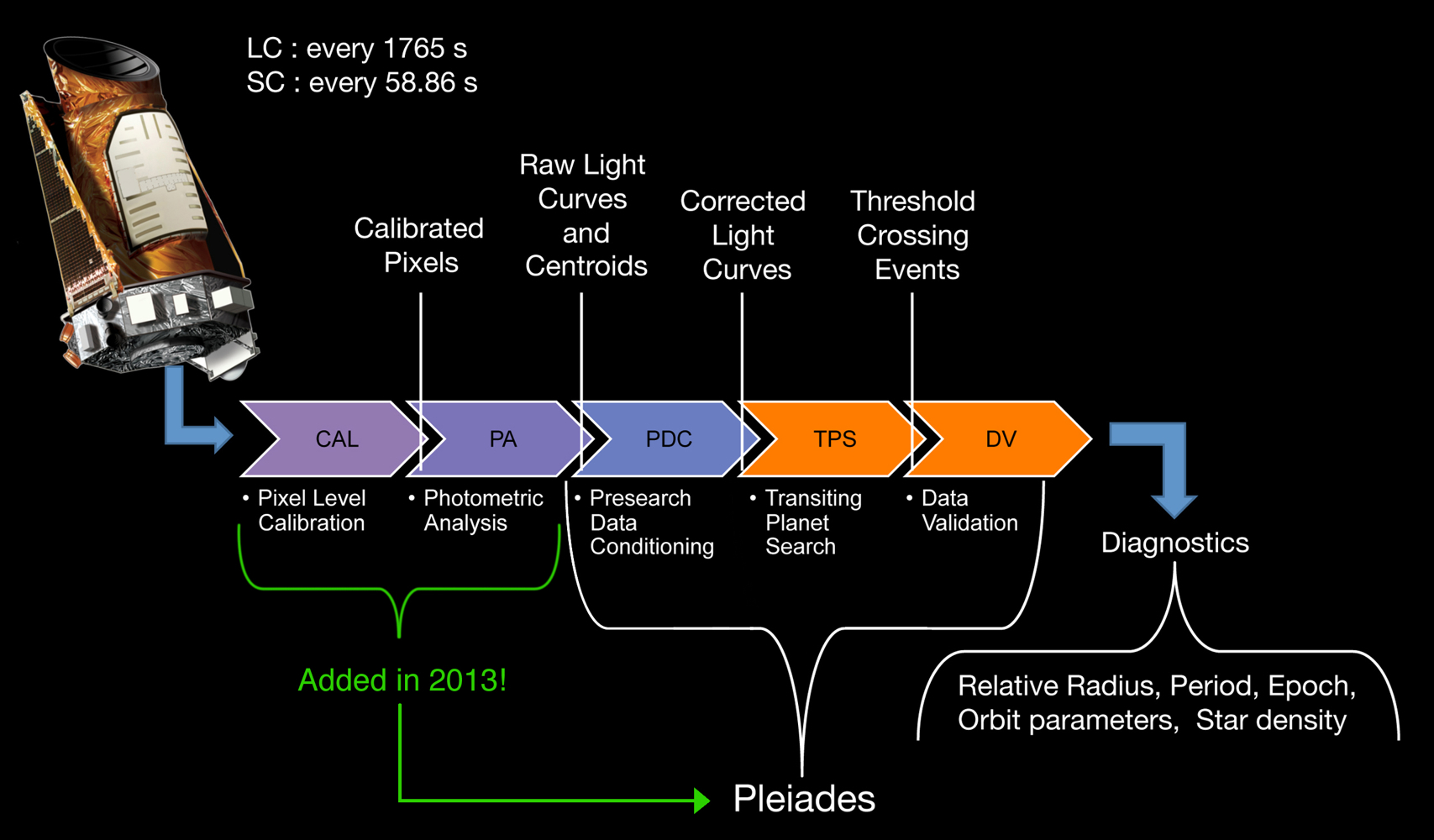
Transferring the entire pipeline to the Pleiades supercomputer will enable sophisticated and computationally expensive processes—data calibration, photometric analysis, pre-search data conditioning, transiting planet search, subsequent data validation, and searches for multiple planet systems—to be run in a just a few days. Improved search sensitivity, enabled through the use of Pleiades, will give scientists a more complete understanding of the percentage of stars that have potentially habitable Earth-sized planets—still the primary goal of the Kepler mission.
Shawn E. Seader, NASA Ames Research Centershawn.seader@nasa.gov