
Computational Airframe Noise Prediction
Overview
One of the major challenges in commercial aviation is reducing aircraft noise. Significant research has been invested in understanding the fundamental flow physics, identifying noise sources, and developing predictive capabilities to guide aircraft designers. Computational aeroacoustics (CAA) has played a critical role in understanding and characterizing the noise-generation sources for different aircraft component designs. Modeling and simulation experts at NASA Ames Research Center have been developing state-of-the-art CAA tools and predictive capabilities using the Launch Ascent and Vehicle Aerodynamics (LAVA) solver.
Project Details
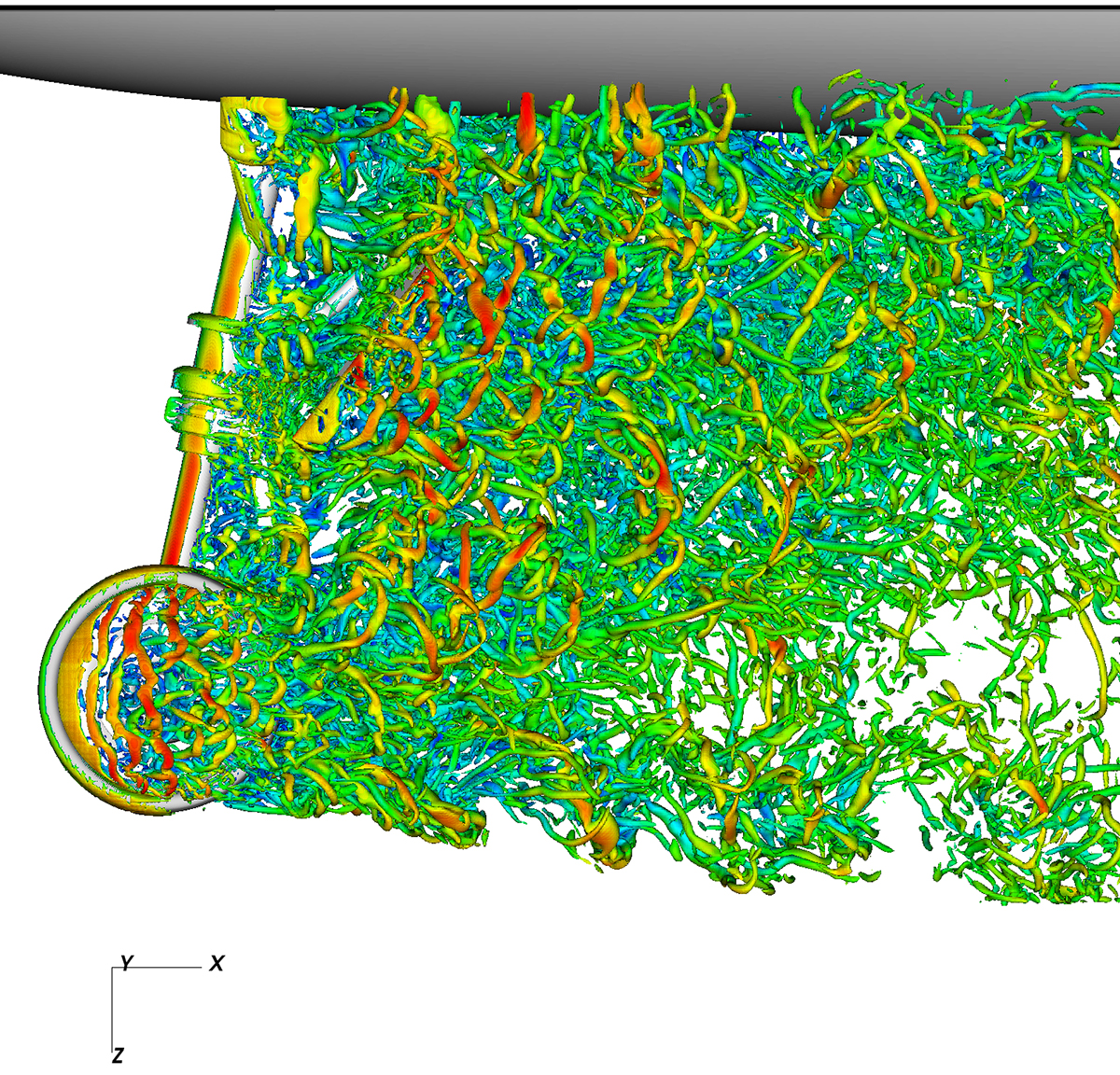
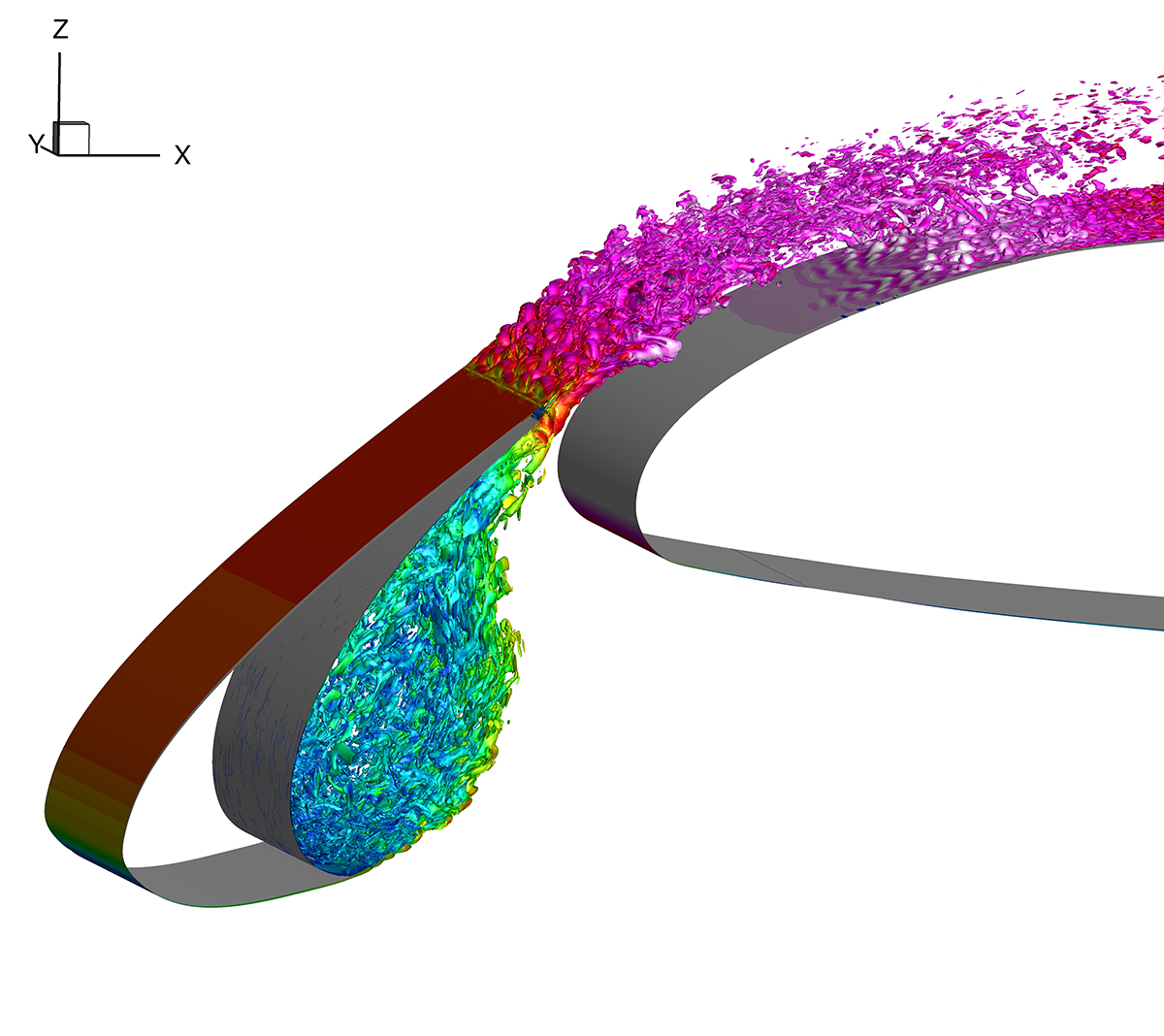
We used the LAVA computational fluid dynamics (CFD) code, developed at NASA Ames, to perform CAA simulations of two test cases for the American Institute of Aeronautics and Astronautics 3rd Workshop on Benchmark Problems for Airframe Noise Computations. The two test cases were a Partially-Dressed Cavity-Closed Nose Landing Gear (PDCC-NLG) and slat noise using NASA's modified 30P30N configuration. The goal of the PDCC-NLG test case is to advance techniques for predicting noise generated by the landing gear—a major contributor to airframe noise. Similarly, the 30P30N configuration seeks to improve prediction of noise radiation from the leading edge slat of a high-lift system, an important component of aircraft noise during landing approach.
Additionally, we used the LAVA framework to assess the Four Jet Impingement Device (FJID). The FJID is an experimental noise-generation device used to reproduce the broadband noise signatures of aircraft engines. The aeroacoustic predictions produced by LAVA better resolved the temporal and spatial scales associated with the FJID's unsteady flow characteristics. These improvements were achieved using fifth-order-accurate WENO5Z discretizations instead of traditional second-order-accurate MUSCL schemes.
Results and Impact
These simulations have demonstrated and validated high-fidelity, time-accurate, and higher-order CFD methods for complex noise-prediction problems. Using these methods, we have identified major noise frequencies and contributions with far-field noise propagation. Our LAVA CAA results show excellent comparison with available experimental and computational results for key analytical benchmark problems. The computational discretization and gridding techniques provide an excellent procedure for future aircraft noise simulations. With the help of these predictive capabilities, next-generation aircraft will be able to meet more stringent noise-generation standards and benefit the community.
Why HPC Matters
Airframe noise prediction requires high-spatial and temporal resolutions to capture the complex, detailed flow physics associated with aeroacoustics. CAA techniques rely heavily on high-performance computing resources to achieve reasonable analysis turnaround times. In this work, the Pleiades supercomputer was utilized for data analysis and flow visualization. Parallel computations were run across thousands of nodes for long intervals to ensure that sufficient time-integration was obtained. Parallel visualization processing was essential to rendering the movies needed to effectively analyze the fundamental flow features in the simulations.
Cetin Kiris, NASA Ames Research Centercetin.c.kiris@nasa.gov