
Efficient Computational Modeling of Launch Environments
Overview
NASA is developing a new heavy-lift Space Launch System (SLS) for space exploration and is considering potential commercial launch vehicles for transporting crew and cargo to low Earth orbit and the International Space Station. To accommodate these new vehicles, NASA Kennedy Space Center (KSC) is reassessing and redesigning its launch site infrastructure, including the flame trench, mobile launcher (ML), launch tower, and associated hardware. The redesign process requires detailed insight into the pressure and thermal loads on each sub-component of the launch complex for various launch scenarios. We have utilized an innovative combination of computational fluid dynamics (CFD) and engineering modeling in order to conduct the necessary analyses efficiently.
Project Details
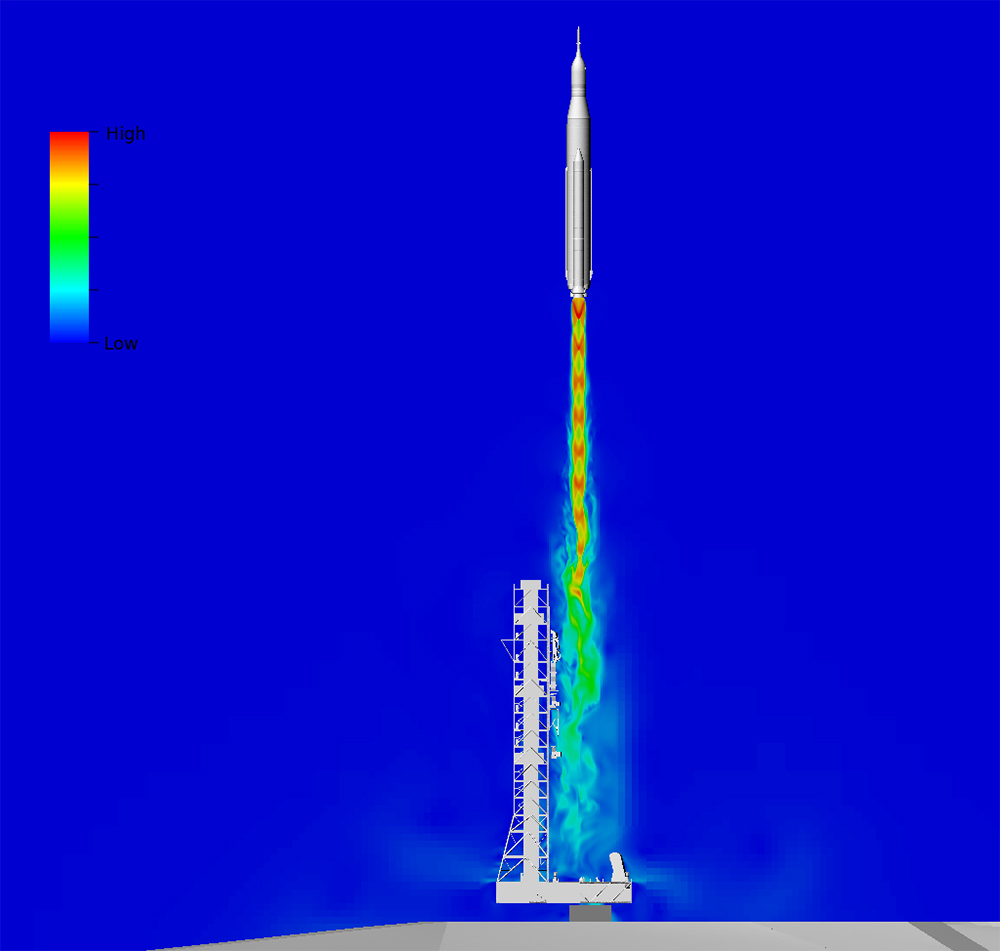
We use engineering analysis to estimate the plume-induced pressure loads on individual components of the launch complex. Various levels of analysis fidelity can be used to provide these estimates, ranging from simple empirical analyses to high-fidelity 3D CFD simulations of the moving launch vehicle with unsteady plume physics. While the latter simulations would provide the most detailed launch environment data, simulation of just a single trajectory case would take hundreds of thousands of processor-hours. We developed and utilized two reduced-fidelity modeling approaches to provide the needed design data while avoiding excessive computational costs. Roughly 10,000 potential vehicle launch trajectories had to be assessed in order to cover a wide range of scenarios such as potential fly-away maneuvers and various wind conditions. Matching an analysis technique at the highest feasible fidelity with the massive trajectory database requirement posed a significant challenge. To accomplish this, we selected a mixed-fidelity analysis approach and validated it with higher-fidelity CFD simulations.
First, we performed unsteady simulations of the launch vehicle plume in free-air to obtain time-averaged flow statistics. In subsequent analyses, this time-averaged plume data was swept past the ML/tower structure following the path of each trajectory variation while accounting for the corresponding vehicle orientation. During this sweep, the total pressure of the plume was projected on the ML/tower structure while employing analytical corrections for supersonic impingement on the surfaces. This methodology enabled us to obtain reliable predictions of transient pressure loads on the launch structures at a fraction of the cost of a pure CFD approach. The validity of this approach has been demonstrated through comparisons with high-fidelity CFD simulations for a limited number of trajectory points.
Results and Impact
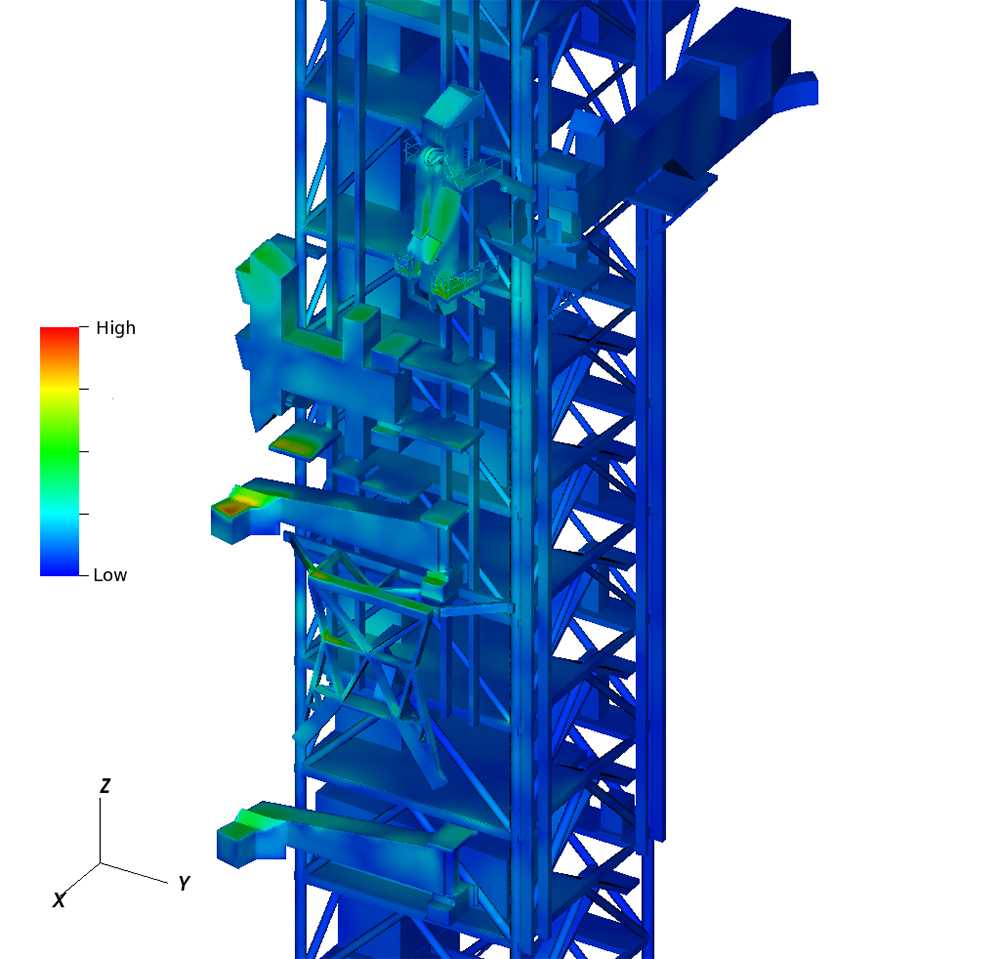
An innovative combination of high-fidelity CFD data and subsequent engineering analyses enabled an otherwise unfeasible set of transient pressure loading analyses for a large number of vehicle launch scenarios. This approach and the data it provides will significantly improve the safety and operational cost of KSC’s redesigned launch complex for future space missions.
Why HPC Matters
NASA’s Pleiades supercomputer was critical to performing the intensive, high-fidelity plume simulations, as well as the subsequent engineering analyses. While the latter was relatively cheap per evaluation, the sheer number of trajectories, and discretization of each of those trajectories, still created a massive demand for parallel computing power.
Emre Sozer, NASA Ames Research Centeremre.sozer@nasa.gov Cetin Kiris, NASA Ames Research Center
cetin.c.kiris@nasa.gov