
When Winds Collide: The Supermassive Binary Eta Carinae
Overview
The supermassive binary star system Eta Carinae—with a mass about 120 times that of the Sun—is famous for the greatest non-terminal stellar explosion ever recorded. In the 1840s, Eta Car became the second brightest star in the sky as it ejected between 10 and 40 Suns' worth of material, forming the bipolar "Homunculus" Nebula. Amazingly, this did not destroy Eta Car. Observations by NASA space instruments such as the Hubble Space Telescope (HST), Chandra, Swift, and others, reveal that Eta Car still undergoes dramatic changes every 5.54 years due to the stars' highly eccentric orbits. Because they are so massive and luminous (1 million and 5 million times the Sun's luminosity), the stars in Eta Car also have powerful, radiation-driven stellar wind mass outflows. These stellar winds violently collide between the stars, producing a pair of strong X-ray emitting shocks. Due to its proximity (about 7,500 light-years from Earth), Eta Car is a unique astrophysical laboratory for studying binarity, extreme shock physics, stellar mass loss, massive star evolution, chemical enrichment of the universe, and supernova progenitors and/or impostors.
Project Details
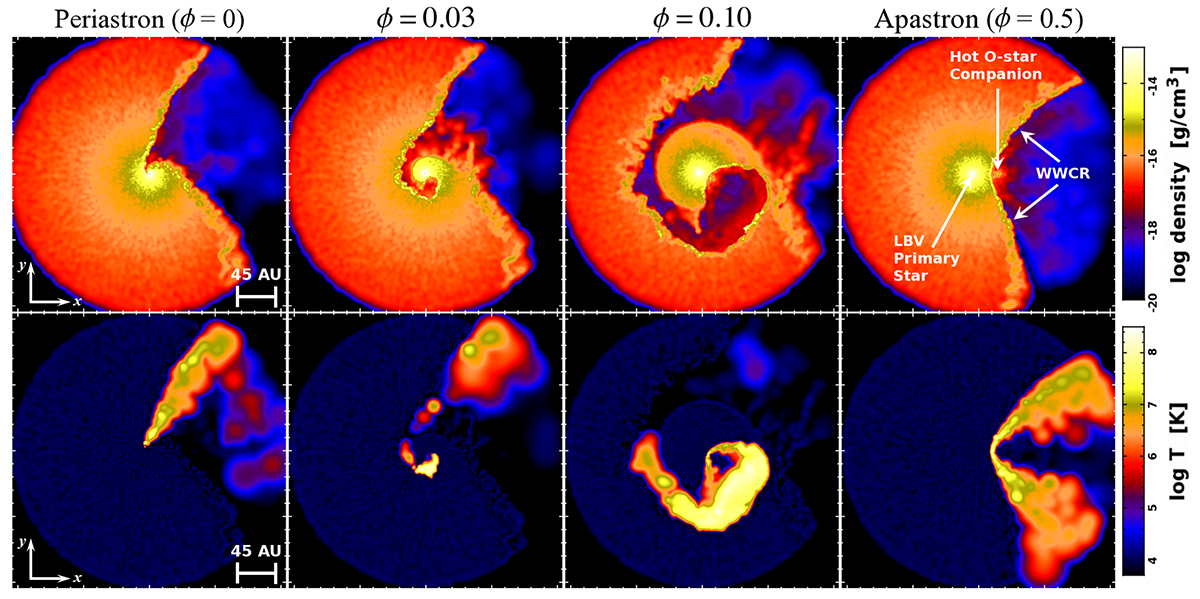
Proper understanding of Eta Car observations requires complex time-dependent 3D hydrodynamical simulations, since orbital motion distorts the geometry and physics of the stellar winds and shocks. The high orbital eccentricity (e = 0.9) also causes large changes in stellar separation—from about 29 astronomical units (AU) (the distance between the Sun and Neptune), when the stars are farthest apart, to about 1.5 AU (the distance from the Sun to Mars), when they are closest together. This necessitates a hydrodynamics code that can adapt its resolution to the stellar separation. Matching the spatial scale of HST observations also requires large-domain simulations.
We use a 3D smoothed particle hydrodynamics (SPH) code to simulate Eta Car's binary colliding winds. Computational domain sizes range from about 20 AU to 1,650 AU in radius and are chosen based on the physics and observations to be investigated. The simulations include orbital motion, optically thin radiative cooling, and radiative forces. The 3D SPH output is post-processed with 3D radiative transfer codes to create synthetic data for direct comparison to observations.
Results and Impact
The simulations have greatly increased our understanding of not only Eta Car, but also of massive colliding wind binaries in general. This work has resulted in three Ph.D. theses and multiple peer-reviewed journal publications. Key results include:
- The first full 3D model of Eta Car and the ability to reproduce the observed Rossi X-ray Timing Explorer (RXTE) X-ray light curve and HST optical spectra.
- The first determination of the 3D orientation of Eta Car's binary orbit, and the first direct evidence of the binary's influence in shaping the Homunculus Nebula.
- The first HST images of stellar wind structures predicted by the simulations.
- Constraints on Eta Car's current stellar mass loss rate and the ability to predict how changes to the mass loss rate affect the 3D stellar winds, colliding wind shocks, and various multi-wavelength observables.
- New understanding of how radiative forces in massive binaries affect the stars' winds, colliding wind shocks, and variable X-ray emission.
Why HPC Matters
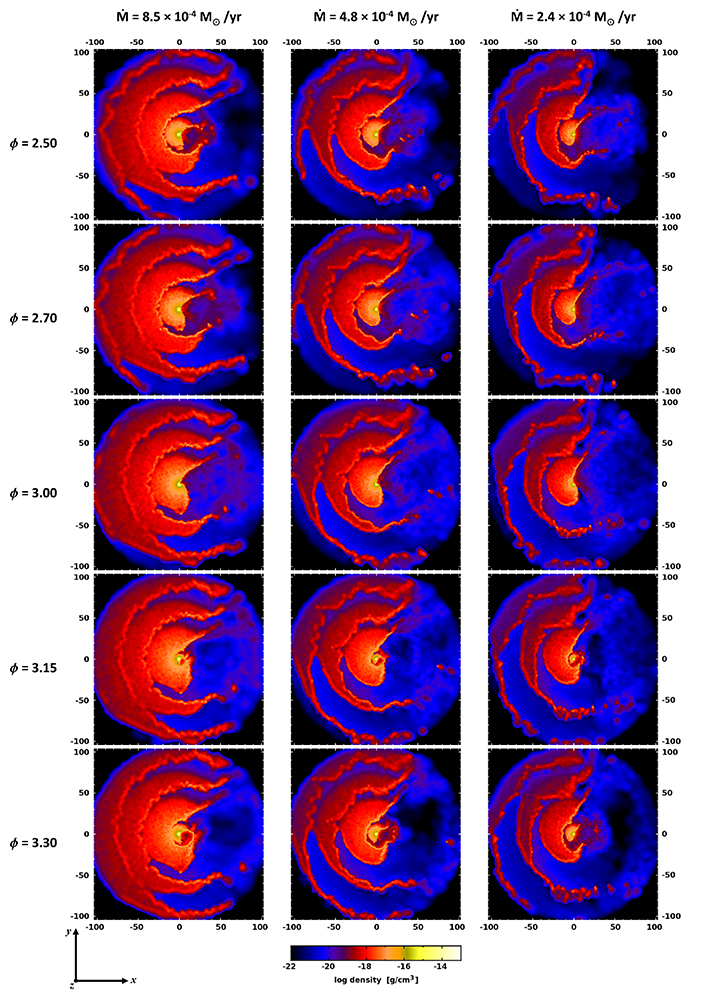
This work would not be possible without NASA high-end computing time. Our SPH simulations, with about 1 million particles, have large shared-memory requirements. Between May 2009 and November 2013, we used 2.2 million processor-hours on the Pleiades supercomputer at the NASA Advanced Supercomputing (NAS) facility. We have ongoing NAS computer time awards totaling 1.6 million processor-hours on Pleiades to continue our work on Eta Car and extend our models to other massive colliding wind binaries. Future simulations will be used to model observations from successfully funded Hubble, Chandra, Swift, and NuSTAR proposals targeting the systems Eta Car, Delta Ori, and HD150136.
Thomas Madura, NASA Goddard Space Flight Centerthomas.i.madura@nasa.gov Theodore Gull, NASA Goddard Space Flight Center
theodore.r.gull@nasa.gov
More Media
See additional videos related to this demo in our media gallery.