
Tracing Ultra-High-Energy Cosmic Rays Through the Galactic Magnetic Field
Overview
Improving our understanding of the Milky Way’s galactic magnetic field (GMF) is crucial for interpreting diverse astrophysical phenomena, from potential signatures of dark matter to observations of ultra-high-energy cosmic rays (UHECRs), the most energetic particles in the universe. The extragalactic origins of UHECRs have so far eluded identification because, in spite of their enormous energy, UHECRs are deflected within the GMF, obscuring their sources.
In this project, we calculated UHECR deflections in the most sophisticated GMF model to date—the Jansson-Farrar 2012 (JF12) model. These computations help reveal their origin and composition, while simultaneously improving our understanding of the GMF itself. The JF12 model, which matches astronomical radio and microwave observations much more closely than earlier models, maps the coherent magnetic fields in the galaxy’s halo and spiral arms, and includes parameters for magnetic turbulence, which varies throughout the Milky Way.
Project Details

Using the publicly available propagation code CRT on NASA’s Pleiades supercomputer, we ran the first high-resolution simulations ever conducted of UHECR trajectories through the Milky Way. Our simulations included both coherent and turbulent components and covered a complete range of relevant energy (E) and electric charge (Z) values, as deflections depend on the ratio of E/Z, known as "rigidity." We simulated more than 109 particles in steps of rigidities, backtracking their trajectories from Earth through the JF12 galactic model, using a realistic turbulent realization method. This work enabled us to construct very high-resolution skymaps of UHECR trajectories, associated with different extragalactic source positions, to help us better understand the deflection properties of the GMF. We compared arrival distributions with and without magnetic turbulence in order to determine its relative effect and importance. The impact of the turbulence coherence length was also explored via multiple realizations of the random field with different maximum coherence lengths.
Results and Impact
Our simulations show that the impact of the GMF on the particle trajectories is much more profound than previously understood. The JF12 model shows spectacular magnification effects that vary across the sky and depend on the rigidity of the particle. Galactic magnetic turbulence is found to have a strong effect on arrival distributions. Below a rigidity of 10 EeV (exa-electronvolt; 1 EeV = 1018 eV) deflections are typically tens of degrees, with arrival distributions from an individual source covering a large fraction of the sky. The turbulent component of the GMF imprints fine structure on these distributions; such structure is independent of turbulent realization and is not reproducible with simple Gaussian smearing. In addition, turbulence coherence length has a strong effect on the arrival distributions.
Why HPC Matters
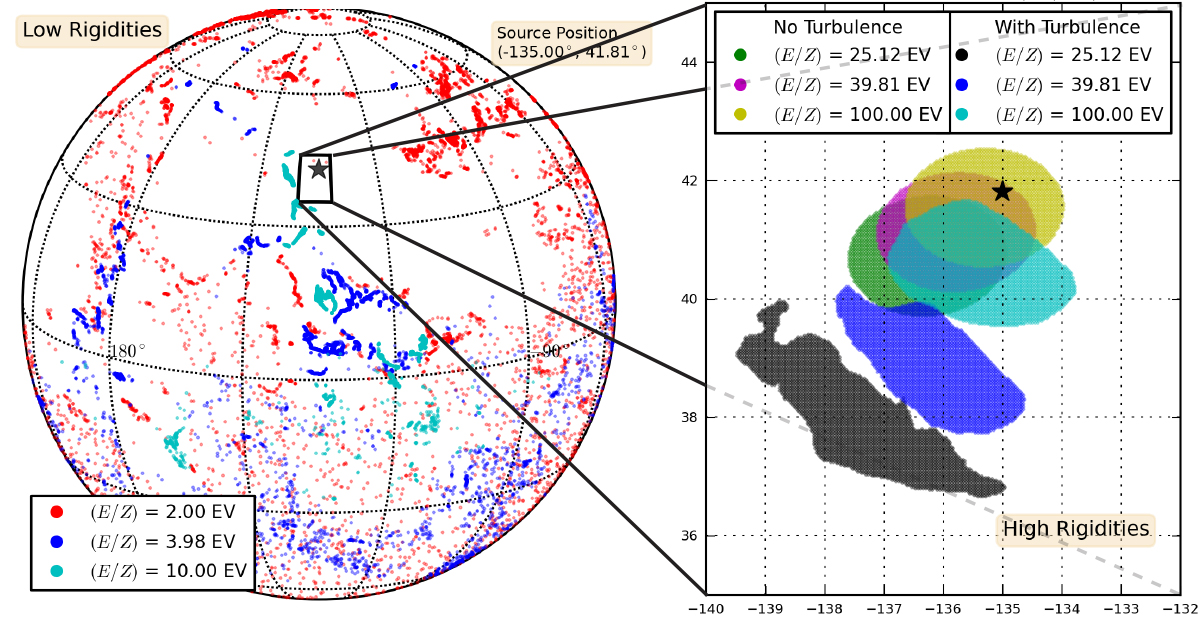
Numerical integration of the particle trajectories requires accurate modeling of the turbulent field below the Larmor radius of each particle, corresponding to tens of parsecs at the lowest simulated rigidities. To accomplish this, we used the Ivy Bridge processors on the Pleiades supercomputer at NASA Ames Research Center to run thousands of individual particle trajectories simultaneously and to efficiently store the full turbulent realizations. Each rigidity simulation was comprised of over 51 million events and required on average 250,000 processor-hours to complete. The NASA Advanced Supercomputing facility’s fast network and efficient transfer tools made it possible to quickly move data from Pleiades to researchers across the country.
What's Next
After simulating more turbulent field realizations, we will produce probability distributions for UHECR arrival directions and use observations of UHECRs to constrain their sources and their nuclear charge (Z). Such constraints could be combined with astronomical observations to further refine the model and better understand the GMF, its origins, and its role in the history of the Milky Way.
Michael Sutherland, Ohio State Universitysutherland.54@osu.edu Glennys Farrar, New York University
gf25@nyu.edu