
Realistic Simulations of the Solar Radiation Spectrum
Overview
The Helioseismic and Magnetic Imager (HMI) instrument aboard NASA's Solar Dynamics Observatory (SDO) provides a unique opportunity to decipher the physics of the Sun's magnetic dynamo by observing the changing solar surface over many spatial and temporal scales. HMI is enabling researchers to study various activities in quiet and active regions on the Sun. Through the use of filters, the HMI instrument continuously acquires near-real-time images of the full solar disk. The filters are tuned to the spectral line of the light emitted by the trace iron (Fe I, 6173Å) in the solar gas. We use the light emitted by iron, produced by realistic solar simulations, to investigate, interpret, calibrate, and explain various effects observed by the SDO HMI.
Project Details
Interpreting and calibrating the signal from an instrument such as HMI requires knowledge about both the physics of observed processes and how the instrument measures them. Therefore, we use realistic 3D simulations of the HMI's optical path to reproduce how the instrument "sees" the data. This strategy produces so-called "synthetic data" that enables us to interpret and calibrate the observations from the HMI instrument, validate new methods of data analysis, determine observational uncertainties, and take into account instrumental artifacts.
Results and Impact
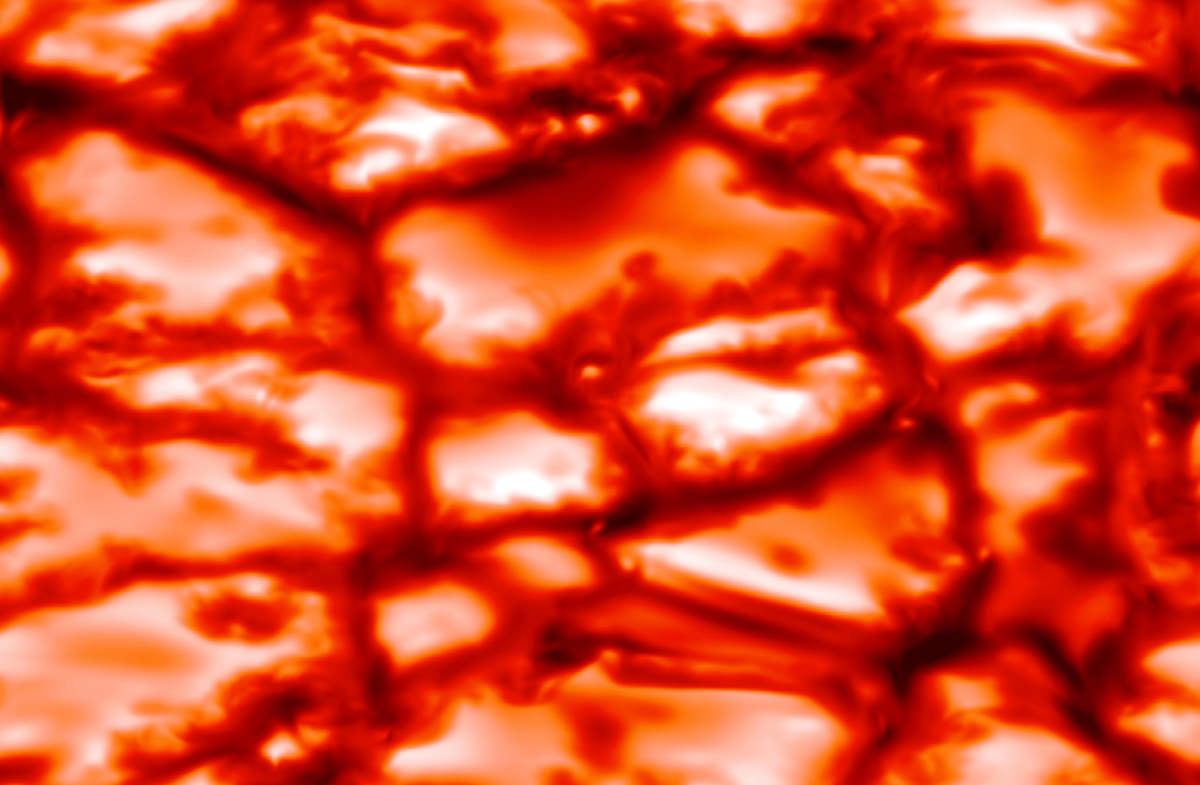
Realistic, 3D, radiative simulations allow us to investigate important solar observation phenomena, such as the formation of the Sun's magnetic structures, eruptions, and subsurface dynamics by taking into account the conditions that the emitted light encounters on the way to the detectors on HMI. These simulated observations also enable us to evaluate the instrument's spatial and spectral resolutions.
Our synthetic observations reproduce the "concave Sun" mystery—an effect observed when the signal from the near-limb regions arrives before the signal from the solar disk center. These results confirm our understanding of this effect, and provide quantitative data for instrument calibration. Comparison of the mean Doppler shift for the iron spectral line at different distances from the disk center reveals a mean blue shift of about 50 – 100 meters per second (m/s) at the disk center, and a 100 – 210 m/s redshift at a 60-degree distance from the center.
We also found a dependence between the height at which the iron spectral line is emitted and the distance from the center of the disk (center-to-limb location). Our analysis shows that the line is formed at a height of about 75 kilometers (km) above the solar surface at the disk center, whereas the formation height increases to about 200 km at 60 degrees from the center. When we account for the particular resolution of the instrument, we find smaller variations of the height: they change from 255 km at the disk center to 275 km at 60 degrees.
These estimations help to improve the accuracy of helioseismology measurements of subsurface flows on global scales.
Why HPC Matters
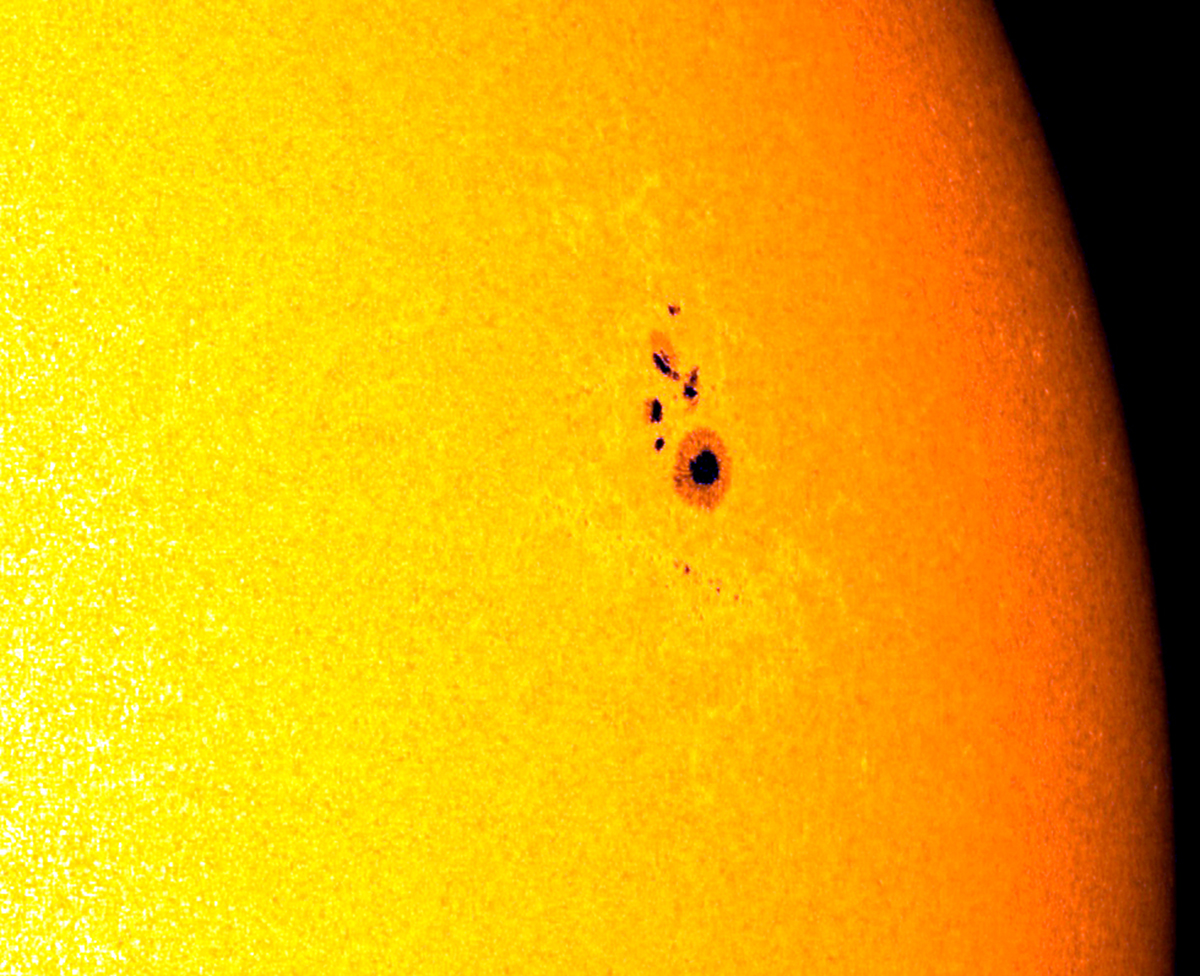
Realistic simulations of the turbulent convection of the Sun are not possible without substantial computational and data storage resources. The advanced computational capabilities of NASA's Pleiades supercomputer enable us to generate massive amounts of data to create a facsimile of the Sun, and to analyze it as the HMI instrument on the SDO satellite observes it. For this project, we used up to 8,000 processors on Pleiades, and more than 200 terabytes of storage.
Irina Kitiashvili, NASA Ames Research Centeririna.n.kitiashvili@nasa.gov Nagi Mansour, NASA Ames Research Center
nagi.n.mansour@nasa.gov