
Space Weather Simulation: Preparing for Solar Storms
Overview
A stream of energetic particles called the solar wind blows continuously from the outer atmosphere of the Sun at speeds as high as 900 kilometers per second and at a temperature of 1 million degrees Celsius. Earth's dipole magnetic field creates a protective shield, called the magnetosphere, that insulates us from most of the Sun's effects—including its frequent storms. Without this dipole field, life on Earth would not be possible. However, the shielding is not perfect and the solar wind is able to penetrate the Earth's magnetosphere.
During solar storms, the intensity of energetic particles in the solar wind can increase dramatically, wreaking havoc on Earth's technological systems. This so-called space weather has caused over $4 billion in satellite losses alone. On March 13, 1989, a solar superstorm known as the Carrington Event caused a catastrophic collapse of the entire power grid in Quebec. According to data from NASA's Solar Terrestrial Relations Observatory (STEREO) spacecraft, Earth narrowly escaped a geomagnetic storm as large as the Carrington Event—by a margin of 7 days—on July 23, 2012. In the next 10 years, there is a 12% chance that a similar solar storm will hit Earth again, causing over $2 trillion in damage, and affecting over 130 million people.
Project Details
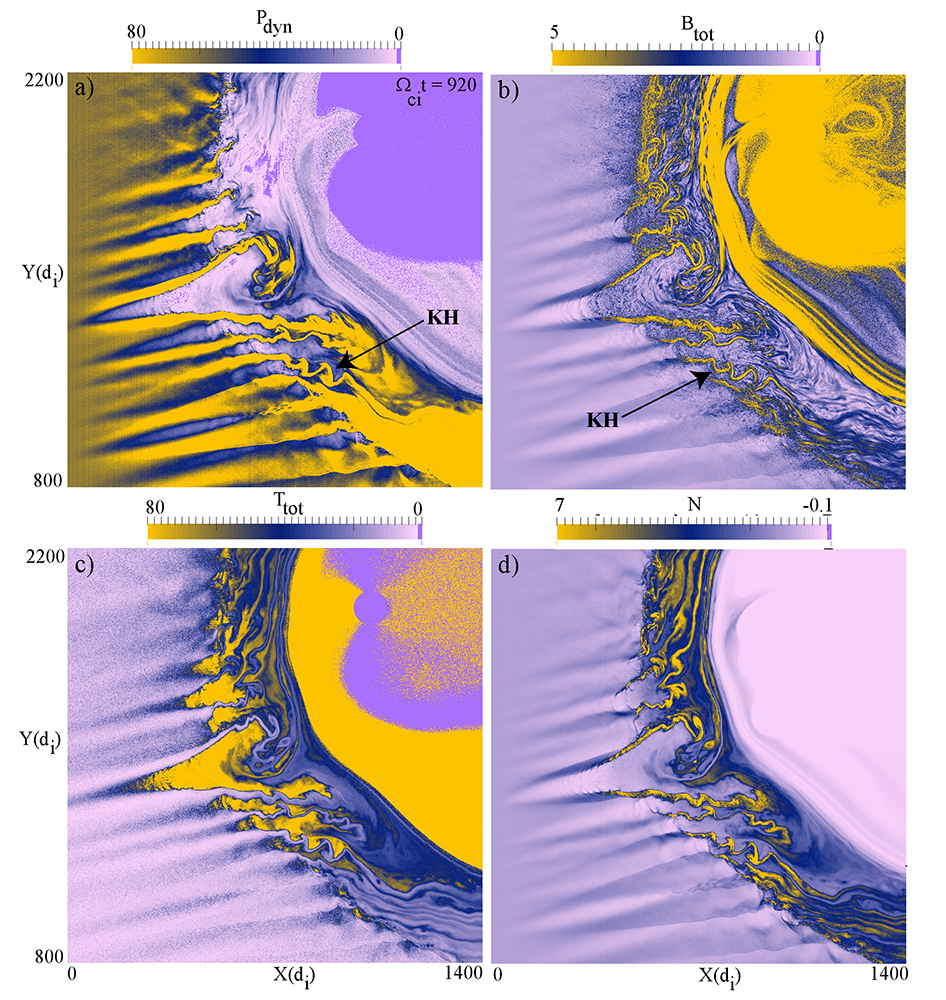
Current space weather forecasting is inaccurate and does not sufficiently help us prepare for solar storms. To increase our understanding of these phenomena, with the ultimate goal of helping advance space weather prediction, we have performed the most detailed magnetosphere-solar wind interaction simulations ever run.
Our goal is to use these high-fidelity global kinetic simulations to develop more accurate modeling of the solar wind's interaction with the Earth's magnetosphere, which is key to the development of accurate space weather forecasts.
Traditional global modeling of the magnetosphere is based on magnetohydrodynamic models in which plasma is treated as a fluid. However, because the magnetosphere is dominated by ion kinetic effects, much more realistic modeling can be accomplished by using code that treats the ions as particles. We ran our simulations on NASA's Pleiades supercomputer using a parallelized hybrid code that treats the electrons in the solar wind as a fluid and the ions as particles. Results of these realistic simulations can be directly compared with spacecraft observations.
Results and Impact
In our work, we have solved several longstanding mysteries related to kinetic processes operating in the magnetosphere, such as the origin of jets of charged particles in the magnetosheath region. We found that under certain conditions, parcels of solar wind plasma are able to reach deep inside the Earth's magnetosphere. These jets exaggerate space weather effects due to their high dynamic pressure, and can even generate large-scale vortices inside the magnetosphere. In recent comparisons, data captured in our simulations matched well with observations from the European Space Agency's (ESA) Cluster spacecraft. Researchers are continuing to compare our predictions with observations from both NASA and ESA spacecraft.
Why HPC Matters

NASA's high-performance computing resources have enabled us to exceed previous state-of-the-art magnetospheric models. In this project, a typical simulation ran for over 400 hours across more than 4,000 cores on the Pleiades supercomputer.
Mahidhar Tatineni, San Diego Supercomputer Centermahidhar@sdsc.edu Homa Karimabadi, University of California, San Diego/SciberQuest, Inc.
homakar@gmail.com
More Media
See additional videos related to this demo in our media gallery.