
Designing Liquid Rocket Engine Injectors for Performance, Stability, and Cost
Overview
NASA is developing the Space Launch System (SLS) for crewed exploration missions beyond low Earth orbit. NASA Marshall Space Flight Center (MSFC) is designing rocket engines for the SLS Advanced Booster (AB) concepts being developed to replace the Shuttle-derived solid rocket boosters. One AB concept uses large, Rocket-Propellant (RP)-fueled engines that pose significant design challenges. The injectors for these engines require high performance and stable operation while still meeting aggressive cost reduction goals for access to space. Historically, combustion stability problems have been a critical issue for such injector designs. Traditional, empirical injector design tools and methodologies, however, lack the ability to reliably predict complex injector dynamics that often impact combustion stability. Reliance on these tools alone would likely result in an unaffordable test-fail-fix cycle for injector development.
Recently at MSFC, a massively parallel computational fluid dynamics (CFD) program was successfully applied in the SLS AB injector design process. High-fidelity reacting flow simulations were conducted for both single-element and seven-element representations of the full-scale injector. Data from the CFD simulations were then used to significantly augment and improve the empirical design tools, resulting in a high-performance, stable injector design.
Project Details

We used the Loci-STREAM CFD code to simulate a multiple-element injector designed to enable robust propellant mixing and combustion in the O2/RP-fueled liquid rocket engine of one SLS AB concept. This code features an extremely efficient parameterization of the hundreds of reactions that occur during the O2/RP combustion. Multiple large, 3D, time-varying simulations of a single-element injector configuration were run to iteratively fine-tune the performance of the initial design. Then, a seven-element configuration was simulated to quantify the effects of enhanced intra-element mixing. Time-averaged data for heat release, pressure drops, and fluid properties were extracted from the CFD simulations and were provided as enhanced inputs for the empirical tools used to assess combustion stability.
Results and Impact
The primary result of this effort is an injector design that meets packaging requirements, pressure budgets, and performance requirements. The design, as modeled, also performs in a stable manner. The CFD simulations supplied critical data to the design and stability assessment process. Moreover, the CFD simulations provided greater amounts of higher-fidelity data than would have been possible using traditional sub-scale hot fire testing. These types of detailed CFD simulations have the potential to help NASA lower the cost of access to space by reducing reliance on costly full-scale hot fire testing. This effort represents MSFC's most extensive use to-date of high-fidelity CFD simulations to augment and improve the injector design process.
Why HPC Matters
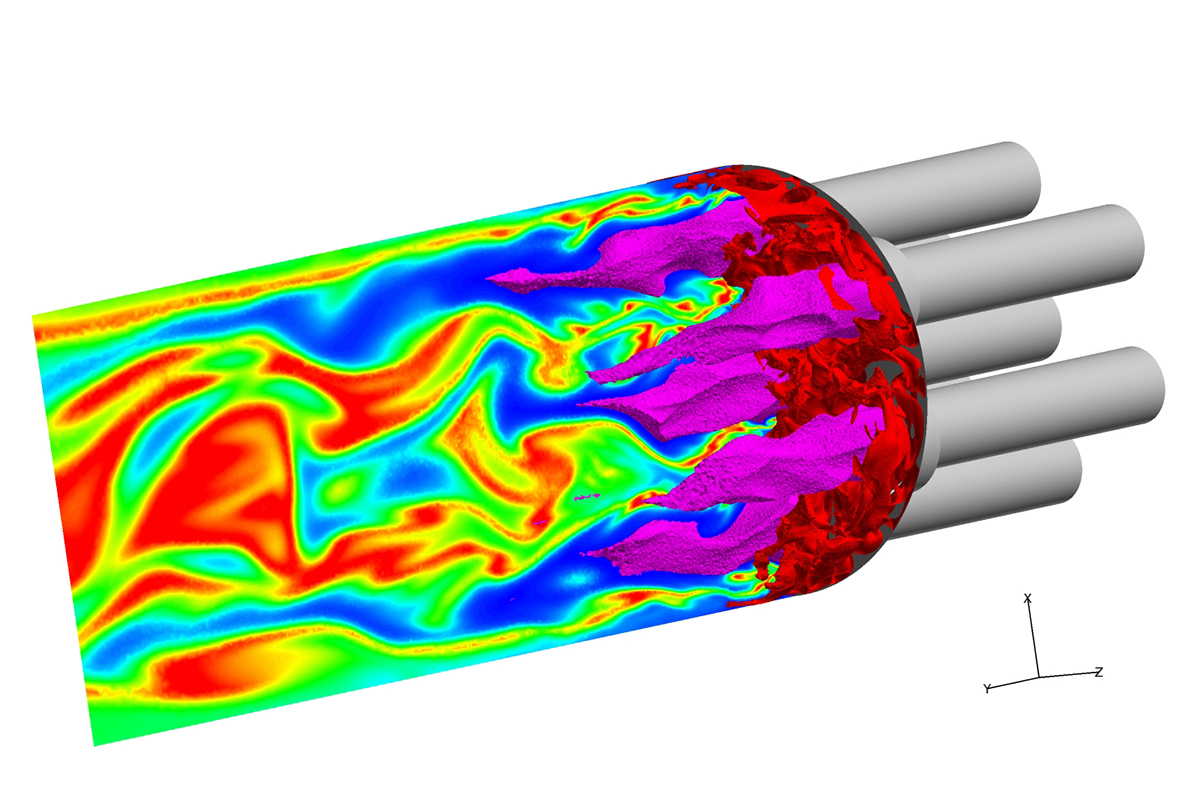
Access to thousands of processors on NASA's Pleiades supercomputer was a game-changer for this project. These CFD simulations required large computational meshes on the order of 100–350 million cells, and long run times at time-steps of one microsecond or less. Despite their large size, these runs were routinely executed in less than two weeks on Pleiades, using 2,000–4,000 processors. This remarkably quick turnaround time enabled the results to be used in a design cycle where multiple iterations needed to be completed quickly.
What's Next
The CFD simulation capability used for this project is relatively new and requires further validation. That validation data is currently being generated at the Air Force Research Laboratory and Purdue University. All of the validation simulations will be run on Pleiades to facilitate timely turnaround. These data and CFD simulations will also be used to develop a process for quantitatively evaluating the CFD-generated improvements in the current design tools. This will shed light on the next steps to continue to improve the injector design process for NASA's launch vehicle propulsion systems.
Douglas G. Westra, NASA Marshall Space Flight Centerdouglas.g.westra@nasa.gov Jeffrey S. West, NASA Marshall Space Flight Center
jeffrey.s.west@nasa.gov