
Simulations of Telescope Cavity Acoustics for the SOFIA Aircraft
Overview
The Stratospheric Observatory for Infrared Astronomy (SOFIA) is the world's largest airborne astronomical observatory, featuring a 2.5-meter infrared telescope mounted in an open cavity in the aft fuselage of a Boeing 747SP. The aircraft typically flies high in the atmosphere, between 12 and 14 kilometers (39,000 – 45,000 feet), reducing atmospheric distortion and enabling high-quality images. However, airflow within and around the open cavity can generate acoustics that affect the telescope’s operation during flight. We perform one-of-a-kind computational fluid dynamics (CFD) simulations to investigate how the flow physics and noise within the cavity can interfere with the optical path and mounting of the telescope. In order to efficiently model the complex, multi-scale geometry and unsteady flows involved in this challenging problem, we developed parallel CFD approaches that enable the simulations to run on up to 32,000 cores.
Project Details

We used a parallel message passing interface (MPI) approach to perform large-scale CFD simulations for SOFIA. NASA's Launch Ascent and Vehicle Aerodynamics (LAVA) CFD flow solver was used to conduct higher-order-accurate implicit large eddy simulations (ILES). Direct numerical simulations and large eddy simulations are essential tools to understand the complex flow physics of unsteady flow fields at realistic Reynolds numbers. These simulations become very computationally expensive because they must accurately capture a wide range of relevant physical and temporal scales. Numerical methods with high spectral resolution are required to efficiently simulate these types of problems. Our simulations used a temporally fourth-order-accurate Runge-Kutta scheme and spatially fifth-order WENO-5Z scheme. The computation of transonic flows is further complicated by the occurrence of shock waves, which generate discontinuities in the flow field. In order to handle these discontinuities, we apply state-of-the-art, higher-order shock capturing schemes. Additionally, LAVA's ghost-cell-based immersed boundary method was used to circumvent the very time-consuming process of manually generating the volume meshes for the SOFIA geometry. This method provides automated gridding for complex geometries and couples naturally with a block-structured Cartesian adaptive mesh refinement (AMR) framework.
We also performed strong scaling studies, which vary the number of processors used for a fixed problem size, to investigate the ability of the simulation approach to run efficiently and accurately on large numbers of parallel processors. The studies showed that simulations with 4-billion-cell computational meshes scale excellently using up to 32,000 cores on NASA's Pleiades supercomputer. Dynamic load balancing techniques based on execution times on individual AMR blocks were shown to address irregularities caused by the highly complex geometry. Limits to scaling beyond 32,000 cores were identified and were used to target code optimizations.
Results and Impact
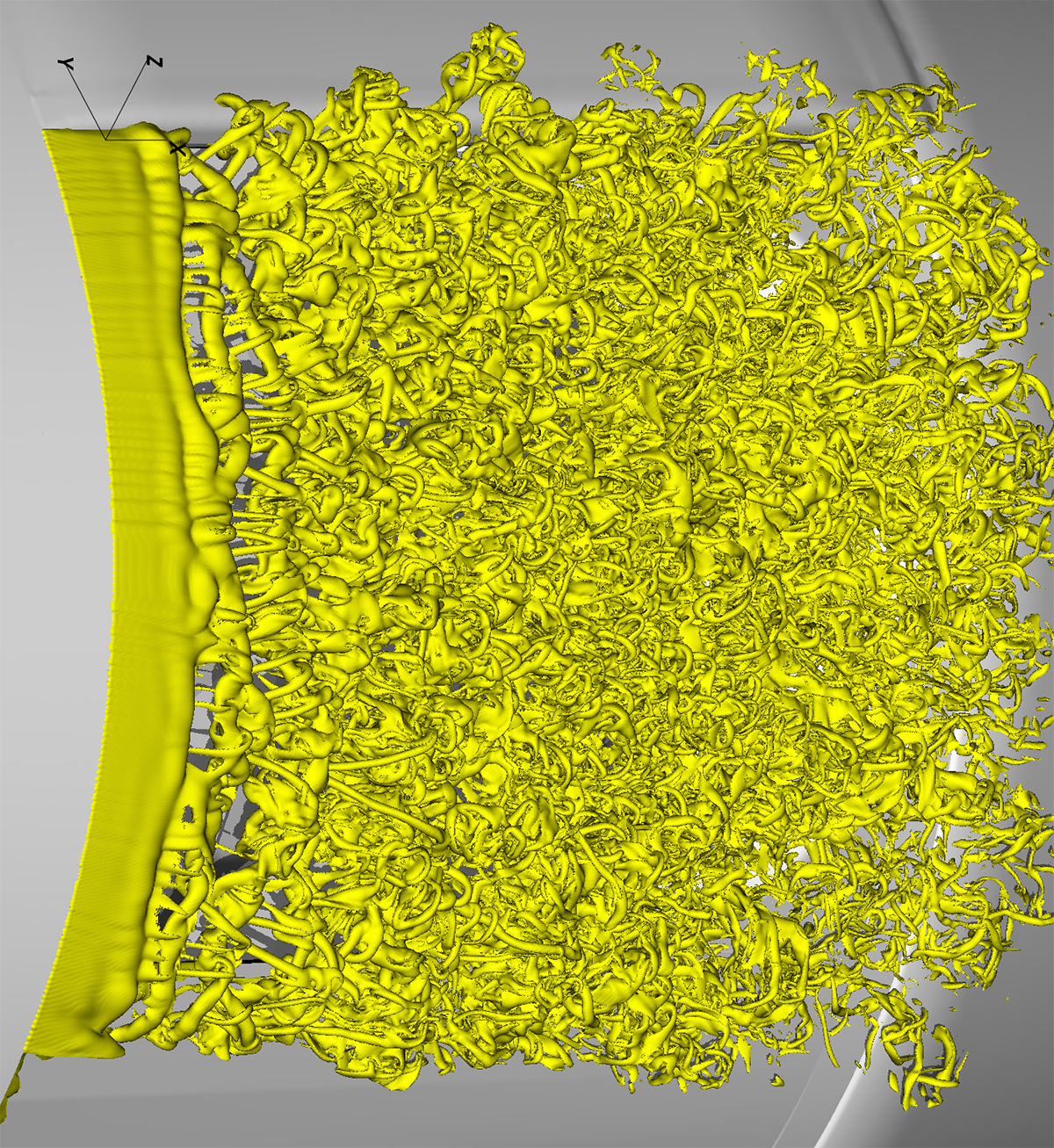
The current simulations for this project focused on how the unsteady flow field inside and over the open cavity interferes with the optical path and mounting of the telescope. Results identified two important mechanisms that could potentially affect image clarity: density variations in the shear layer leading to image distortion, and vibrations of the telescope structure that reduce image quality by perturbing the optical path. A “secondary” breakdown process of the shear layer involves the generation and interaction of vortical flow structures with significant density fluctuations disturbing the optical path. Two different sources of pressure fluctuations were observed: high-frequency acoustics noise generated by unsteady flow structures inside the shear layer, and an acoustic noise source that appears to be located where the unsteady shear layer impinges on the aperture ramp. In addition to these classical, acoustic wave-like solutions, two dominant pressure modes were identified by employing proper orthogonal decomposition (POD) methods. One of these modes extends over the entire cavity, and the other displays raised amplitudes within the observational Nasmyth tube that connects the telescope and the science instrumentation in the cabin. These pressure POD modes may contribute to structural vibrations of the telescope.
Why HPC Matters
Simulating the entire flight-scale aircraft with geometric complexities and unsteady, nonlinear flow physics is a highly challenging, multi-scale mathematical, physical, and computer science problem. These demanding CFD simulations require thousands of cores on a massively parallel cluster such as the Pleiades supercomputer. Without these supercomputing resources, analyses could not be performed at the fidelity level needed to capture the complex flow physics affecting the SOFIA telescope.
Michael Barad, NASA Ames Research Centermichael.f.barad@nasa.gov Cetin Kiris, NASA Ames Research Center
cetin.c.kiris@nasa.gov