
ODISEES: Ontology-Driven Interactive Search Environment for Earth Science
Overview
ODISEES is a tool developed in cooperation with NASA's Langley Research Center and provided by NASA's Climate Model Data Services (CDS) at Goddard Space Flight Center for identifying and downloading climate model data, specifically data produced at or published by the NASA Center for Climate Simulation (NCCS). Users can search the collections based on the meaning of the data (i.e., semantic content and relationships). This capability allows the discovery of datasets with equivalent semantic content to be used for comparison and analysis.
Project Details

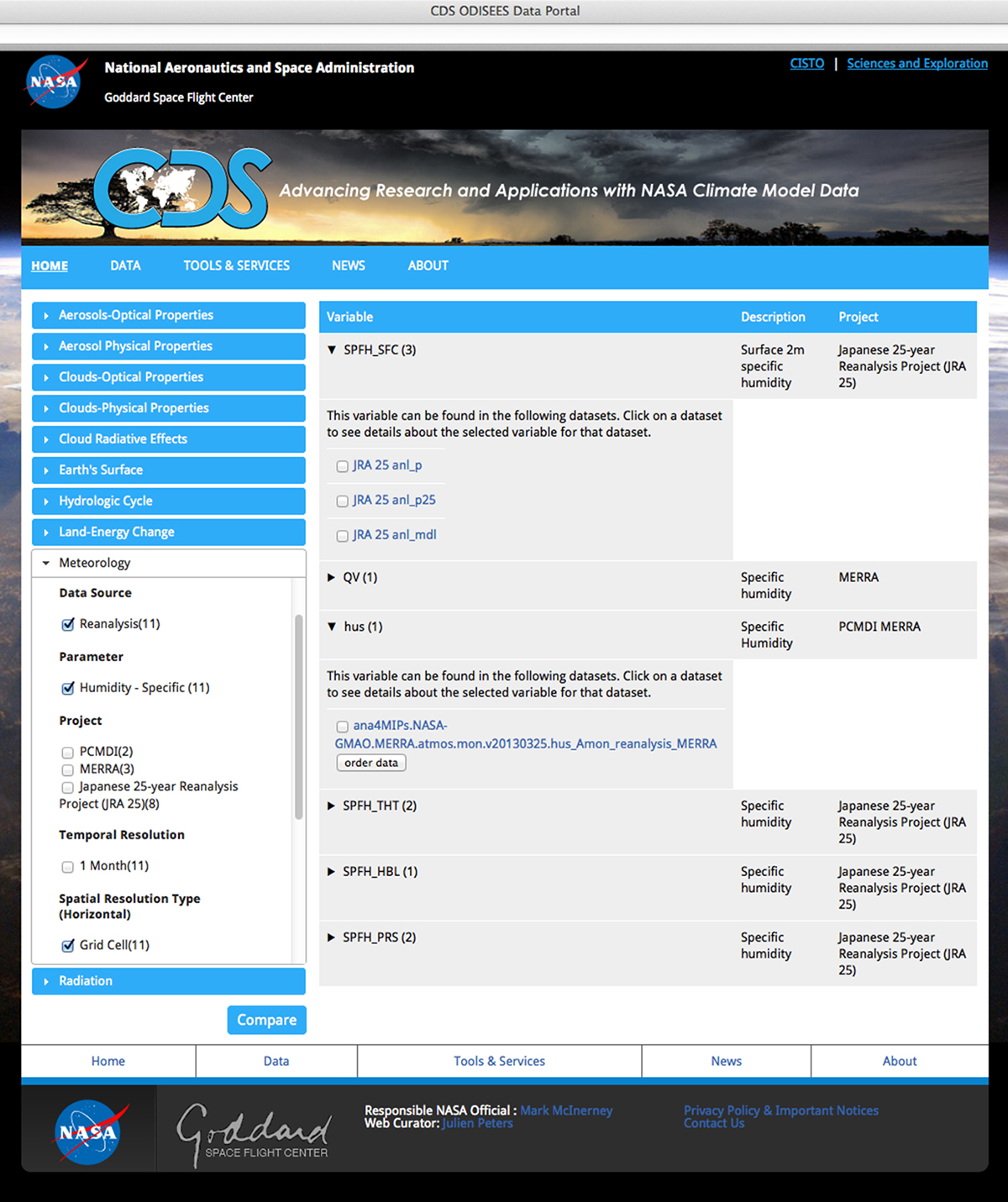
The ODISEES system is a web interface to a database of semantic content and relationships accessed through a SPARQL Endpoint. Browsing the collections based on meaning shows how attributes are shared among comparable datasets. As the user makes selections, ODISEES displays the datasets meeting the selected set of criteria, as well as the remaining available attributes that can be used to further refine the selection.
Results and Impact
ODISEES allows a user with little experience with specific data collections to initiate a query at a high level and refine the search criteria based on the results of the current search criteria. High-level groupings used to classify data include: aerosols, clouds, hydrology, meteorology, and radiation.
Once a user has identified one or more datasets of interest, ODISEES enables comparing the details of the datasets at a high level, to ensure that the semantic content of the data addresses the problem at hand and that the details of the actual data are compatible with the science objectives. For example, the user can compare multiple datasets to see details of temporal resolution, vertical location, and data units.
Why HPC Matters
The sheer volume of datasets produced by modern climate models makes it infeasible for a user to browse through individual file collections to find data of interest. Comparing results from different models is critical in efforts to validate those results, especially as models evolve with new algorithms and new computational facilities. Execution of climate models consumes a significant fraction of NASA's high-end computing resources, and efficient use of those resources necessitates the capability to easily compare results and identify potential anomalies. The ODISEES system ensures that these comparisons can be done quickly, so that computing resources can be focused on the most scientifically appropriate models and scenarios.
Eric Winter, NASA Goddard Space Flight Centereric.winter@nasa.gov Beth Huffer, NASA Goddard Space Flight Center
beth@lingualogica.net