
Understanding the Sun's Weather
Overview

Magnetic fields emerging through the solar surface control the Sun’s weather, including the dynamics and energetics of its atmosphere and the ejection of high-energy protons and electrons into the solar wind. These solar conditions, in turn, impact Earth’s space weather environment and magnetosphere.
Researchers in the Physics and Astronomy Department at Michigan State University are modeling solar magneto-convection in order to understand how magnetic fields emerge through the Sun’s surface, heat the Sun’s outer atmosphere, and produce sunspots, spicules, and flares. This research furthers NASA’s scientific goals to understand the Sun, its variations, and its interactions with Earth and the solar system.
Project Details
We use the Pleiades high-performance computer at the NASA Advanced Supercomputing (NAS) facility to perform magnetohydrodynamic simulations of the Sun. These simulations solve the equations of mass, momentum, and energy conservation, along with the induction equation, using 6th-order spatial finite differencing and a 3rd-order time advance scheme. In addition, we use a tabular equation of state that assumes local thermodynamic equilibrium, and calculate the radiative heating and cooling by using a multi-group method to solve the 3D radiation transfer equation.
Results and Impact
Our simulations of solar-magneto convection reveal that, as the magnetic field approaches the solar surface, violent convective motions keep the large-scale, dynamo-produced structures intact while simultaneously shredding the field into thin filaments. As a result, active-region magnetic fields emerge with mixed polarities (up and down direction), which then counterstream to collect into opposite polarity pores and sunspot pairs.
These models will increase our understanding of the Sun’s dynamics and energetics and provide test data to improve diagnostics. This will help achieve NASA’s goal of predicting the emergence of magnetic fields before they become visible at the solar surface.
Why HPC Matters
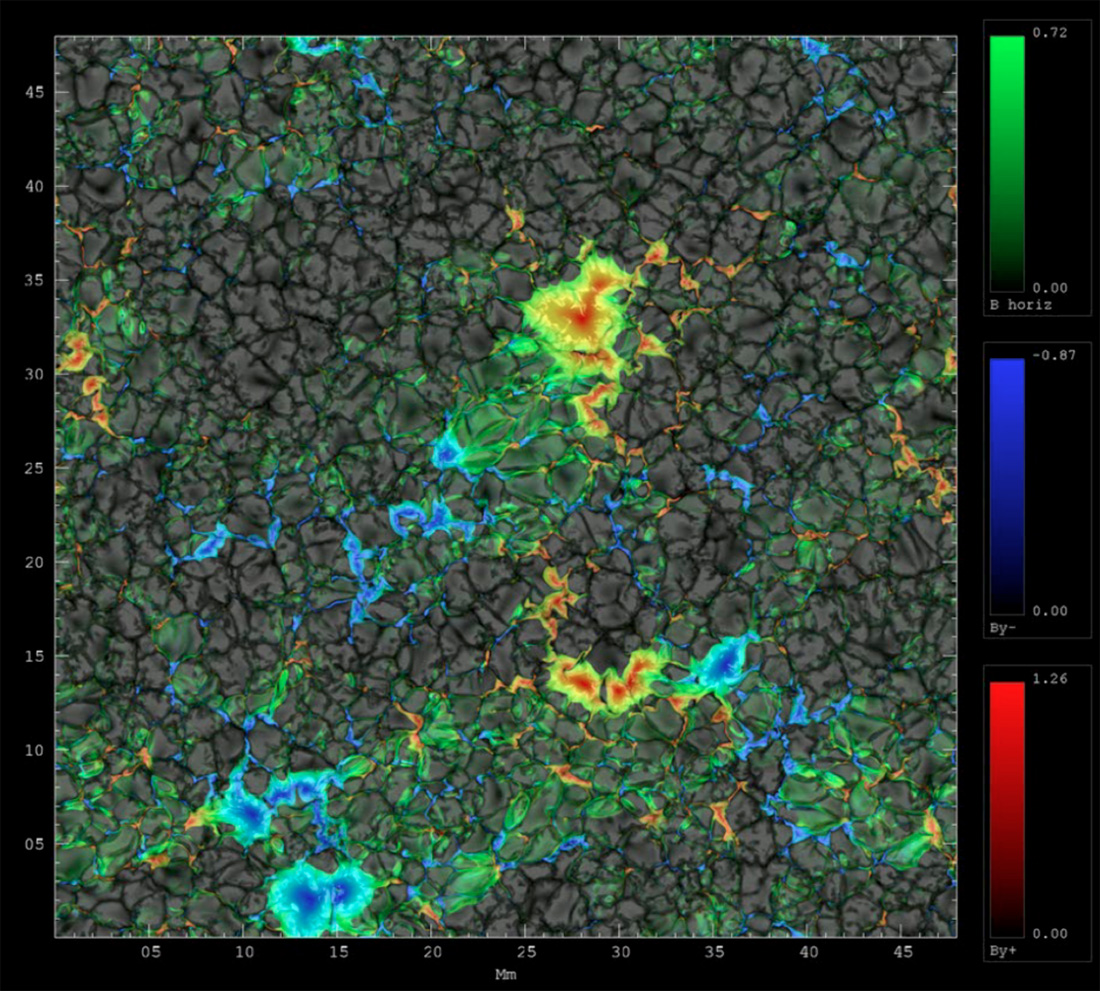
Supercomputers such as Pleiades are necessary to perform calculations with large enough dimensions to include the interactions of very disparate spatial and temporal scales of motion. In this case, we include spatial scales ranging from solar supergranules (48,000 km) to sub-granules (24 km). Visualizations of the simulation results, provided by experts at the NASA Advanced Supercomputing (NAS) facility at NASA’s Ames Research Center, are also necessary to assess and understand the complex phenomena that they represent.
Robert Stein, Michigan State Universitysteinr@msu.edu
More Media
See additional images related to this demo in our media gallery.