
Cooling the Future of High-End Computing
Overview
NASA is investigating innovative ways of improving the energy efficiency of its high-end computing (HEC) systems by reducing energy requirements and the physical footprints of HEC resources. A leading candidate for helping the agency achieve substantial energy savings is direct, warm water cooling (DWC) technology. DWC offers dramatic reductions in the energy needs of the dense, high-production HEC systems used by NASA scientists to help solve today's most pressing problems and gain insight into questions about the Earth, the Sun, exoplanets, and stars. Recent experiments with a DWC prototype show that HEC scalable systems can be migrated to this technology to obtain large energy savings in existing computer rooms, forestalling the need to expand floor space and chilled water requirements while continuing to provide the growth in HEC capacity needed to meet the agency’s demands.
Project Details

NASA partnered with IBM to test and ascertain the performance of a prototype DWC server rack. Establishing the characteristics of such a highly energy efficient server in an operational facility is necessary to determine how the technology might be integrated into an existing NASA heterogeneous, hybrid-cooled HEC facility and how the technology could be profitably deployed in a containerized (modular data center) environment.
We used a standard, 26-kilowatt computer rack that is fully populated with liquid-cooled servers and accommodates liquid coolant up to 45 degrees Celsius. The prototype was deployed in an existing computer room at the NASA Center for Climate Simulation (NCCS) facility at NASA's Goddard Space Flight Center (GSFC), and data was collected to document the system's thermal performance and energy usage in that environment. The anticipated benefits of such energy-efficient configurations include a potential savings of 11% of the data center's operating costs. If the technology is used for all current HEC resources at GSFC, the savings could reach 1.3 million kilowatt-hours of electricity and $360,000 annually.
Results and Impact
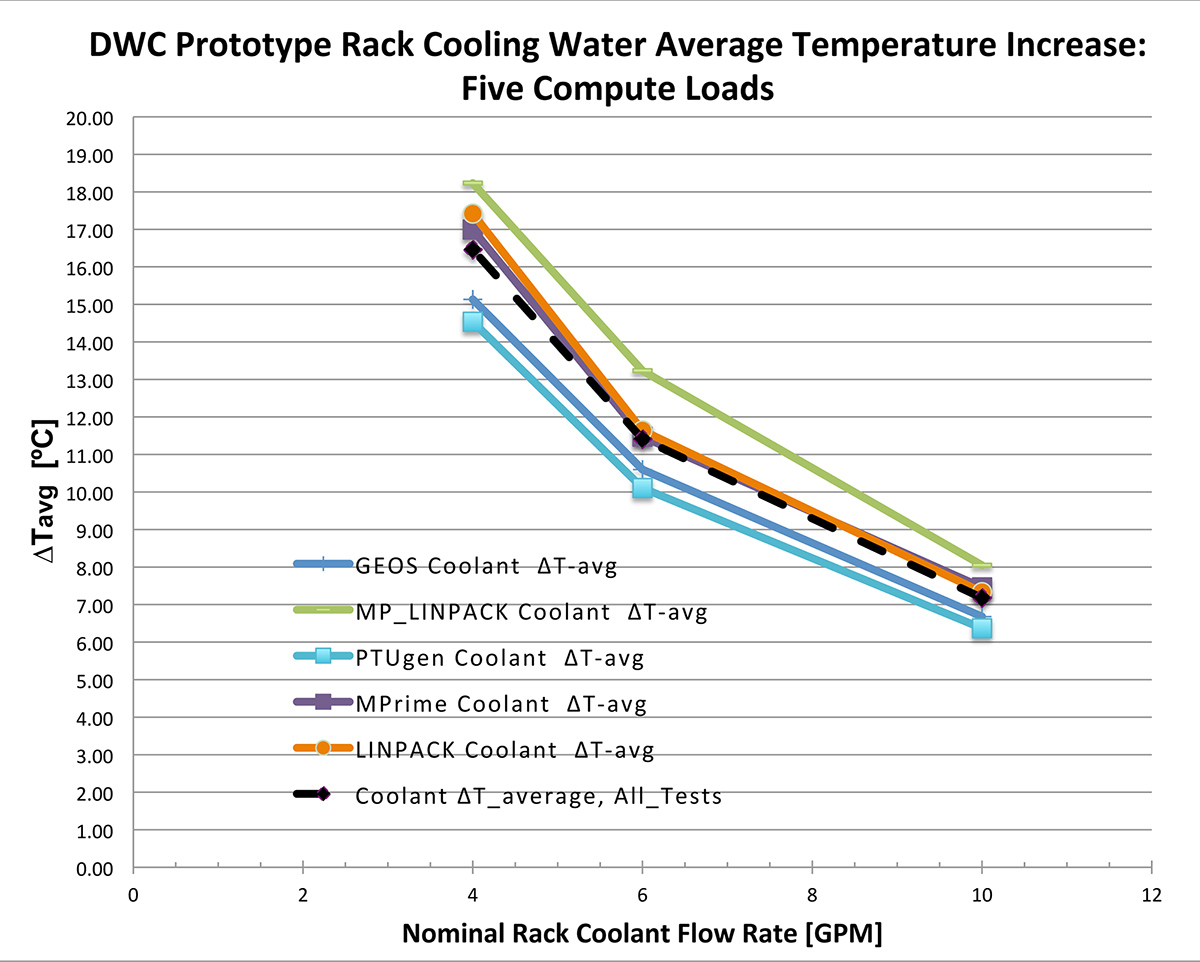
Results confirm that valuable operating efficiencies are available with DWC technology. Direct water cooling of processors and memory removes 78% to 85% of the rack heat generated during operation, depending on the flow rate of the cooling water. The same amount of heat removal can also be achieved through a combination of air cooling and rear door heat exchangers (RDHx). However, the advantage of the DWC approach is the ability to expand the number of servers in existing computer rooms beyond the current cooling constraints of air cooled racks and RDHx—a substantial reduction of capital expenditures needed to meet NASA's HEC demands.
Although the existing building and facility design at GSFC does not offer the opportunity to reuse waste heat from HEC operations, deployment of containerized servers using DWC would permit NASA to realize the benefits of the sizeable efficiencies available from this energy-efficient technology. Even with the up-front capital investment required for such a deployment, the added efficiency of heat reuse and subsequent operational savings obtained by DWC technology would allow the HEC center to realize an overall savings well within the usual server refresh cycle.
Why HPC Matters
NASA science missions require HEC resources to aid in the efforts to increase understanding of Earth's climate system, natural and human influences on climate, and consequences for life on Earth; and to advance space science and scientific exploration beyond Earth. NASA acquires, operates, and maintains HEC and data storage resources, simulation tools, and analytics specifically designed to enable scientists and engineers to carry out critical missions and to make new scientific discoveries.
Lynn Parnell, NASA Goddard Space Flight Centerlynn.parnell@nasa.gov