
Curiosity's Two Years of Discovery on Mars
Overview
The journey of NASA's Curiosity rover across the Martian landscape began more than two years ago on August 5, 2012, when the world watched its spectacular landing on the Red Planet. Before the end of its first year on Mars, Curiosity had successfully completed its primary science objective—discovering whether conditions on Mars had ever been suitable for life. Since then, the rover has driven many miles and experienced many different types of Martian terrain.
Project Details

Curiosity's mission began as a two-year project to determine whether Mars could have ever supported life. Now beginning its third year, the mission has been extended until October 2016. Today, the rover is accompanied by a fleet of Mars orbiters—all working together to help answer scientists’ next questions about the planet's history.
Curiosity's payload of scientific instruments—ten times more massive than any previous Mars mission—enables it to collect and test rock samples, take high-resolution images, and blast rocks with a laser to analyze their chemical spectra. Researchers are continuing to use these capabilities to design experiments and procedures that were previously seen as impossible, but are leading to amazing discoveries.
Results and Impact
The science enabled by Curiosity has dramatically changed our understanding of Mars. Most significantly, we now know that in the planet's far-distant history, Mars was once capable of supporting life. The rover also found an ancient streambed near the spot where it landed, based on observations of rounded pebbles in the local conglomerate rock. Later, at the Yellowknife Bay location, Curiosity studied a very fine-grained rock that was likely formed as mud at the bottom of an ancient lake. Most recently, the rover's onboard Sample Analysis at Mars (SAM) instrument has enabled scientists to determine the age of the Martian rocks it studied—the first time that geologic age dating has been performed on the surface of another planet.
Why HPC Matters
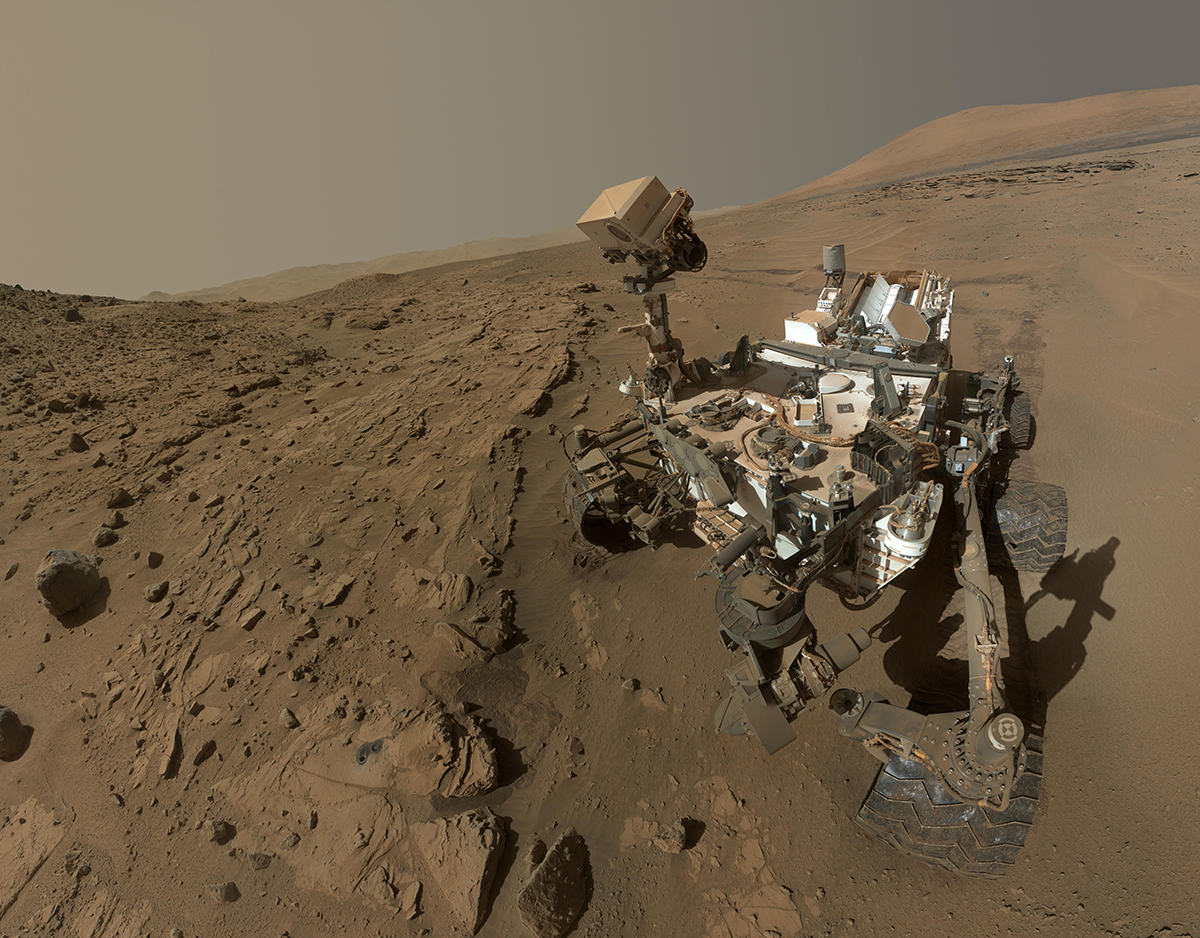
Over 500 researchers around the world have used an arsenal of computers, servers, and high-end computing resources to process Curiosity's data and images, to design experiments, and to extend the rover's capabilities. Engineers at NASA's Jet Propulsion Laboratory (JPL) have used about 50,000 processor-hours on the Pleiades supercomputer at NASA's Ames Research Center and on the Zodiac supercomputer at JPL to model the rover's capabilities. Results have helped them understand Curiosity's behavior in the Martian environment, optimize its path, and plan its next moves—including steering the rover through difficult conditions, such as waist-high sand dunes.
What's Next
In September 2014, Curiosity arrived at the foot of Mount Sharp, its primary destination. After exploring the base of the three-mile-high mountain, the rover will soon begin climbing to explore the mountain's different layers of rock and minerals. Scientist believe that the geological record of Mount Sharp will answer many remaining questions about the history of Mars, helping us understand the environmental changes that have left Mars the dry planet it is today—and perhaps providing insight that can help us learn how to protect our own planet.
Timofey Ovcharenko, NASA Jet Propulsion Laboratorytimofey.ovcharenko@jpl.nasa.gov Ashwin Vasavada, NASA Jet Propulsion Laboratory
ashwin.r.vasavada@jpl.nasa.gov