
Melting Snowflakes to Support Quantitative Precipitation Estimates from Space
Overview
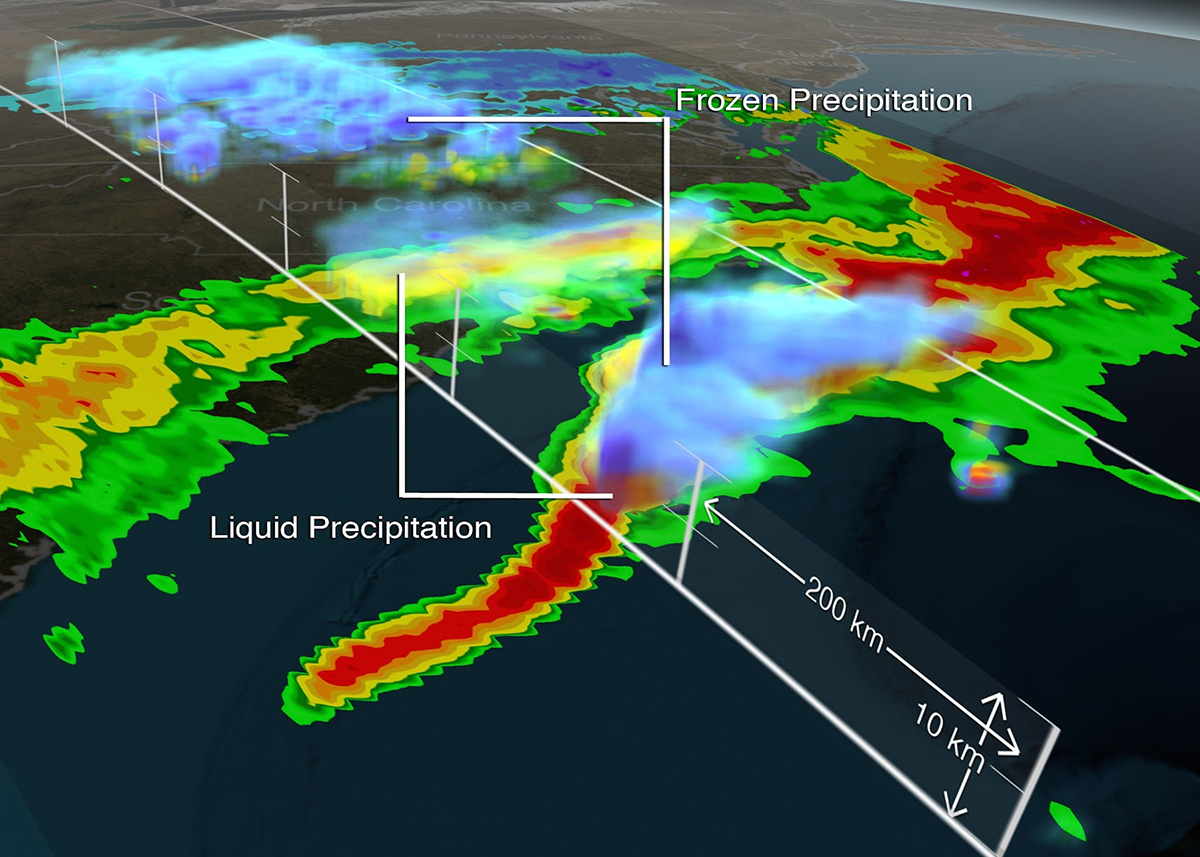
Changes in Earth’s hydrological cycle, of which the precipitation process is a major link, play an important role in regional responses to climate changes. One of the greatest difficulties in measuring precipitation from space is accurately estimating the collective properties of the particles suspended in a precipitating column, especially those in the form of frozen snow and ice particles. Even more difficult is estimating the same properties for particles in the process of melting and thus composed of both solid and liquid phases of water. One can accurately estimate properties for liquid particles by remote sensing means using relatively simple models of spherical or near-spherical drops. However, estimations for frozen or melting contents— consisting of varied and irregularly shaped particles—require a significantly more sophisticated treatment. To achieve the necessary fidelity, one must first simulate the crystalline growth of snow particles in a supersaturated environment and allow for subsequent aggregation of particles as they collide. Next, one must include effects due to melting as particles fall through regions of the precipitating system where temperatures remain above the freezing point of water. Finally, one must simulate the radiative scattering properties of the ensemble of particles to make predictions about what would be observed by remote instruments.
Project Details
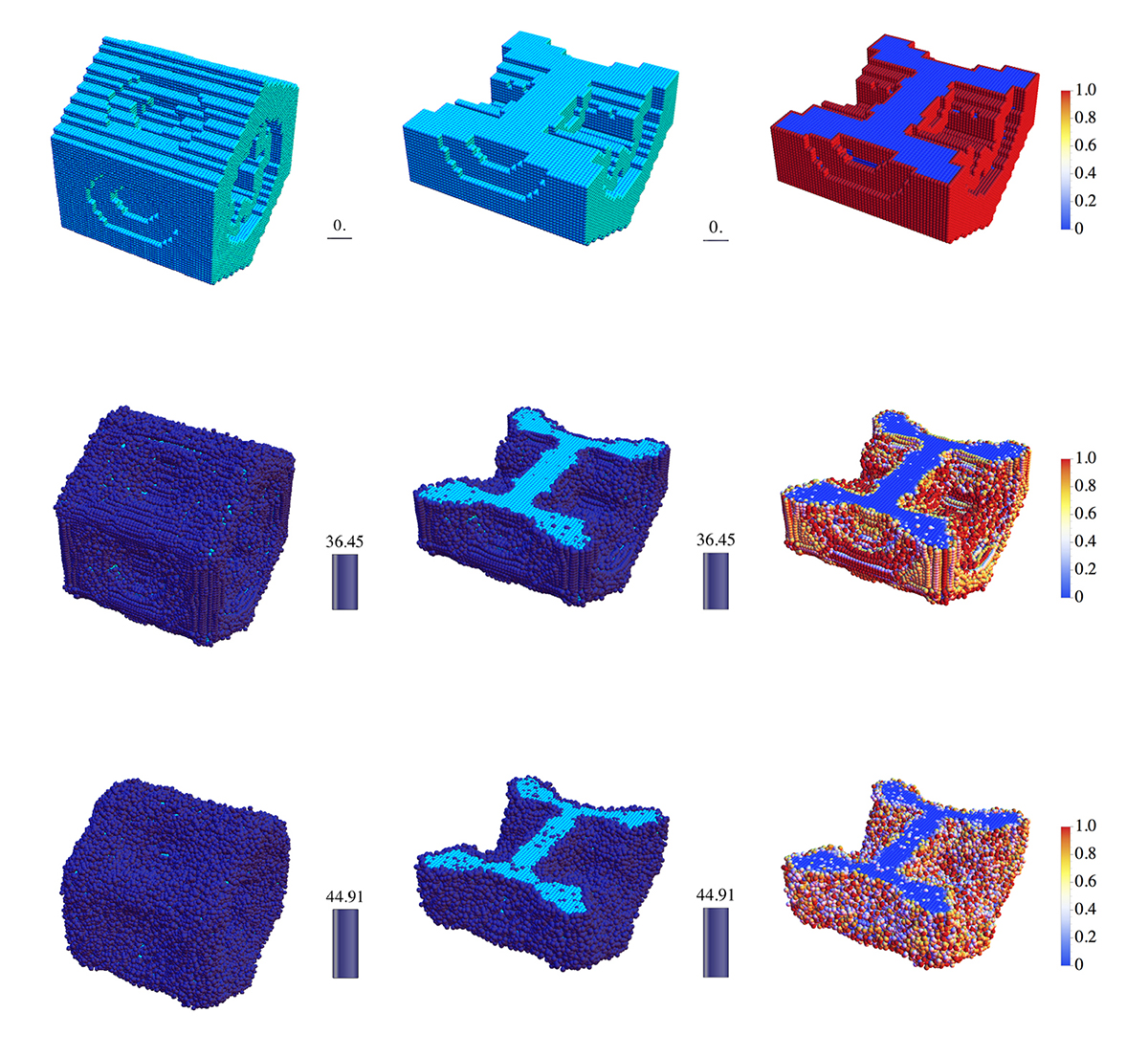
In order to simulate melting with realistic morphology, a set of snow/ice particles with geometries as realistic as those that occur in nature needs to be generated first. We chose the proposed method of Gravner and Griffeath for generating realistic particles. Melting simulations are difficult because of the interplay between ice and water. The particle’s liquid portion is subject to the laws of hydrodynamics. The surface of the solid portion, however, forms a very complicated and time-varying boundary condition for the hydrodynamic problem of the liquid portion and is exceedingly difficult to solve using conventional finite difference grids. Therefore, we use the Smooth Particle Hydrodynamics (SPH) method for the melting simulation. In this method, an ice particle is assumed to be composed of and represented as a collection of SPH particles. The SPH particles in the solid portion of the ice particle are held in place by the ice crystal lattice, while the SPH particles in the liquid portion are subject to interfacial tension with the solid SPH particles, coherent forces between other liquid SPH particles, surface tension, etc. We currently use several hundred thousand SPH particles to represent one ice particle, but this should be scaled up to approximately one billion particles for better fidelity.
Results and Impact
The results of this work are expected to lead to a better understanding of the nature of the melting layer and the structure of precipitation systems. We have created an extensive set of particle geometries and completed a first attempt to melt the particles using SPH. Moreover, the scattering properties of the melted particles have been successfully obtained using the open-source Discrete Dipole Scattering (DDSCAT) software. However, further work along these lines is needed to achieve higher resolution of the melting process and carry out convergence studies.
Why HPC Matters
We have performed SPH on the NASA Center for Climate Simulation’s Discover supercomputer to simulate the melting of snow/ice particles. Simulations of the melting process that satisfy our science goals will require hundreds of millions (and possibly billions) of SPH particles. This problem size requires thousands of compute cores to shorten wall-clock time as well as meet memory requirements. In addition, one simulation has to be done for each snow/ice particle type.
Craig Pelissier, NASA Goddard Space Flight Centercraig.s.pelissier@nasa.gov Kwo-Sen Kuo,, NASA Goddard Space Flight Center
kwo-sen.kuo@nasa.gov