
Optimizing the Design of Complex Rocket Components with Fluid Analysis
Overview
Ullage gas diffusers are an essential part of any launch vehicle that uses cryogenic propellant. As hot, high-pressure gas enters a propellant tank, the ullage gas diffuser must slow it down from supersonic speeds to only a few meters per second. Historically, ullage gas diffusers are large, bulky devices that occupy a significant portion of the tank and thus decrease the amount of room available for propellant. Advanced computational fluid dynamics (CFD) analyses are now enabling the designs of complex rocket hardware, such as ullage diffusers, to be efficiently optimized before they are finalized. This project utilized CFD analyses to mature a low-profile diffuser (LPD) from an initial concept to a prototype, and to provide extremely accurate pre-test predictions of its performance.
Project Details
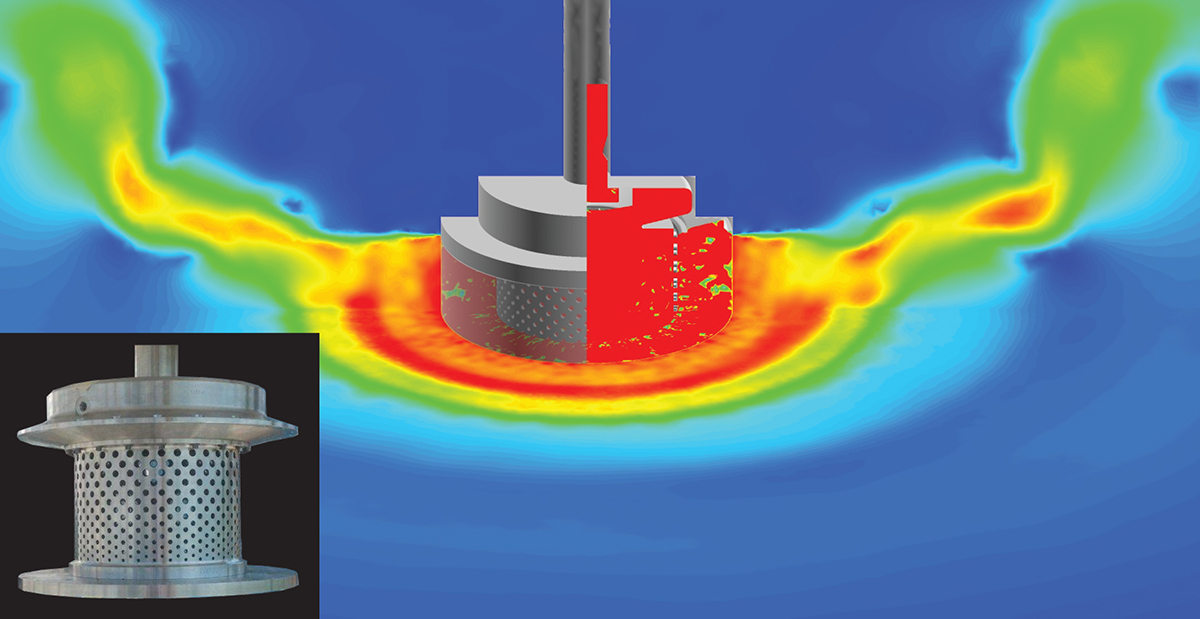
This project consisted of three main parts. First, a momentum resistance model was developed for the Loci-STREAM CFD code. A momentum resistance model is a computationally efficient method for modeling flow through porous media such as wire-cloth screens, which are sometimes used at the exit of diffusers. The new modeling capability was tested by performing a CFD analysis of heritage diffuser hardware and operating conditions.
In the second part of the project, CFD analyses were performed to optimize the design of an LPD concept by minimizing its size and maximizing its performance. This effort involved generating detailed 3D models of approximately 20 different diffuser designs and performing CFD simulations of each concept—all in less than two months. Additional analyses of the final diffuser concept were also conducted to provide pre-test performance predictions before the hardware was fabricated.
Thirdly, pre-test performance predictions were provided for flow tests of a large, traditionally designed ullage gas diffuser. Within a three-month turnaround time, a large-scale, ~700-million-cell computational mesh of the diffuser was generated and time-accurate, 3D CFD simulations were performed at two different flow conditions.
Results and Impact
Each part of this project both advanced NASA’s CFD analysis capabilities and impacted the development of new spacecraft hardware. This work provided NASA with a new, experimentally validated method for modeling porous media using large-scale, 3D CFD simulations. These simulation methods were used to optimize the design of an ullage gas diffuser, bringing it from an original concept sketch to a functional test prototype in a very short amount of time. CFD analysis of a traditional diffuser design guided the test data collection effort and provided new insights into the flow physics involved in the device’s operation. Additionally, the pre-test CFD predictions of diffuser performance were validated to within 1% error compared with the experimental data.
Why HPC Matters

NASA continues to invest significant resources to advance the state of the art in CFD analysis for increasingly complex hardware applications. Unstructured mesh generation greatly reduces the human effort required to create computational models for complex geometries and thus provides analysts more time to understand and benefit from the CFD results. However, this approach is very computationally intensive because the mesh size becomes quite large for complex problems. As a result, CFD design support for rocket hardware would not be possible without access to a large supercomputing resource such as the Pleiades supercomputer at NASA Ames Research Center. Each of the LPD concept simulations required a computational mesh with around 50 million cells and around 75,000 processor-hours to complete, while the CFD simulation of the traditionally designed diffuser required a 700-million-cell mesh and 2.8 million processor-hours.
Narayanan Ramachandran, NASA Marshall Space Flight Centernarayanan.r.ramachandran@nasa.gov