Innovative Simulations for Modeling the SLS Solid Rocket Booster Ignition
Overview
The Space Launch System (SLS), NASA's next-generation heavy-lift launch vehicle, will utilize two five-segment Reusable Solid Rocket Motor V (RSRMV) rockets as boosters. The results of RSRMV static test firings to date suggest that an interaction between the booster and thrust stand dynamics is likely compromising test data, especially the critical thrust rise rate, during motor ignition.

To address this issue, multiple time-accurate, 3D computational fluid dynamics (CFD) simulations have been performed using NASA's supercomputing resources to model the first half-second of the RSRMV ignition transient. Because these simulations accurately characterize the ignition transient, they also provide high-fidelity inputs for subsequent SLS launch-induced environment simulations.
Project Details
The CFD simulations of the RSRMV ignition transient were performed using a code named Loci/CHEM and included a transient pressure vs. time boundary condition that was applied to the motor igniter. The simulations incorporated an updated Loci/CHEM ignition module that solves a 1D heat equation into the propellant grain to determine when each propellant surface cell should ignite. When ignited, the simulated propellant "burns" using an empirical boundary condition based on propellant formulation and local pressure. The combustion products were modeled as a homogenous, single species gas.
Validation efforts included an input sensitivity study that used different boundary conditions based on parametric values for inputs such as burn-rate and gas properties. In addition, grid size and timestep studies were used to verify that the solution is spatially and temporally converged. The grid sensitivity study used meshes ranging from 90–250 million total cells. The timestep study used steps ranging from 1–5 microseconds.
Results and Impact
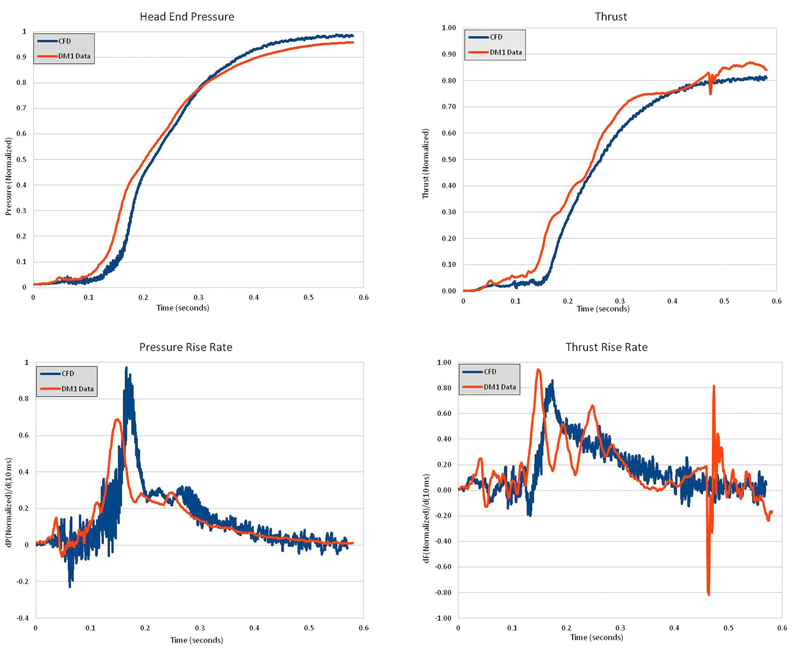
CFD head-end pressure results and thrust calculations match very well with static test data. Visualizations were created to help identify and separate the fluid mechanisms that affect the motor pressure rise rate from the contributions of the thrust stand dynamics to the measured thrust.
To provide high-fidelity inputs for additional SLS launch-induced environment simulations, over 100 numerical probes were placed in an axial plane located at the entrance of the nozzle to capture the fluid properties of the gas at regular time intervals. These were used to create a 3D CFD profile for an input boundary condition for the additional simulations.
Role of High-End Computing Resources
Because NASA's Pleiades supercomputer can perform multiple cases simultaneously, and Loci/CHEM scales very efficiently as the number of processors is increased, we were able to complete the simulations in two weeks using 2,400 processors per simulation. This quick turnaround time enables early support of the SLS during the design and development phases. In addition, NASA's Lou archival system has been used to store the several terabytes of data produced by each simulation.
Philip Davis, NASA Marshall Space Flight Centerphilip.a.davis@nasa.gov