Solid Rocket Booster Ignition Overpressure Simulations for the Space Launch System
Overview
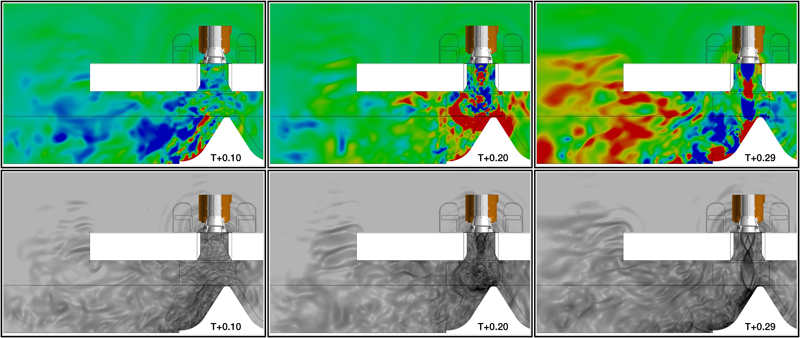
During launch, the Space Launch System (SLS)—NASA's next generation heavy-lift launch vehicle—will experience a series of large pressure waves that emanate from the flame trench below the launch platform. These pressure waves, which are caused by the fast ignition transient of the solid rocket boosters (SRBs), can damage the vehicle.

Although this ignition overpressure (IOP) phenomenon was observed during the Space Shuttle Program, existing engineering-level IOP analysis tools cannot account for the different configuration of the SLS vehicle and launch pad. To study the effects of the new configuration, we performed time-accurate computational fluid dynamics (CFD) simulations of the SLS IOP event using NASA's supercomputing resources.
Project Details
The goal of this work was to resolve multiple uncertainties in the existing IOP analysis, such as the interaction of the SRB IOP with the core stage liquid engines at full power, the effects of the new SLS mobile launcher design, and possible design changes to the flame deflectors below the vehicle.
Several simulations were performed with varying levels of fidelity in order to specifically address each of these uncertainties and include updated vehicle and mobile launcher designs. Between 50 and 150 million computational cells were used to model the detailed structures of the SRB and core stage plumes within the complex launch pad geometry. The simulations were achieved with a CFD code named Loci/CHEM, using thousands of processors in parallel.
Results and Impact
Of the various uncertainties addressed in this work, our simulations showed that the interaction of the SRB and core stage plumes had the most significant impact on the IOP environment. Because the core stage engines are at full power at the time of SRB ignition, the IOP wave is partially entrained or dissipated by the core stage plume flow field, which creates smaller, less coherent waves with lower amplitude. As a result, the IOP wave interaction with the SLS vehicle was more localized than in the shuttle configuration, and peak impingement pressures were reduced.
These, and other findings, were used to improve the IOP analysis provided to the SLS vehicle designers by removing unnecessary levels of conservatism. In addition, the higher fidelity simulations were used to modify parameters in the IOP analysis tools so that the predicted IOP waveform reflected the SLS vehicle and mobile launcher configuration, rather than being anchored to early space shuttle data.
Role of High-End Computing Resources
Due to the time-sensitive nature of producing the IOP analysis for the SLS vehicle design cycles, the use of NASA's supercomputing resources was vital to completing this work. Each simulation was run with thousands of processors on the Pleiades cluster, required 7 to 15 days to complete, and produced over 2 terabytes of data.
Brandon Williams, NASA Marshall Space Flight Centerbrandon.williams@nasa.gov