From a Roar to a Whisper: Making Modern Aircraft Quieter
Overview
Aircraft noise is an environmental hazard that affects metropolitan areas adjacent to major airports. With the projected growth in air travel, noise exposure levels are expected to increase substantially. The Environmentally Responsible Aviation (ERA) project of the NASA Aeronautics Mission Research Directorate is developing and maturing noise reduction technologies that will confine aircraft noise footprints on the ground within airport boundaries, without detrimental effects to the aerodynamic efficiency of aircraft.

To most people, aircraft noise is synonymous with jet engine noise. During approach to landing, however, noise generated by the airframe is comparable to, and in some instances even louder than, propulsion noise. The prominent sources of airframe noise are the landing gear and lift-generating devices such as wing flaps and slats.
Project Details
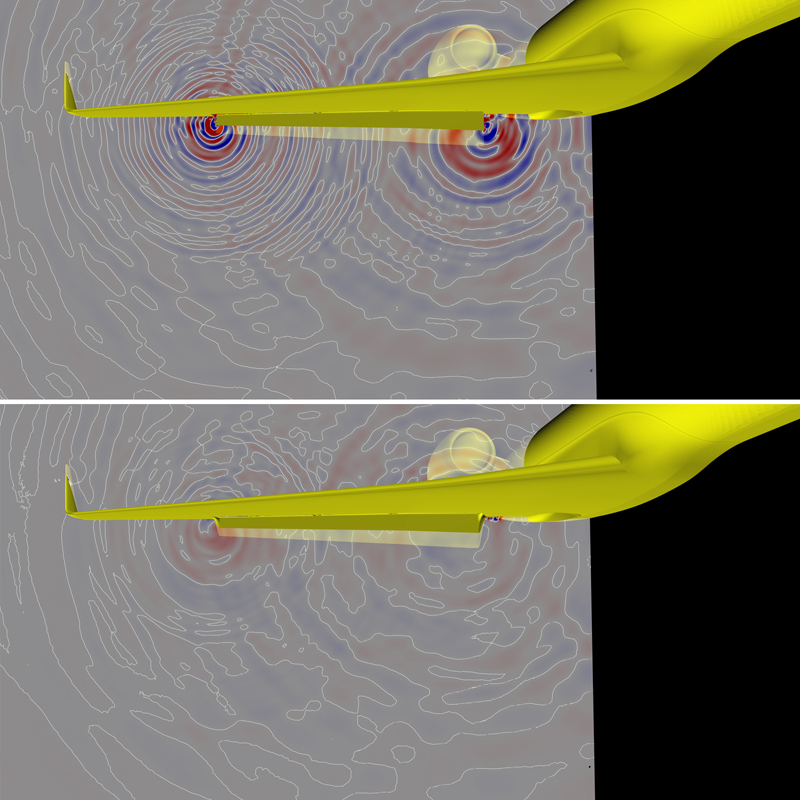
As part of the ERA-Gulfstream partnership on airframe noise research, we simulated the airflow over a semi-span model of a Gulfstream aircraft in landing configuration. We focused on accurately capturing the prominent noise sources at both flap tips for the baseline configuration. Then, we evaluated the effectiveness of a novel noise-reduction concept applied to the flap tips. The time-accurate simulations were obtained using the NASA Langley FUN3D unstructured Navier-Stokes flow solver and Exa Corporation's PowerFLOW Lattice-Boltzmann flow solver. Approximately one billion volumetric cells were used to discretize the space surrounding the aircraft surfaces.
Results and Impact
Our simulations have provided unique and detailed insight into the prominent fluid dynamical processes that create noise at the aircraft flap tips. Scrutiny of the flowfield in the vicinity of the tips revealed the formation and/or presence of multiple vortices that behave like miniature tornados. Their evolution, merging, and interaction with the sharp corners at the tips produce high-amplitude sound waves that propagate toward the ground. We also demonstrated that the noise abatement concept applied to the tips is very effective.
Role of High-End Computing Resources
The vast number of arithmetic operations needed to perform any of our simulations requires the use of the largest supercomputers available. All the simulations were performed on NASA's Pleiades supercomputer using approximately 2,000 processors. Depending on the nature of the information required, the computational runs could last from two weeks to two months, resulting in several petabytes of data. The rendering and effective visualization of such massive datasets were made possible by members of the NASA Advanced Supercomputing (NAS) facility's visualization team at Ames Research Center.
Mehdi R. Khorrami, NASA Langley Research Centermehdi.r.khorrami@nasa.gov