Modeling Extended Formation Flight on High-Performance Computers
Overview
Just as birds flying in formation expend less energy, aircraft can reduce fuel consumption through formation flight. Using this arrangement, aircraft can obtain significant savings in induced drag due to favorable upwash of the lead aircraft on the followers. NASA's Fundamental Aeronautics Program is studying this concept as part of a comprehensive strategy aimed at reducing carbon emissions and gaining fuel economy. Formation flight is one of the few technologies that offers significant impact using aircraft that are already in service.

While formation flight has been studied since the early 1900s, estimates of the potential benefits have varied significantly. Credible estimates of induced drag savings of 10–30% have been predicted by low-order computational fluid dynamics (CFD) methods but have been difficult to confirm with high-fidelity CFD simulations.
Project Details
Even with modern computing resources these simulations are challenging, since they depend on accurately predicting and measuring induced drag of complete aircraft at transonic conditions, as well as accurately propagating vortices and wakes over long distances through a computational domain. In extended formation flight, operational safety dictates separation distances of 15–50 spans, which further increases the level of difficulty of the simulations.
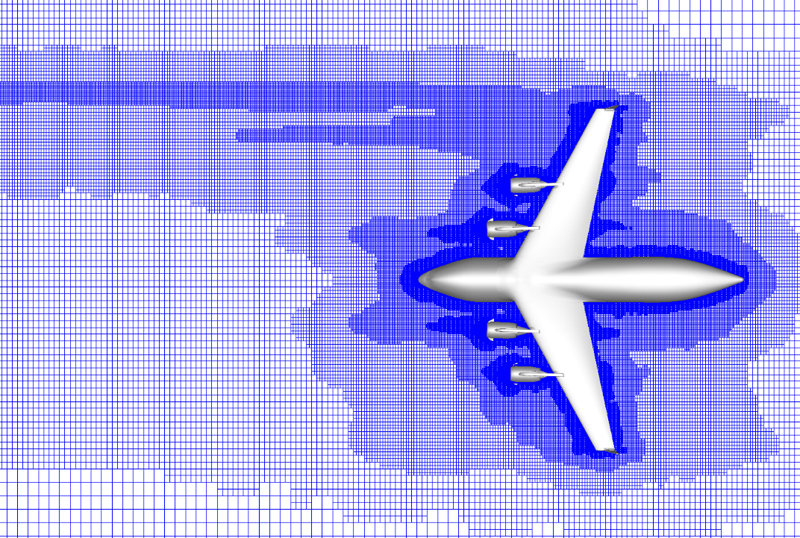
These challenges are met by using a non-body-fitted simulation approach on meshes that dynamically adapt to minimize errors in measuring induced drag of the aircraft in formation. The simulations include effects of flow compressibility, aircraft trim, control surface deflection, and other important physics that are lacking in previous work.
Results and Impact
Our research shows that the benefits of formation flight remain significant even when accounting for losses due to the transonic compressibility and control surface deflection required for aircraft trim. In trimmed transonic flight, aircraft following 30 spans downstream can still achieve a 35% savings in induced drag. Moreover, these savings are relatively insensitive to precise positioning of the trailing aircraft.
Results from our simulations are verified with flight-test data gathered in cooperation with other government agencies. After validation, the data are used in models of the National Airspace System to quantify the potential of formation flight to reduce fuel consumption at a national scale.
Role of High-End Computing Resources
Formation flight involves aerodynamic phenomena spanning lengths from millimeters to miles–an extraordinary range of scales. Combined with high sensitivity to slight errors in the simulation, this makes analysis of formation flight extremely challenging. With problem sizes that are on the order of a billion degrees of freedom, and hundreds of cases to consider, the availability of NASA's high-end computing resources and the massive parallelization capability of the Pleiades supercomputer are key to this research.
Michael Aftosmis, NASA Ames Research Centermichael.aftosmis@nasa.gov