Adjoint-Based Design for Complex Aerospace Configurations
Overview
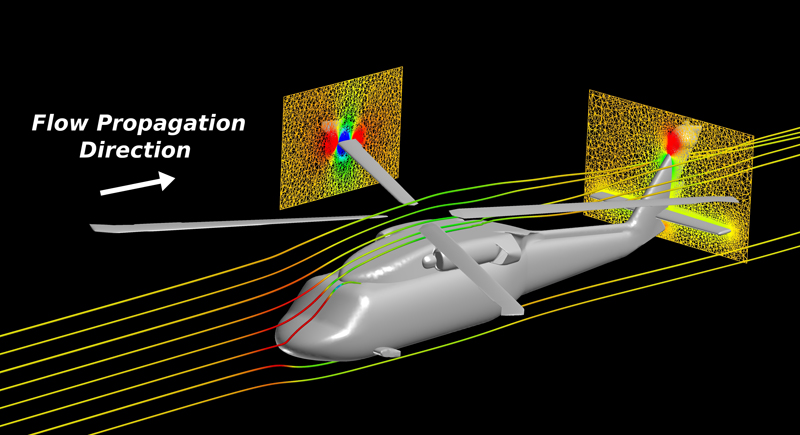
Aerospace engineers face enormous challenges when designing new aircraft and space vehicles to meet modern safety and efficiency standards. To enable formal, constrained design optimization of complex aerospace configurations, we have developed adjoint-based methods that are implemented in the NASA FUN3D computational fluid dynamics (CFD) code. A single simulation for configurations experiencing unsteady turbulent flows and requiring dynamic/deforming geometries and high-fidelity physical models may require millions of compute hours, so highly efficient strategies are needed to compute accurate sensitivities for many thousands of design parameters.

Our adjoint-based methods, implemented on massively parallel computers, allow design engineers to formally tackle a broad array of complex optimization problems across the speed range. Without these powerful supercomputers, it would be nearly impossible to address these computational problems.
Project Details
In a typical CFD problem, the governing equations are integrated forward in physical time to determine aerodynamic quantities of interest, such as heat transfer, pressure, and forces. To efficiently compute numerical sensitivities of these quantities with respect to thousands of input parameters, the adjoint approach solves the linearized governing equations in reverse physical time. In this manner, the adjoint solution marches backward in time to determine the sensitivities of output functions due to any input parameters required for the simulation.
We have taken a discrete adjoint approach, in which the discretized governing equations are linearized exactly with respect to the flowfield and mesh variables. Our implementation supports steady and unsteady flows based on compressible and incompressible forms of the Reynolds-averaged Navier-Stokes equations. Computational meshes may include general element types belonging to single-block or overset grid topologies. Furthermore, these grids may be rigidly moving, deforming, or any combination thereof; general parent-child body motion relationships are also accommodated.
Results and Impact
The effort required to develop and mature this general capability has taken two decades of sustained research and software development. Our approach has been successfully demonstrated on a broad range of realistic design problems including rotorcraft geometries, fighter jets, biologically inspired micro-air vehicle configurations, active flow control systems, and wind energy devices. The adjoint-based methodology also provides a rigorous foundation, valuable insight, and an effective tool for estimating error, adapting meshes, and quantifying uncertainties for such problems.
Role of High-End Computing Resources
A relatively simple, single-point design optimization case typically requires the equivalent of O(30) flow simulations. Since a single simulation may require millions of compute hours, efficient use of the world's most powerful supercomputers is essential. In addition, a customized asynchronous parallel I/O strategy enables the terabytes of data generated to be transferred and stored efficiently.
Eric Nielsen, NASA Langley Research Centereric.j.nielsen@nasa.gov