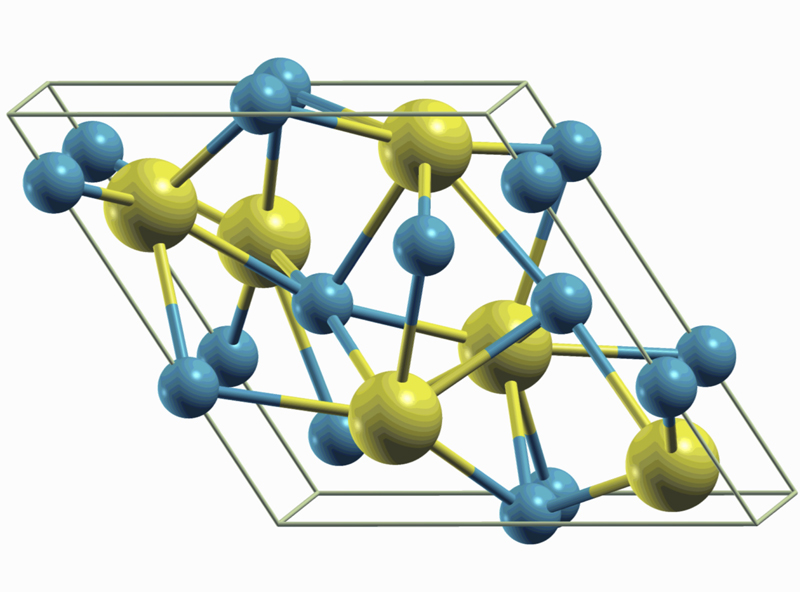
Powering Deep Space Missions: Thermoelectric Properties of Complex Materials
Overview
In deep space mission spacecraft, thermoelectric materials are used to generate electric power from the decay of radioisotopes. So far, only simple materials (such as silicon and bismuth telluride) have been used for space applications, but researchers at NASA's Jet Propulsion Laboratory (JPL) are studying more complex materials such as lanthanum telluride (La3Te4), zintl phase materials, and skuterrudites) that can produce electricity more efficiently. The objective of this project is to use state-of-the-art electronic structure calculations to compute thermoelectric properties of complex materials, and to guide laboratory synthesis of materials with improved thermoelectric properties.
Project Details
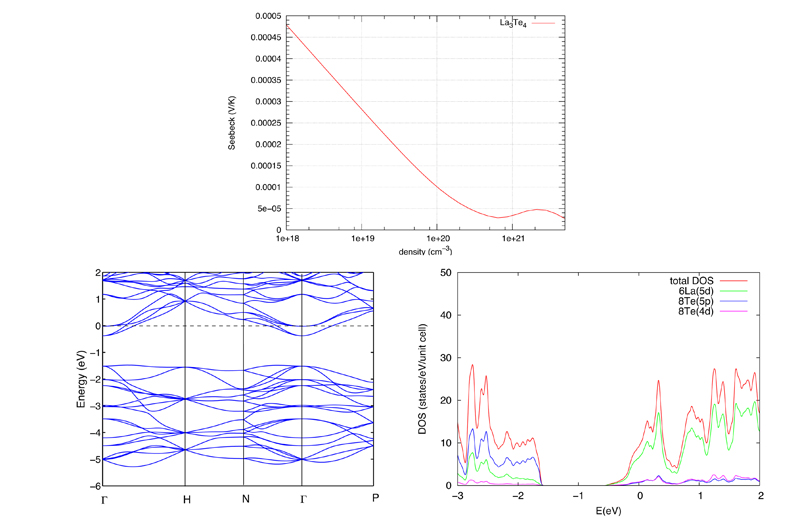
The figure of merit for thermoelectric materials is proportional to the square of the Seebeck coefficient, which measures the electric field that arises in a material in response to an applied temperature gradient. Our work focuses on computing the Seebeck coefficient for complex materials using first-principles electronic structure calculations.
The first-principles electronic structure is obtained from the density functional theory, where the many-body interactions between the electrons are approximated by a one-electron potential. The electronic structure is used to compute the Seebeck coefficient from a solution of the Boltzmann transport equation.
To compute the electronic structure, we used the community software package Quantum ESPRESSO, in which the most computationally intensive numerical algorithms are fast Fourier transforms that allow orthogonalization of large vector sets.
Results and Impact
We calculated the band structure, the electronic density of states, and Seebeck coefficient for La3Te4 and several zintl phase materials. We validated our modeling approach by comparing our results with published calculations and with measured data, when available, and found excellent agreement.
In addition, we found that substituting appropriately chosen elements at the atomic level can alter the Seebeck coefficient. These exploratory studies have prompted new experiments that are expected to lead to the discovery of materials with improved figures of merit, as predicted by our calculations.
Role of High-End Computing Resources
A typical first-principles electronic structure calculation for complex materials takes up to six weeks of computing time, uses up to 200 processors, and requires approximately 439 megabytes of memory per process and 589 gigabytes of disk space. Because these complex calculations cannot be performed on desktop computers, the Zodiac supercomputer at JPL was an essential resource.
Trinh Vo, Jet Propulsion Laboratory/California Institute of Technologytrinh.vo@jpl.nasa.gov Paul von Allmen, Jet Propulsion Laboratory/California Institute of Technology
paul.a.vonallmen@jpl.nasa.gov