Validating Water Spray Simulation Models for the SLS Launch Environment
Overview
NASA regularly uses computational fluid dynamics (CFD) simulations to assess the loads and risks for space vehicles at liftoff. Traditionally, these simulations have been used to make predictions either near the vehicle, such as for plume recirculation, or for large-scale effects like wind. However, validations against recent test data have shown that modern codes can make meaningful pressure predictions over the full launch pad for frequencies up to 150 Hz–high enough that significant phenomena such as the transient startup and overpressure pulse of rockets can be modeled.
These validations have provided confidence in the results of CFD simulations, allowing them to make immediate impacts on the design of NASA's new Space Launch System (SLS). Modifications to the mobile launcher, flame deflector, vehicle base, and liftoff design have all been influenced by this work. However, they have been limited in their validation and use to dry launch pads. To examine the full range of designs, CFD simulations must also incorporate multi-phase components, like water sprays.
Project Details
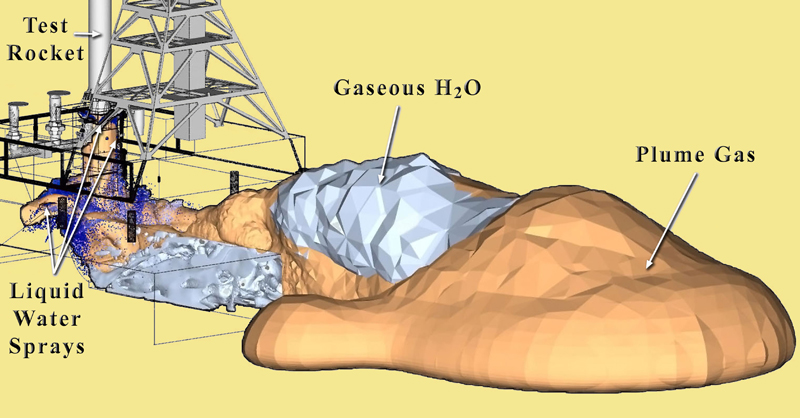
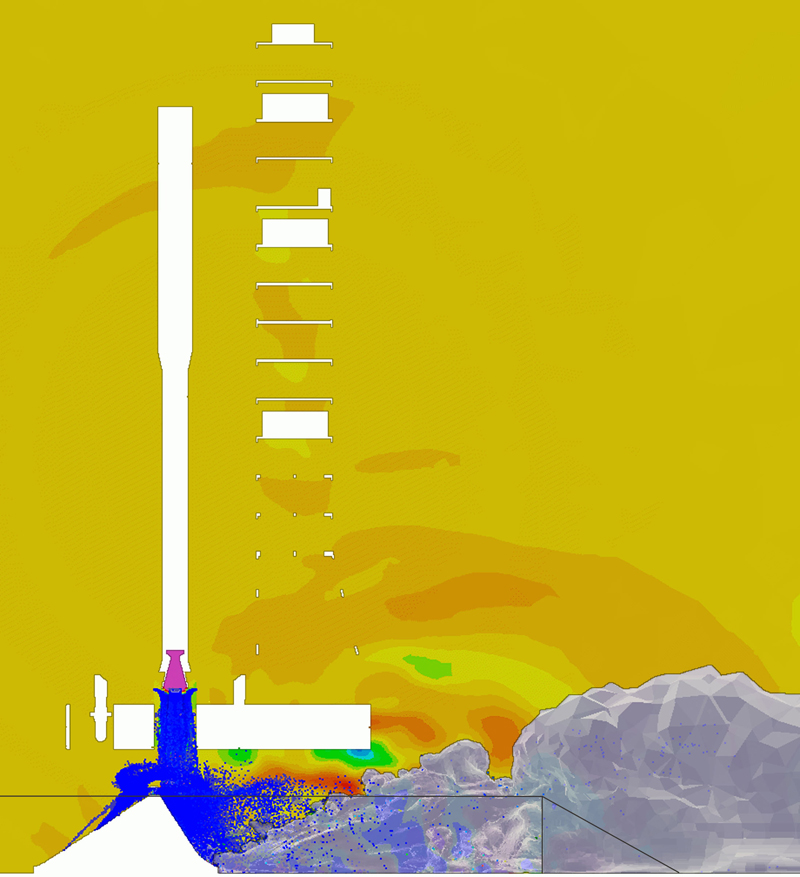
This capability has been developed in partnership with Mississippi State University and used to simulate the effects of water suppression for a wet launch pad validation case. We simulated the emission, flight, and evaporation of water spray systems on an active launch pad by using a two-phase approach that includes Lagrangian water particles and gas phase CFD elements. The simulation was based on a test case from the Ares I Scale Model Acoustic Test so that pressure predictions from across the launch pad could be validated against real data. Approximately 200 million grid cells were used to capture the fine detail and geometry of the pad, and millions of particles were tracked to capture the dynamics of a water cascade. This work was performed using a density-based, finite-volume CFD code called Loci/CHEM.
Results and Impact
Ignition overpressure and payload acoustics are design considerations that are consistent risk drivers for new launch vehicles. Traditionally, these effects have been predicted using analytical methods, with low-fidelity scaling of results from old designs. However, the technology development and validation efforts supported by this work allow CFD simulations to make validated pressure predictions over a full launch pad using the geometry designed for a specific vehicle. Suppression systems can be optimized for maximum effect using CFD parametrics. Furthermore, problems with these systems can be identified and fixed before fabrication begins, providing significant cost savings to NASA.
Role of High-End Computing Resources
The prediction of acoustic effects for a structure the size of a launch pad is an intense computational task that would be very difficult without the resources of a supercomputer like Pleiades. Even simulations of a scaled rocket took nearly a week to complete on over 1,000 processors, and were typically run in groups of two or more to test design permutations. Storage requirements were on the order of multiple terabytes per simulation, with regular processing of hundreds of gigabyte-scale files for visualization, post-processing, and data analysis.
Gabriel Putnam, NASA Marshall Space Flight Centergabriel.c.putnam@nasa.gov