CFD Simulations to Support the Next Generation of Launch Pads
Overview
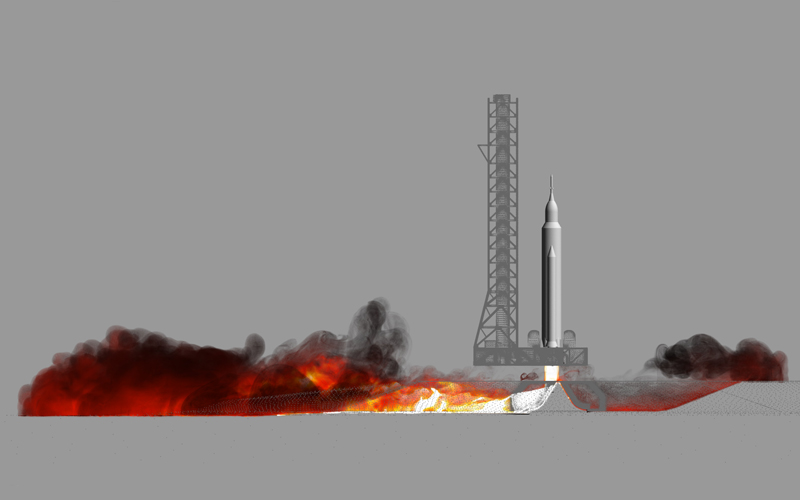
With the retirement of the Space Shuttle, NASA is developing a new heavy-lift launch capability, the Space Launch System (SLS), to transport crew and cargo to the International Space Station (ISS) and beyond. In addition, commercial vehicles such as SpaceX's Falcon, United Launch Alliance's Delta IV Heavy and Atlas V rockets, and Alliant Techsystems's Liberty are being considered as potential options for travel to the ISS and other destinations. To accommodate launches of these next-generation vehicles, engineers at NASA Kennedy Space Center (KSC) are working to modernize its launch site capabilities, which requires a thorough re-assessment across KSC's launch facilities. Components of particular interest are the flame trench and the Main Flame Deflector (MFD), whose main purpose is to safely deflect the exhaust plume away from the vehicle as it lifts off.
Project Details
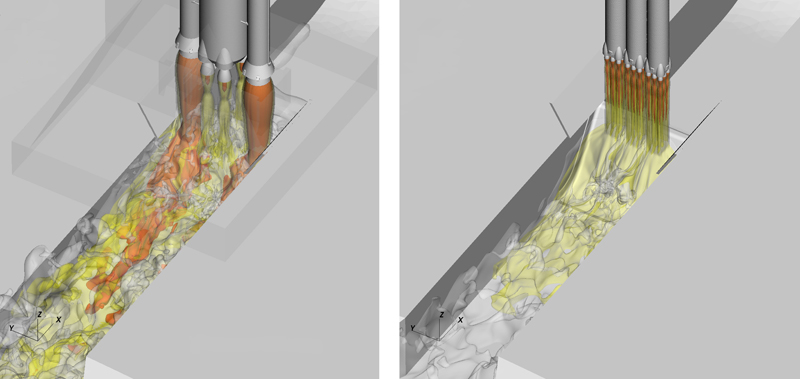
Redesigning the MFD requires an assessment of its ability to contain plumes in the trench as well as a comprehensive study of the pressure and thermal loads that the SLS and commercial vehicle launches will place on the deflector and the surrounding environment. During a rapid design cycle, a computational fluid dynamics (CFD) approach is well suited to provide the necessary predictive capabilities for this work. With the use of CFD, we can examine the areas of concern in detail, and produce incremental design trade studies and comparative studies of various concepts in a timely and cost-efficient manner. Toward these ends, applied modeling and simulation experts at NASA Ames Research Center have undertaken extensive CFD work in support of the MFD redesign project.
Results and Impact
This project assesses candidate MFD designs combined with different vehicle configurations and layouts, and has already provided design engineers with feedback during the design cycle. Specifically, analysis includes: plume containment characteristics, time evolution of pressure, and temperature and heat transfer rate distributions on the MFD and flame trench surfaces.
Role of High-End Computing Resources
Each of these simulations requires approximately one week of simulation time using up to 960 Westmere cores on the Pleiades supercomputer at the NASA Advanced Supercomputing (NAS) facility. Because the simulations are unsteady, several terabytes of data are generated for each calculation. Data analysis and visualization are conducted using NAS's high performance systems, including in-house particle tracing tools and other software.
Cetin Kiris, NASA Ames Research Centercetin.c.kiris@nasa.gov Christoph Brehm, NASA Ames Research Center
christoph.brehm@nasa.gov