NASA Climate Simulations and Observations for the IPCC and Beyond
Overview
Exploiting more than 30 years of global satellite observations, NASA scientists are creating observation-driven climate simulations that improve our insights into both climate model behavior and the complex physical processes and feedback systems that influence the Earth's climate.
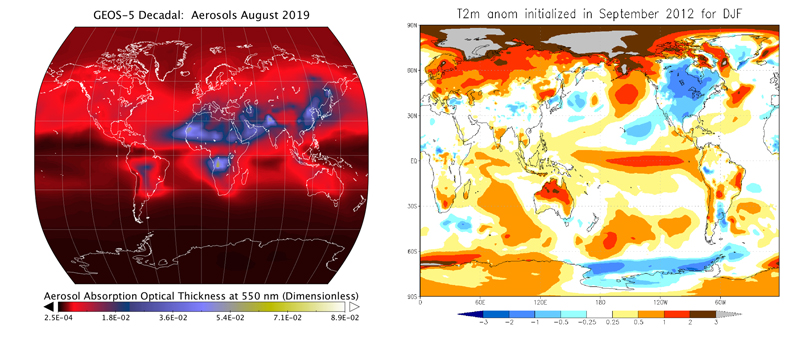
NASA's near- and long-term climate simulations and observations are contributing to international efforts such as the Coupled Model Intercomparison Project Phase 5 (CMIP5) and the Intergovernmental Panel on Climate Change Fifth Assessment Report (IPCC AR5), in addition to the United States' monthly National Multi-Model Ensemble and quadrennial National Climate Assessment.
Project Details
NASA's global climate simulations and satellite observations allow us to explore the evolution and variability of the Earth's immensely complex climate system from a variety of perspectives and time scales.
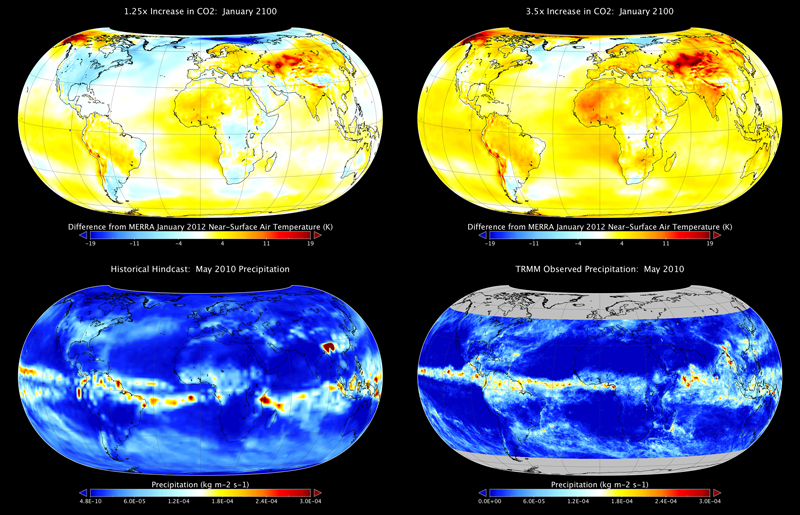
- The Goddard Institute for Space Studies (GISS) focuses on long-term climate simulations, with time scales stretching from multiple decades to centuries, using their ModelE General Circulation Model (GCM) coupled with the Russell ocean model or the Hybrid Coordinate Ocean Model
- For nearer-term, seasonal to decadal time scales, the Global Modeling and Assimilation Office (GMAO) applies its Goddard Earth Observing System Model, Version 5 Atmosphere-Ocean GCM (GEOS-5 AOGCM)
- To advance the use of climate simulation results and related observations and analyses, NASA makes the data available on Earth System Grid Federation websites at the NASA Center for Climate Simulation (NCCS) and the Jet Propulsion Laboratory
- GISS's Panoply tool allows researchers to quickly visualize NASA's climate simulation data, while NASA's collaboration with the U.S. Department of Energy's Ultrascale Visualization Climate Data Analysis Tools project supports analysis capabilities such as interactive 3D data exploration
Results and Impact
NASA's historical climate hindcasts and observation-driven near- and long-term simulations contribute to our understanding of the complicated interactions of climate's physical processes. NASA's collections of satellite observations since 1979 provide scientists with essential data for analysis and comparison with model results. The resulting range of past and future climate change is of great value for IPCC AR5 investigators, other scientists, and policymakers considering possible consequences.
Role of High-End Computing Resources
GISS and GMAO simulations run on the NCCS Discover supercomputer. From June 2010 through July 2012, climate processing consumed more than 300 million processor hours and produced more than 60,000 simulation years.
Ellen Salmon, NASA Goddard Space Flight Centerellen.salmon@nasa.gov