Simulating Planetary Entry Environments for Space Exploration Vehicles
Overview
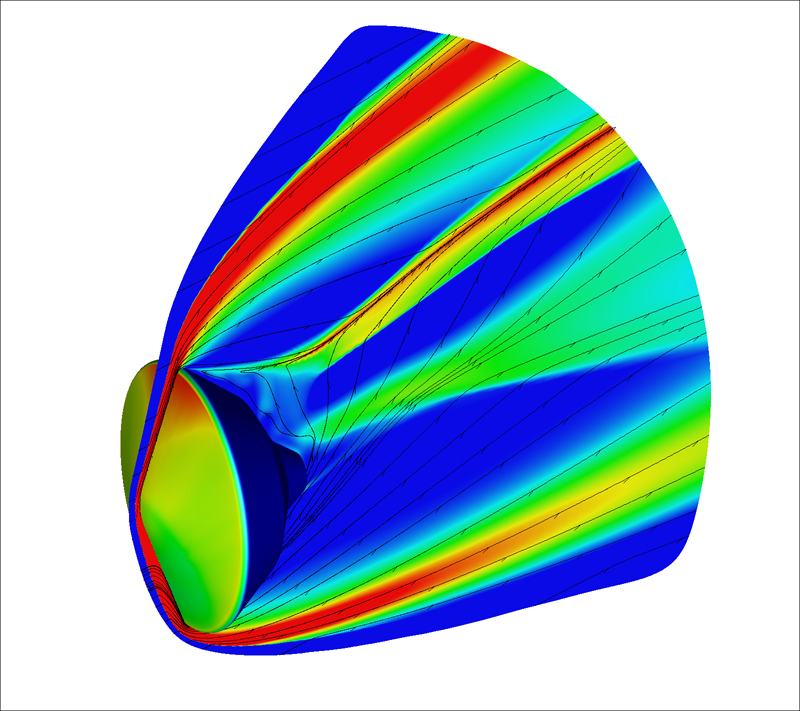
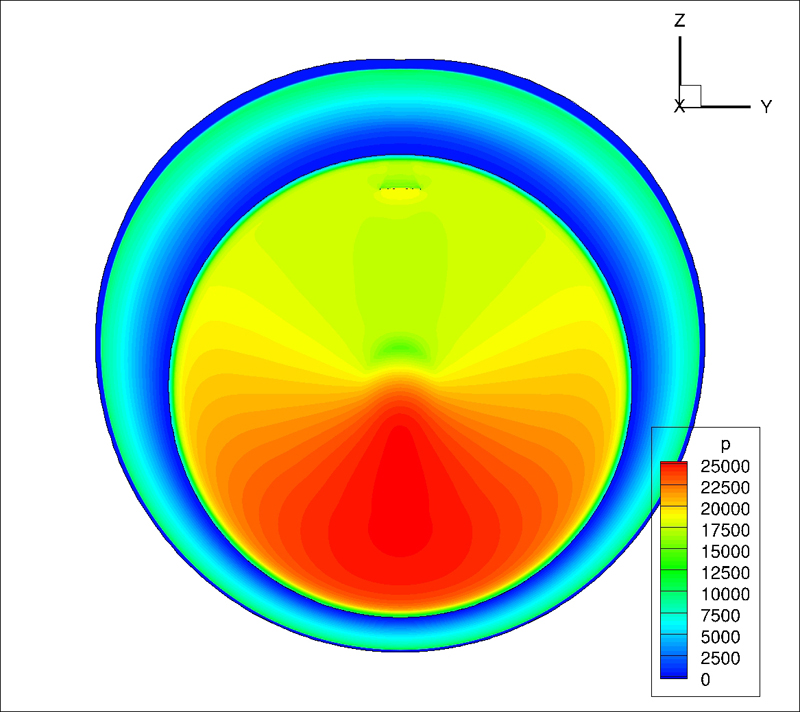
One of the challenges in designing a spacecraft capable of withstanding the searing temperatures that are experienced when entering a planetary atmosphere is to predict the heating on the vehicle's surface. It is critical that designers have an accurate estimate of the aerothermal environment so they can select appropriate thermal protection system (TPS) materials and determine the TPS thickness required to protect a spacecraft during high-speed entry into a planet's atmosphere. Since it is impossible to reproduce the exact flight conditions with ground-based experiments, we must rely on computer simulations to predict worst-case thermal environments and to extrapolate test data to generate flight-like conditions.

Project Details
For the Mars Science Laboratory (MSL) and the Orion Multi-Purpose Crew Vehicle (MPCV) projects, computational fluid dynamics codes produced simulations that were used to estimate the aerothermal environments at both flight and ground-based test conditions. These simulations, along with experimental data, were then used to verify the accuracy of our computer models, to establish uncertainties in the heating estimates, and to study the differences among various turbulence models.
Results and Impact
Our research revealed that even on a smooth body vehicle with lower drag, it is difficult to accurately predict the heating on the separated heat shield backshell; therefore, large safety margins are needed when designing the backshell TPS. Simulations using a more complex, two-equation shear stress transport turbulence model performed no better than the algebraic Baldwin-Lomax or the one-equation Cebeci-Smith turbulence models.
Role of High-End Computing Resources
These large, aerothermal environment simulations typically require more than 70 hours using 1,000 cores on NASA's Pleiades supercomputer at the NASA Advanced Supercomputing facility. It is unfeasible to run hundreds of these calculations without NASA's high-end computing resources—Pleiades has played a critical role in the generation of aerothermal databases for the MSL and Orion MPCV programs.
Chun Tang, NASA Ames Research Centerchun.y.tang@nasa.gov David Saunders, NASA Ames Research Center
david.a.saunders@nasa.gov