Simulating Galaxies and the Universe
Overview
According to the now-standard Lambda Cold Dark Matter (ΛCDM) theory, most of the universe is invisible dark matter and dark energy. Our Bolshoi and BigBolshoi are the most accurate high-resolution ΛCDM simulations of the large-scale structure of the universe. We have recently processed the outputs of these simulations to determine the complete merger history of every dark matter halo, and have made the data publicly available. This provides the basis for semi-analytic models (SAMs) of the evolution of the entire galaxy population. We are also running a large suite of hydrodynamic galaxy simulations.

Project Details
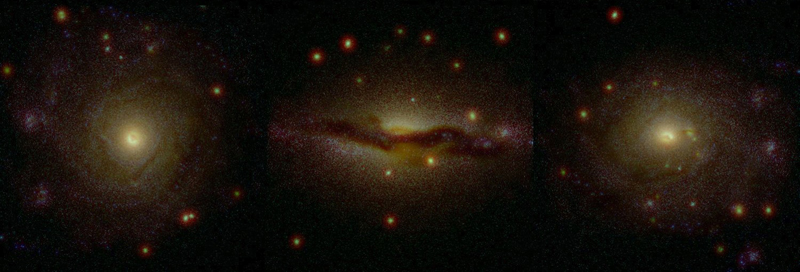
We are using our state-of-the-art hydrodynamics plus N-body code, hydroART, to simulate hundreds of cosmological regions at high resolution (15-30 parsecs), each containing a large galaxy and many dwarf and satellite galaxies. In the past year, we have published several papers on these simulations, including a discussion of clumps and Lyman alpha absorption in these simulated galaxies at high redshifts. Our Monte Carlo radiative-transfer code, Sunrise, allows us to make realistic images of the simulated galaxies in many wavebands at many times during each simulation, and to include the important effects of stellar evolution and dust. We are directly comparing such "simulated observations" with Hubble Space Telescope (HST) observations from the Cosmic Assembly Near-IR Deep Extragalactic Legacy Survey (CANDELS) program, the largest HST time allocation ever granted, to clarify how galaxies form in different environments.
Results and Impact
We have set up a conversion pipeline to allow for direct comparison of our simulated images with observations. Pipeline stages include redshifting the wavelengths, decreasing the resolution, adding background noise, and repixelizing the images. These simulated and HST images are being classified by astronomers. However, since the resulting hundreds of thousands of images are far too many to be analyzed entirely by human eyes, we are currently developing techniques for human-computer interactions in order to classify these images using computer vision. About 300,000 participants in the GalaxyZoo citizen science project are also classifying real and simulated galaxies.
Role of High-End Computing Resources
Our cosmological and high-resolution galaxy simulations are run on the Pleiades supercomputer at the NASA Advanced Supercomputing (NAS) facility. Each galaxy simulation is run on a Pleiades node with 12 cores and 24 gigabytes of memory. In the past year we have run about 30 of these simulations, each running for approximately 6 months, for a total of about 1.5 million processor-hours. We have also stored about 50 timesteps of each simulation, totaling around 10 terabytes of data. In addition, our Sunrise "observations" of galaxy simulations are now being run on 64 new graphic processor unit (GPU) nodes on Pleiades, which provides a speedup factor of 12.
Joel Primack, University of California, Santa Cruzjoel@ucsc.edu