Active Controls for a Smooth Ride on Air Taxis in Urban Environments
Overview
NASA, in collaboration with industry partners, is actively pursuing Urban Air Mobility (UAM) projects, including several types of advanced concept air mobility vehicles (AAMV) currently under consideration for different purposes, such as air taxis. Recently, NASA teamed up with Joby Aviation to conduct flight tests for a prototype urban transport air taxi. A typical electric vertical take-off and landing electric (eVTOL) vehicle design, like an air taxi, uses multiple propellers. However, sudden gusts of wind in an urban environment can lead to vehicle instabilities such as Dutch-Roll oscillations—a motion combining roll (up-down movement of wings) and yaw (rocking side-to-side). For the safety and comfort of passengers, it is crucial to design future vehicles that account for these possible instabilities during flight. An active control system is being designed by NASA to suppress such oscillations and improve flight stability.
Project Details
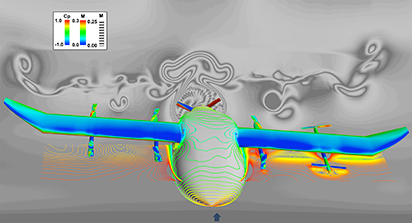
Since instabilities such as Dutch-Roll oscillations can occur due to unexpected gusts during cruise, it is not practical to pre-design the vehicle for all instability scenarios. To design an optimal control mechanism that can respond to the complex flows over air taxis with multiple propellers, it is essential to use the Navier-Stokes (NS) based computational fluid dynamics (CFD) codes, coupled with stability equations of motion. Simulations using the NS equations are only feasible with the use of supercomputers.
Active control mechanisms to suppress oscillations leading to instabilities are already in use for aircraft by activating existing components like control surfaces, including ailerons, elevators, and rudders. However, for eVTOL vehicles, propellers are placed close to the leading and trailing edges, and they do not have control surfaces; and adding control surfaces to wings is not practical due to the presence of pods to hold multiple propellers.
Design costs can be significantly reduced with high fidelity modeling of flows by using the Navier Stokes equations and reducing amount of wind tunnel test cases. High-performance computers like those at NAS facilitate the use of high-fidelity flow models.
This work represents a new procedure to suppress gust-induced oscillations using existing lifting propellers on air taxis. Since flight conditions often involve time-dependent transient cases, a time-accurate simulation is needed. In this effort, a new active control module has been added to NASA’s CFD software, OVERFLOW. The module activates control mechanisms by sensing the wing displacement and rotating the selected out-board lifting propellers. RUNDUA, a dual-level protocol based on a script in the Portable Batch System (PBS) job scheduler used at the NASA Advanced Supercomputing (NAS) facility, facilitates automatic running of multiple cases.
Results and Impact
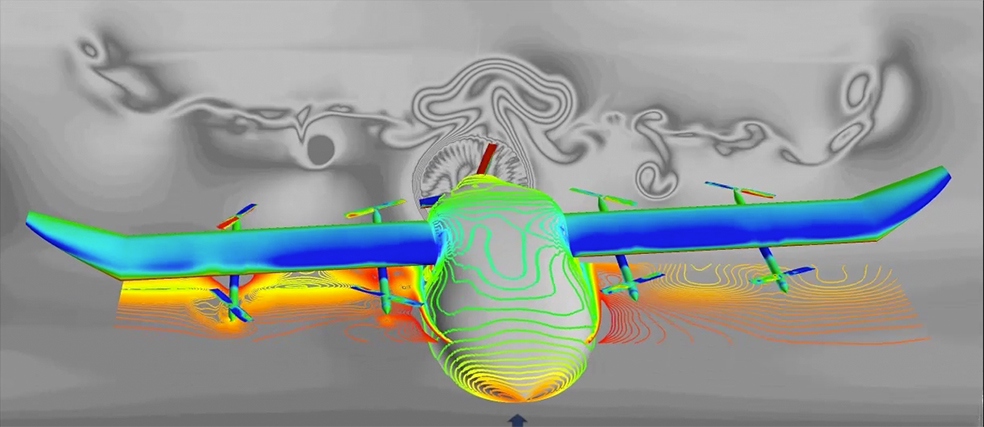
Simulation results for a typical lift + cruise air taxi with eight lifting propellers and one pushing propeller demonstrate active controls of Dutch-Roll oscillations due to sudden gusts. Once the oscillations start, the control mechanism is activated. The outward propellers on the wing that is moving in the downward direction are activated to generate counter moment to suppress oscillations. The rotating speed of activated propellers is a function of amplitude of the wing downward motion.This process is alternated between the left and right wings until oscillations are suppressed. The successful simulation of the active control mechanism in OVERFLOW demonstrates a new computational tool for NASA AAMV projects.
Why HPC Matters
Each simulation required 6,400 processor hours on the NAS facility’s Pleiades supercomputer and completed within 80 hours of wall-clock time using 80 processors, generating six terabytes of data for preparing scientific visualization videos. With the use of the RUNDUA protocol, about 100 simulations can be completed in approximately 90 hours of wall-clock time using 8,000 cores on Pleiades.
What's Next
NASA also plans to study oscillations induced by aerodynamic disturbances that occur when air taxis fly close to tall buildings in an urban environment. For a complete design of the active control system, several hundred simulations are needed. Timely generation of a database for design iterations is feasible only with the use of supercomputers such as those available at the NAS facility.
More Information
- Active Control of Dutch-Roll Oscillations of eVTOL
- Dutch-Roll Stability Analysis of an Air Mobility Vehicle Using Navier-Stokes Equations
- Dual Level Parallel Computations for Large Scale High-Fidelity Database to Design Aerospace Vehicles (PDF 5.7MB)
Researcher
- Guru Guruswamy, NASA Ames Research Center Please enable Javascript to see email address.