Preparing to Map the World in Living Color with the Surface Biology and Geology Mission
Overview
In this era of unprecedented global climate change, NASA’s Earth System Observatory (ESO) program will launch the Surface Biology and Geology (SBG) mission to map the Earth in unprecedented detail starting in 2027. SBG consists of a hyperspectral visible and shortwave infrared (VSWIR) instrument and a thermal infrared (TIR) instrument to be launched on separate spacecraft—which will map our planet globally every sixteen and three days, respectively—and a constellation of small satellites with VSWIR capabilities. SBG was identified by the 2018 National Academies' Earth Science Decadal Survey, “Thriving on Our Changing Planet: A Decadal Strategy for Earth Observation from Space,” with the following observing priorities:
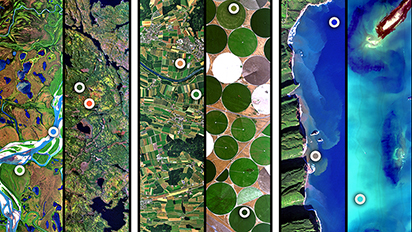
- Terrestrial vegetation physiology, functional traits, and health.
- Inland and coastal aquatic ecosystems physiology, functional traits, and health.
- Snow and ice accumulation, melting, and albedo.
- Active surface changes (eruptions, landslides, evolving landscapes, hazard risks).
- Effects of changing land use on surface energy, water, momentum, and carbon fluxes.
- Managing agriculture, natural habitats, water use/quality, and urban development.
With great opportunities come great challenges: SBG is expected to collect 10-15 terabytes (TB) of data on a daily basis—equivalent to streaming 2,000 to 3,000 Netflix movies per day—and will generate up to 75 TB of data products per day.
Project Details
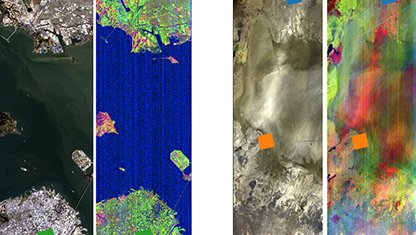
Processing this much data to obtain science-ready results requires considerable computational resources. To meet the challenge, researchers the NASA Advanced Supercomputing Division are working with NASA Earth Exchange (NEX) scientists to develop hybrid high performance computing (HPC)-cloud computing frameworks, as part of SBG’s Space-based Imaging Spectroscopy and Thermal pathfindER (SISTER) study, which is led by NASA's Jet Propulsion Laboratory in collaboration with Ames Research Center and Goddard Space Flight Center. Ames' pathfinder pipeline concept is based on the pipeline control infrastructure, called “Ziggy,” which was developed for NASA's Kepler and Transiting Exoplanet Survey Satellite (TESS) missions to detect exoplanets orbiting Sun-like stars in the solar neighborhood.
It’s important to assess the scalability of the candidate science algorithms and the pipeline infrastructure when contemplating the enormous dataset SBG is designed to acquire. As a first step, we are implementing a science data pipeline to reprocess the 55-TB Hyperion hyperspectral dataset from Earth Observer 1 (EO-1) mission as a proxy for future SBG data. This will help us to understand SBG's needs and develop the science data system. As an added benefit, the reprocessed Hyperion data will be distributed to the Earth sciences community for research use.
A full year of synthetic SBG data has been generated and is available on the NAS Data Portal. These datasets will be distributed to the science community to help them prepare their analytic software codes for future SBG data.
Ames is also participating in the Modeling End-To-End Traceability for SBG (MEET-SBG) Study, and NEX has developed the capabiilty to generate synthetic full-volume hyperspectral datasets. These datasets will also be used in prototyping the science data system for SBG and to support the Earth sciences community as they develop algorithms to mine the huge dataset that SBG promises to deliver.
Results and Impact
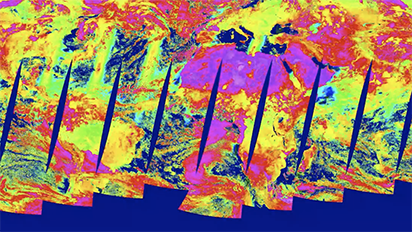
Currently, we are processing the Hyperion dataset from raw images to level 1 (top of the atmosphere radiances), and are developing the second stage of processing to correct for atmospheric effects in order to obtain level 2 data (surface reflectance data across the wavelengths observed by Hyperion). The level 2 data represents the primary global dataset for detailed analysis and study by higher-level algorithms contributed by the science community to investigate various ecosystems, waterways and minerology. A full year of synthetic SBG data has been generated and is available on the NAS data portal. These datasets will be distributed to the science community to allow them to prepare their analytic software codes for future SBG data.
Why HPC Matters
Processing such a large stream of data such as that expected for SBG is no mean feat and while cloud resources will be utilized extensively for processing and distribution of SBG data products, NASA’s HPC resources offer tremendous computational capabilities at no direct cost and can be leveraged to significantly reduce the costs associated with processing such large datasets.
What's Next
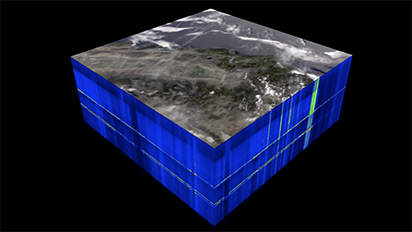
We plan to reprocess the Hyperion data to obtain surface reflectance as a function of time, position, and wavelength in early 2022. We will then prototype additional workflows to leverage the reflectance data to study terrestrial vegetation traits, aquatic scenes, snow and ice properties, and geology. Meanwhile, SBG is headed to Mission Confirmation Review in the spring of 2022.
More Information
- NASA’s Surface Biology and Geology
- Surface Biology and Geology Study
- Thriving on our Planet: A Decadal Strategy for Earth Observations from Space
- NASA Ames Global Hyperspectral Synthetic Data
Researchers
- Jon Jenkins, NASA Ames Research Center Please enable Javascript to see email address.
- Andy Michaelis, NASA Ames Research Center Please enable Javascript to see email address.
- Yohei Shinozuka, Bay Area Environmental Research Institute Please enable Javascript to see email address.
- Weile Wang, NASA Ames Research Center Please enable Javascript to see email address.