Modeling a Young Sun’s Role in Lunar Ice and Hematite Deposits
Overview
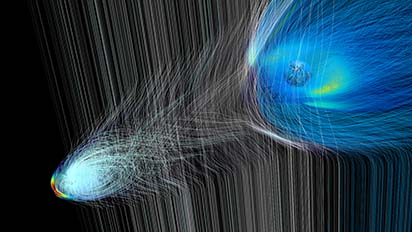
After decades of study, it has been confirmed that water is present on the surface of the Moon, with the majority of it being concentrated at the polar regions. A similar trend in evidence has been found for the mineral hematite, which is concentrated exclusively at the polar caps, leading researchers to wonder what physical mechanisms are responsible for this distinct latitudinal gradient. In this work, we carry out the first 3D multifluid magnetohydrodynamic (MF-MHD) simulations to investigate how frequent superstorms from an active young Sun and the intertwined magnetic field of the ancient Earth-Moon system created a synergistic effect that caused the polar surface to be bombarded by high fluxes of solar superstorm protons and oxygen ions derived from Earth's atmosphere. Our results provide a likely explanation for the observed distribution of water and hematite on the Moon in ways that are readily testable via laboratory analyses of lunar samples by future NASA missions.
Project Details
Access to these resources make it possible to perform the large and complex Sun-Earth-Moon models required for this work, with each run using 52,000 cores on the Pleiades or Electra supercomputers.
While water has been detected on the Moon via remote sensing and sample analysis, tracing the origin of lunar water has proven to be challenging. Several sources have been proposed, ranging from interior water to hydrated impactors and solar wind implantation. In addition to the fact that water is found mostly at the lunar poles, hematite—a common oxidization product on Earth, Mars, and some asteroids—is also observed exclusively near the polar regions and has been hypothesized to stem from enhanced oxidizing conditions at these locations by oxygen ions from Earth's atmosphere.
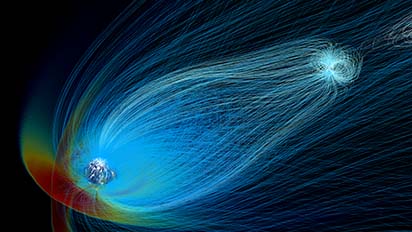
Using the Block-Adaptive-Tree Solarwind Roe-type Upwind Scheme (BATS-R-US) MF-MHD model developed at the Center for Space Environment Modeling, we simulate the interaction between a solar superstorm and the Earth-Moon magnetic field to better understand the formation of lunar polar ice and hematite and to determine the associated proton and ionospheric heavy oxygen ion fluxes falling on the lunar surface. The model contains a self-consistent ionosphere and the associated photochemistry, such as photoionization, electron impact ionization, charge exchange, and electron recombination. Given the young Sun was very magnetically active, we focus on producing the first 3D MF-MHD simulations of the entire magnetized Earth-Moon during an extreme “Carrington-type” space weather event—also known as a solar superstorm.
Results and Impact
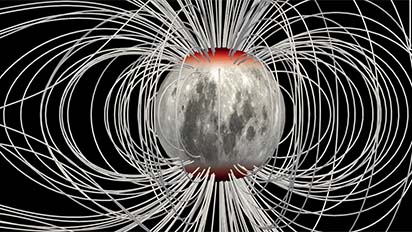
Our simulation results highlighted how the magnetic field configuration of the ancient Earth and Moon, in combination with a volatile young Sun, could have naturally caused the lunar surface to be bombarded by a copious amount of solar storm protons and Earth ionospheric oxygen ions, especially at the poles, leading to the large deposits of water and oxidization-derived hematite, It has been long believed that the Sun plays a role in controlling water formation and distribution in the inner solar system, and the Moon acts as an ideal natural laboratory for studying solar wind implantation given its lack of an atmosphere. It is important to simulate solar proton and Earth wind (terrestrial ionospheric outflow) fluxes on the lunar surface over time for comparison with remote sensing data—an undertaking that could revolutionize our understanding of the origin of volatile compounds such as water on planetary bodies within the inner solar system, and enhance the science return on past and future lunar missions.
Why HPC Matters
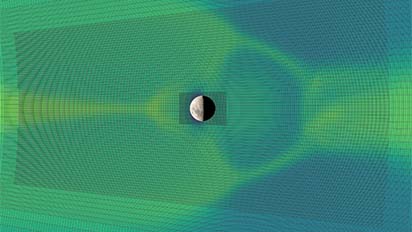
In order to run these first-of-their-kind 3D high-resolution MF-MHD simulations of the entire Earth-Moon system, we utilized the high-performance computing resources at the NASA Advanced Supercomputing (NAS) facility at NASA’s Ames Research Center in Silicon Valley. Access to these resources make it possible to perform the large and complex Sun-Earth-Moon models required for this work, with each run using 52,000 cores on the Pleiades or Electra supercomputers.
What's Next
Future simulations will include adding isotopes to Earth’s upper atmosphere in order to study their transport and implantation to the lunar surface. These results will be testable via laboratory isotopic analyses of lunar samples returned by future NASA lunar missions.
More Information
- Moon’s Polar Ice and Hematite: A Consequence of Ancient Lunar Dynamo (PDF)
Researchers
- Chuanfei Dong, Princeton University Please enable Javascript to see email address.
- Liang Wang, Princeton University Please enable Javascript to see email address.
- James Green, NASA Headquarters Please enable Javascript to see email address.
- David Draper, NASA Headquarters Please enable Javascript to see email address.