NASA Studies Snowflake Melting to Improve Storm System Models
Overview
NASA Center for Climate Simulation (NCCS) supercomputers are being used in an ongoing effort to produce accurate simulations of melting snowflakes. Such simulations can become components in weather models that predict the severity and amount of precipitation from storms. These capabilities are critical for disaster mitigation (e.g., flooding), agriculture (e.g., drought monitoring), and other applications. One outstanding modeling challenge is the generation of partially melted snowflakes, which is an important step in modeling the melting layer in rainstorms.
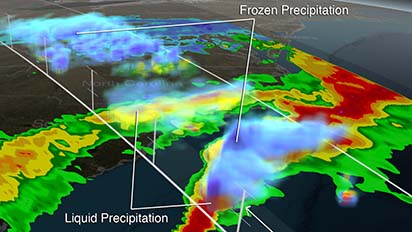
Models work in concert with NASA’s ground and spaceborne instruments including those from the NASA-JAXA Global Precipitation Measurement (GPM) Mission. This international network of satellites uses active and passive radar to measure precipitation and provide rain and snowfall estimates across the globe. Data from GPM and other satellites are assimilated into NASA weather and climate models toward the aim of producing more accurate forecasts.
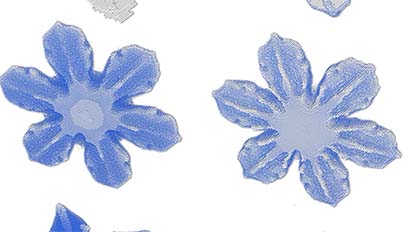
NASA’s storm system models must represent hydrometeors of various types and shapes as well as snowflake melting. While raindrops are simple and can be modeled as spheroids, snowflakes are more complex. Researchers have developed methods to synthetically generate snowflakes, and these collections are stored in databases including the NASA Snow Particle and Scattering Property (NASA OpenSSP) database.
Project Details
Storms involve a range of hydrometeors, which can be frozen, such as snowflakes; partially melted; or all melted, as in raindrops. The melting layer lies at the top of the rainstorm system, where temperatures transition from below to above freezing, and contains snowflakes at different stages of melting. The distribution of water within the snowflakes at various melting stages changes the radiative properties observed by spaceborne instruments.
NASA’s storm system models must represent hydrometeors of various types and shapes as well as snowflake melting. While raindrops are simple and can be modeled as spheroids, snowflakes are more complex. Researchers have developed methods to synthetically generate snowflakes, and these collections are stored in databases including the NASA Snow Particle and Scattering Property (NASA OpenSSP) database. In this work, we developed a method to simulate snowflake melting using snowflakes in this database.
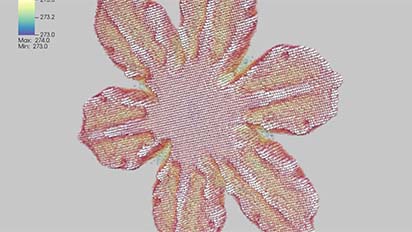
Simulating snowflake melting requires modeling complex microphysics—both thermal and fluid dynamics as well as cohesive and adhesive forces. We deploy a Meshless-Lagrangian approach known as smoothed-particle hydrodynamics (SPH). In SPH, a snowflake is represented by a collection of small point particles that interact with each other and exchange thermal energy. As the simulation progresses, SPH particles change phase from ice to water, after which fluid dynamics, cohesion, and adhesions determine their motion.
We implemented this SPH approach in a C++ code called Snow Meshless Lagrangian Technique (SnowMeLT). In this phase of the project, we are validating SnowMeLT on a variety of snowflake shapes found in the OpenSSP database.
Results and Impact
In the last few years, a numerical algorithm and code has been developed that can melt synthetic snowflakes using SPH. The success of this project will be an important step in modeling the melting layer in rainstorms and advancing NASA’s Precipitation Measurement Mission.
Why HPC Matters

The SnowMeLT simulations require significant computational resources. Current simulations run on the NCCS Discover supercomputer use roughly 1 million SPH particles, need approximately 10 million timesteps, and can take a few weeks of runtime on several hundred compute cores. Increased computational efficiency and the use of hardware accelerators are both essential to the success of the project.
What's Next
The next phase of this project involves melting a sufficiently large and diverse set of snowflakes, computing their diverse radiative properties, and including those properties in storm system models to compare them with observational data. The final step is to evaluate whether our methods improve model accuracy. The ultimate goal is to provide better precipitation estimates and forecasting capabilities.
More Information
- Global Precipitation Measurement Mission
- OpenSSP Snow Particle and Scattering Property Database
- Recent Advances to the OpenSSP Particle and Scattering Database
- Towards a Mass-Consistent Methodology for Realistic Melting Hydrometeor Retrieval
Researchers
- Craig Pelissier, NASA Goddard Space Flight Center Please enable Javascript to see email address.
- William S. Olson, NASA Goddard Space Flight Center Please enable Javascript to see email address.
- Kwo-Sen Kuo, NASA Goddard Space Flight Center Please enable Javascript to see email address.
- Ian S. Adams, NASA Goddard Space Flight Center Please enable Javascript to see email address.