3D Radiative Hydrodynamics Model to Capture the Effects of Solar Rotation
Overview
Solar rotation is a driving force of the Sun’s global magnetic activity that can significantly impact Earth's space environment. The global dynamics of the Sun are characterized by differential rotation (faster rotation at the equator and slower at the poles) and meridional circulation (flow from the equator to the poles and back). High-resolution observations of the whole solar disk made by NASA’s Solar Dynamics Observatory (SDO) provide a unique opportunity to investigate solar dynamics and analyze variations in differential rotation and meridional circulation due to magnetic activity. However, understanding the physical processes behind the observed dynamics is challenging and requires modeling the solar interior and atmosphere with a degree of realism that is at the limit of current computational capabilities.
Project Details
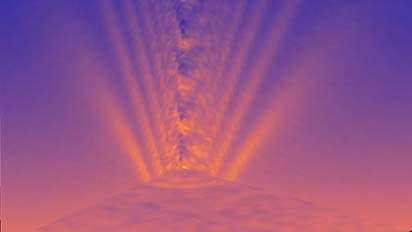
Our heliophysics team in the NASA Advanced Supercomputing (NAS) Division used available technological and computational capabilities to perform 3D radiative simulations of a patch of the solar surface located at 30 degrees latitude, with a size of 3.6 x 3.6 degrees (80,000 x 80,000 kilometers or about 50,000 miles), extending to 25,000 kilometers (km) below the solar surface. Because of the Sun’s slow rotation (approximately 2 km per second), the team produced a dataset over 100 hours long using the Pleiades supercomputer located at the NAS facility. The resulting model data was used to compute the Fe I (neutral iron) spectral line (617.3 nanometers), which is observed by the Helioseismic and Magnetic Imager (HMI) instrument on board the SDO spacecraft. These data are converted into observables such as continuum intensity, Doppler shift, and line depth at different locations on the solar disk to mimic observations by HMI. The dataset is available to the public through the online NASA Heliophysics Portal.
Access to NASA’s HPC resources allows researchers to improve their understanding of how the Sun operates through realistic modeling and synthetic observations to test new methods for analyzing observations from NASA space missions.
Results and Impact
Our 3D radiative hydrodynamics model of solar convection captures the effects of solar rotation, such as the rotational splitting of solar oscillation modes, revealing the fine structure of differential rotation and the formation of meridional flows. For the first time, the simulations revealed the formation of the leptocline—a thin, 10,000-km-deep layer where the rotation rate decreases closer to the solar surface. Studying the properties of this layer, accompanied by modeling of synthetic SDO/HMI observations, allows us to understand the role of leptocline dynamics in the emergence of solar active regions, and to improve the capability to detect those active regions that are most dangerous to Earth due to their impacts on space weather.
Why HPC Matters
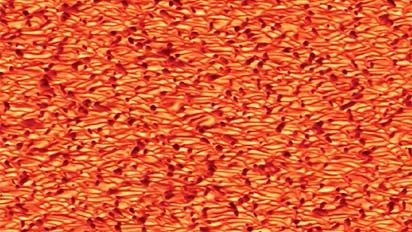
The high-performance computing and data storage resources at the NAS facility, accompanied by exceptional work from the NAS Division support teams, enable us to perform these high-resolution simulations of rotational effects in the Sun’s subsurface and atmosphere. This work was primarily performed on NASA’s Pleiades supercomputer. The raw dataset requires 160 terabytes of storage and took about 3 million processor-hours to create.
What's Next
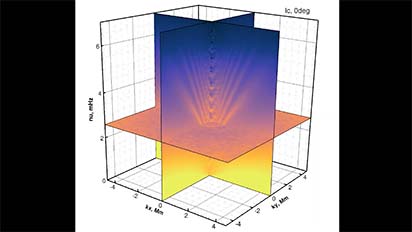
The results of this work will be applied to improve the existing methodology of helioseismology in order to more precisely measure the dynamics of subsurface flows from SDO mission data. Next steps include studying the solar interior dynamics in the presence of magnetic fields to understand the formation of highly magnetized magnetic structures in the leptocline and how these processes are reflected in observations.
More Information
Researchers
- Irina Kitiashvili, NASA Ames Research Center Please enable Javascript to see email address.
- Alan Wray, NASA Ames Research Center Please enable Javascript to see email address.
- Alexander Kosovichev, New Jersey Institute of Technology Please enable Javascript to see email address.
- Viacheslav Sadykov, Georgia State University Please enable Javascript to see email address.