CFD Analysis of Mars Retrorocket Wind Tunnel Models
Overview
For human exploration missions to Mars, supersonic retro-propulsion (SRP) represents a promising technique to slow down a spacecraft during the atmospheric descent phase. The SRP maneuver involves using multiple retrorocket engines at supersonic descent conditions, rather than using a large parachute, as has previously been done for smaller uncrewed Mars landers. Researchers at NASA’s Langley Research Center are preparing for an SRP test in the Langley Unitary Plan Wind Tunnel (UPWT) in 2022 in order to quantify the SRP prediction capabilities of multiple computational fluid dynamics (CFD) solvers for a range of vehicle configurations, thrust magnitudes, and tunnel conditions. The models will have up to eight nozzles blowing high-pressure air to serve as rocket engine simulants. The team’s CFD analysis at wind tunnel test conditions will provide uncertainty quantification (UQ) of high-fidelity CFD solvers for SRP in a wind tunnel environment.
Project Details

The Langley team’s CFD analysis plan was designed to have solutions completed for a range of tunnel conditions prior to the observational wind tunnel test, including low/medium/high tunnel Mach numbers, low/medium/high model thrust levels, low/medium/high model attitudes, and six different nozzle designs. Data will be collected during the test to examine the effects of each parameter on the observed results: model surface pressure, high-speed video of the jet plumes, and measured forces on the model. Once the wind tunnel test is completed and the conditions are known, CFD analysis will resume so that direct comparisons to the test data can be made.
Almost all CFD analysis to date has been conducted on NASA Advanced Supercomputing (NAS) facility resources at Ames Research Center. The wind tunnel models and test effort are funded by the NASA Aeroscience Evaluation and Test Capabilities office in the Aeronautics Research Mission Directorate. NASA’s Space Technology Mission Directorate is funding the CFD and UQ analysis.
Results and Impact
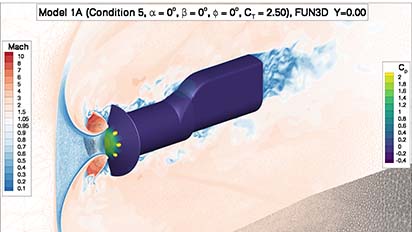
At expected test conditions, all CFD solvers used in this effort predict that the wind tunnel models will always have unsteady plumes from the simulated rockets, with the level of unsteadiness decreasing with higher thrust. Additionally, all solvers predict that the jet plumes partially shield the wind tunnel model at lower thrust levels and completely shield the model once thrust reaches a level near the maximum possible value for the planned test conditions.
The information generated during the CFD and testing process will be used to:
- Establish best practices for modeling SRP flow fields using CFD methods.
- Inform the planning of future SRP wind tunnel tests with improved testing and measurement methods.
- Compare the total required resources required to execute the wind tunnel test and the CFD simulations.
- Form the basis for uncertainty estimation of CFD methods at Mars SRP flight conditions.
Why HPC Matters
In 2021, CFD analysts have used over 30 million processor-hours to complete over 300 solutions on the Aitken, Electra, and Pleiades supercomputers. Each solution typically required computational meshes with tens to hundreds of millions of grid points and thousands of processor-hours, since the SRP problem is almost always an unsteady fluid dynamics problem. Most of these simulations could not be executed on other NASA resources due to their large memory requirements.
What's Next
The wind tunnel test and comparisons with CFD results will be completed in 2022. The test data will include discrete steady pressures on the model surface, high-speed schlieren videos, and direct force and moment measurements using a flow-through balance. The exercise will be used to plan future SRP wind tunnel tests with improved testing and measurement methods, and to compare the total amount of resources required to execute the wind tunnel test and the CFD simulations. Comparisons between the CFD results and test data will form the basis for understanding how accurately and efficiently CFD methods can predict future Mars SRP vehicle performance.
More Information
Researchers
- Karl Edquist, NASA Langley Research Center Please enable Javascript to see email address.