Active Flow Control for Enhancing High-Lift Wing Performance
Overview
Because transonic aircraft must operate efficiently over a wide range of airspeeds and altitudes, designing wings for these vehicles is challenging. While wings are designed primarily for cruise efficiency, as airplanes spend most of their flight time in the cruise phase, additional lift is needed at lower airspeeds during takeoff and landing in order to keep runways short and keep airport infrastructure costs low. Traditionally, additional lift is obtained using a high-lift system that mechanically deploys additional airfoil elements such as flaps. These high-lift systems have a significant impact on airplane size, cost, and safety. Studies have shown that small improvements in high-lift system performance can have a significant effect on an airplane’s weight, and thus on its payload and/or range.
NASA’s Advanced Air Transportation Technology (AATT) Project is seeking innovative approaches to increase high-lift performance in order to reduce fuel burn without sacrificing aerodynamic performance during cruise. One possible solution is to use an Active Flow Control (AFC) system that could provide the required lift and lift-to-drag ratio at take-off, landing, and engine-out conditions in lieu of deploying flaps. In this project, AFC devices called microjets are studied. Microjets blow air normal to the flap’s trailing edge surface to rapidly change aerodynamic characteristics without conventional mechanical flaps.
Project Details
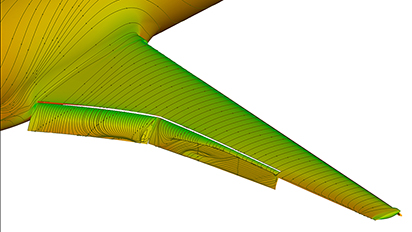
A multi-year computational and experimental study by a team of researchers at NASA’s Ames Research Center and the University of California, Davis was conducted to design and test surface-normal pneumatic circulation control AFC—also known as microjets. Initially, microjets were implemented on the lower-surface, near-flap trailing edge of multi-element airfoils using two-dimensional computations. Using the OVERFLOW flow solver, the team studied the effects of microjet characteristics such as location, exit width, momentum coefficient, mass flow, and continuous vs. pulsed blowing to assess lift and lift-to-drag enhancement potential at a range of flow conditions. These parametric studies were extended to the high-lift Common Research Model (CRM-HL) in three dimensions to identify the most promising microjet configurations. The team has also conducted experiments in the Orans W. Nicks Low-Speed Wind Tunnel at Texas A&M University to validate the computational results and begin to gain understanding of system requirements of microjet implementation.
Having access to NAS HPC systems has played an essential role in this effort, enabling us to revisit some studies from the past to understand them better and also to advance technologies that can help meet NASA’s goal of improving aircraft efficiency.
Results and Impact
Computational solutions were obtained for configurations with and without subsonic microjets, with relatively small momentum coefficients. The linear regime of the lift curve was investigated over a broad range of angles of attack, Reynolds numbers, and Mach numbers. A few encouraging microjet trends were obtained regardless of configuration and flow conditions, confirming their potential in enhancing lift and lift-to-drag ratio. These trends included a lift enhancement relationship as a function of microjet momentum coefficient, mitigation capability of moderate trailing edge flow separation, and form drag reduction. Experimental results to date are also in general agreement with the numerical findings. This work confirms that microjets can produce significant changes in aerodynamic characteristics, encouraging more research and development.
Why HPC Matters
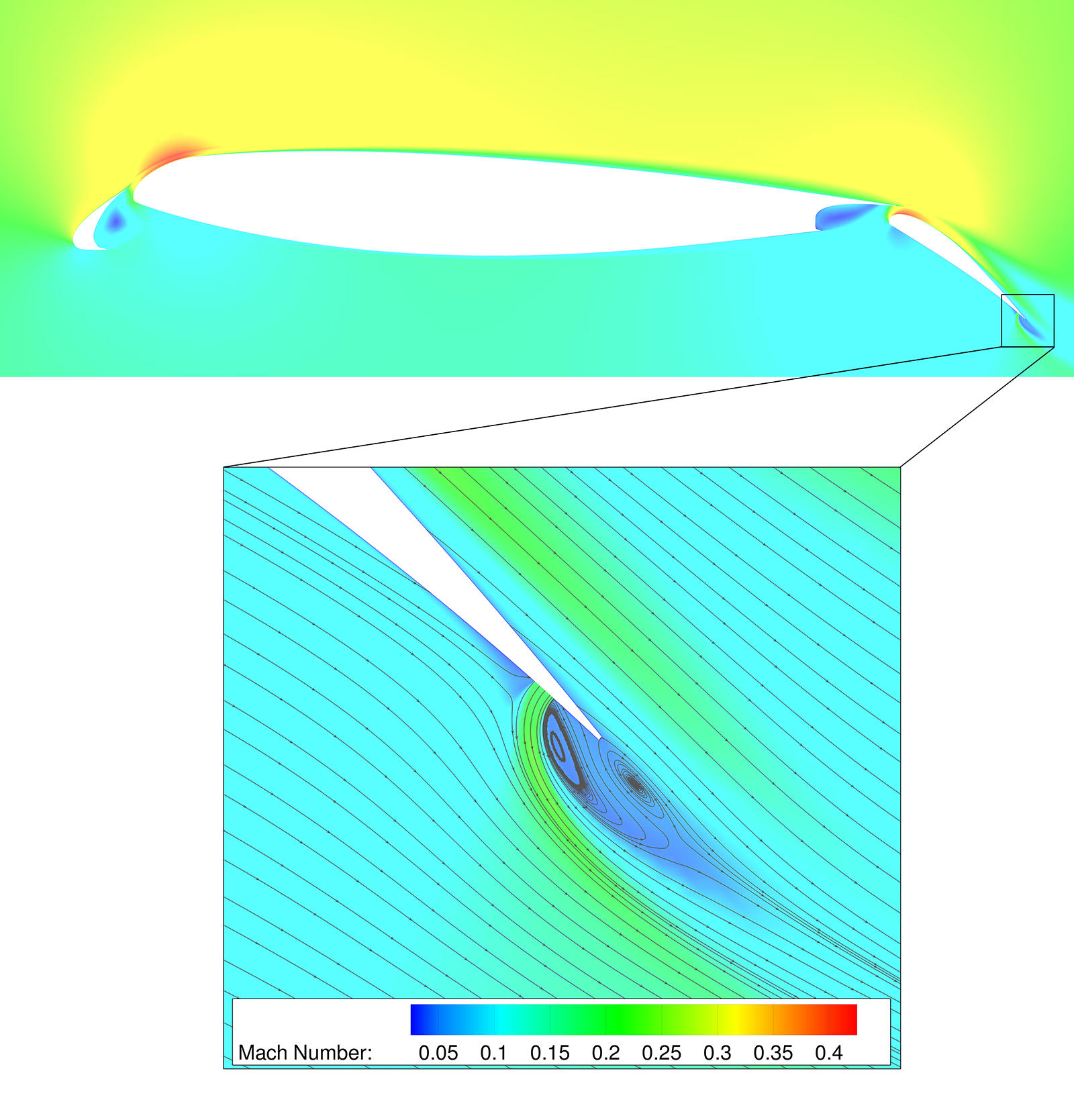
The microjet studies required high-fidelity, time-accurate simulations utilizing nearly three million core-hours on computing resources at the NASA Advanced Supercomputing (NAS) facility. Although surface-normal blowing for airplane lift enhancement was initially studied experimentally about 60 years ago, due to the lack of sufficient computational capabilities researchers could not explain the experimental results, and the topic was not actively studied until this project. Having access to high-performance computing systems such as the ones at the NAS facility has played an essential role in this effort, enabling us to not only revisit some of the studies from the past to understand them better but also to advance this technology that can help meet NASA’s goal of improving aircraft efficiency.
What's Next
As work continues, the team plans to conduct computational and experimental studies on CRM-HL configuration with various flap deflection settings. These studies are required to assess the potential benefits of microjets during takeoff and landing to meet AATT project goals in the coming years.
Researchers
- Seyedeh Sheida Hosseini, NASA Ames Research Center Please enable Javascript to see email address.
- Shishir Pandya, NASA Ames Research Center Please enable Javascript to see email address.
- C. P. van Dam, University of California, Davis Please enable Javascript to see email address.