Protoplanetary Disk Simulations from Large to Small Scales
Overview
Kepler and Transiting Exoplanet Survey Satellite missions, has brought a new perspective on Earth’s place in the universe. Many of these planets are strange, exotic worlds, with compositions and orbits unlike those seen in our solar system. In order to better characterize them, we’re utilizing computational simulations to understand how these planets form, from natal disk material around protostars to kilometer-sized planetesimals. Our investigations at all scales of the planet formation process—the initial size distribution of the grains, how the grains collect together, and the evolution of the protoplanetary disk as a whole—are relevant to major asteroid efforts currently underway at NASA’s Jet Propulsion Laboratory, as well as many other NASA astrophysics missions.
Project Details
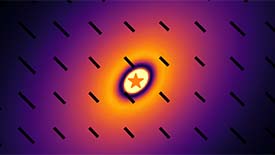
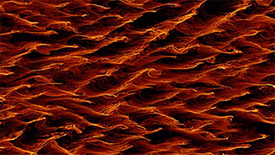
To study how grains congregate into planetesimals, we use computer simulations with particle mesh methods to examine the streaming instability. Similar to the effect of slipstreaming or drafting, the streaming instability is a robust, aerodynamic mechanism that concentrates dust in gaseous protoplanetary disks and overcomes planetesimal formation barriers. We use the astrophysical magnetohydrodynamics code ATHENA++ to explore the formation efficiency of planetesimals and dominant component pebbles—generating some of the most realistic dust-gas simulations to date.
Protoplanetary disks evolve over time, depending on the environment provided by its host star. In particular, disks around multi-star systems can form “Tatooine worlds” such as Kepler-16b, but they also pose a unique environment for planet formation due to the gravitational forces from multiple stars. Using ATHENA++, we can model how disk material evolves around binary star systems at lower viscosities than have previously been simulated.
We use observations of protoplanetary disks to infer grain sizes, since grain properties determine how the dust radiates—that is, how the dust absorbs, emits, and scatters starlight, which affects what we see from Earth. By combining multi-wavelength observations of continuum and polarized emissions, we can infer dust grain sizes present in the disk, which allows us to realistically constrain our initial conditions for simulating planetesimal formation via the streaming instability.
Access to HPC allows us to efficiently parallelize hundreds of radiative transfer calculations in weeks instead of months, and to trigger and resolve the turbulent and stochastic effects of the streaming instability’s dust-gas dynamics in illuminating detail.
Results and Impact
At large scales, our simulations are able to capture the dynamics of the disk, including a phenomenon that showed a protoplanetary disk can align itself in an orbit perpendicular to those of its host binary stars under certain conditions. Our simulations also show that the gravitational force from the stars sends ripples through the disk, causing it to twist, warp, and sometimes break into pieces.
At smaller scales, we studied the process of grain growth and planetesimal formation, including reproducing several different observations that showed the dust grain should be either very small (less than 100 micrometers) or moderately porous. For example, a grain’s composition can be as low as 30% by volume of water ice, silicates, and organics; the rest is empty space. Other disk sizes and ages prefer larger grains (millimeter to centimeter in size), so the dust grains in protoplanetary disks are likely to be moderately porous. These inferences help constrain the streaming instability’s initial conditions in forming planetesimals, improving the model’s agreement with observational data.
Why HPC Matters
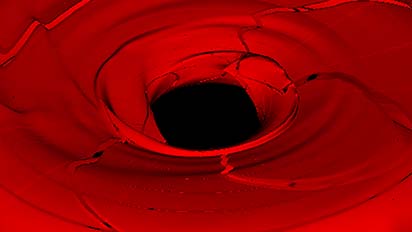
In order to accurately simulate protoplanetary disk evolution at the highest resolutions, we use millions of high-performance computing (HPC) hours, parallelized across thousands of processors on the Pleiades and Electra systems at the NASA Advanced Supercomputing facility at NASA’s Ames Research Center. Access to HPC allows us to efficiently parallelize hundreds of radiative transfer calculations in weeks instead of months, and to trigger and resolve the turbulent and stochastic effects of the streaming instability’s dust-gas dynamics in illuminating detail.
What's Next
By comparing our warped protoplanetary disk simulations with observations, including triple-star systems like GW Orionis in the Orion constellation, we may discover important physical processes missing from ultramodern numerical models. It is becoming apparent from NASA’s Kepler and K2 star surveys that misaligned disk cases are common, so future work will aim to computationally couple stellar radiation with hydrodynamics in order to properly study how an inner disk’s shadow cast on the outer disk affects formation.
More Information
Researchers
- Shangjia Zhang, University of Nevada, Las Vegas Please enable Javascript to see email address.
- Ian Rabago, University of Nevada, Las Vegas Please enable Javascript to see email address.
- Stanley A. Baronett, University of Nevada, Las Vegas Please enable Javascript to see email address.
- Chao-Chin Yang, University of Nevada, Las Vegas Please enable Javascript to see email address.