Simulating Supersonic Parachute Inflation for Mars Landing
Overview

Every robotic mission to the Martian surface begins with a capsule entering the atmosphere at hypersonic speeds. The shape of the capsule generates enough aerodynamic drag to slow itself down to about two times the speed of sound, but a large parachute is still needed to slow it down to a speed suitable for landing. This 65-foot diameter parachute, which is only three-thousandths of an inch thick, opens up in under half a second to an aerodynamic load over thirty-thousand pounds. The inflation process of these parachutes in supersonic conditions is a challenging problem that has seen decades of flight tests and wind tunnel tests starting in the 1960s. NASA is currently developing efficient numerical methods utilizing modern high-performance computing systems to simulate supersonic parachute inflation in order to reduce the reliance of parachute design on expensive flight tests, while increasing mission confidence by simulating a parachute’s performance in a wide-range of environments and possible entry trajectories.
Project Details
NASA’s Entry Systems Modeling project tasked the Launch Ascent and Vehicle Aerodynamics (LAVA) team in the NASA Advanced Supercomputing (NAS) Division with assessing the agency’s modeling and simulation capability for supersonic parachute inflation relevant for Mars entry, descent, and landing systems. The physics of supersonic parachute inflation demand very efficient and accurate computational fluid dynamics (CFD) methods in order to simulate a number of complicating factors, including unsteady, turbulent wakes; wake-bow shock interaction; and supersonic jet flow through orifices in the parachute. However, the motion and deformation of the parachute body also needs to be factored into the simulation, since the fluid dynamics induces a structural response in the parachute, which, in turn, affects the fluid dynamics. This is known as fluid-structure interaction (FSI).
Using optimized compilers and libraries on NASA supercomputing systems, the codes developed by the LAVA team can solve for hundreds of millions of degrees-of-freedom in the fluid and structural domains, and perform geometry queries and ray casting on a few million triangles composing the problem geometry very quickly.
For this project, the flow physics are simulated using the LAVA-Cartesian CFD solver, and the structural dynamics of the parachute are captured by coupling it with the LAVA-Structural solver, which uses shell and cable finite element formulations to solve for the motion and deformation of the parachute. The two solvers interact through the exchange of loads and displacements at their shared boundary (the surface of the parachute). To validate the solvers’ accuracy, the team simulated flight tests involving parachutes inflating in supersonic conditions, where certain quantities, such as the peak opening load, are compared with the values from experimental flight tests. Agreement between simulated and experimental values ensures that the tools are accurate and can be used by engineers for parachute design and analysis.
Results and Impact
The coupled LAVA solvers have been used to simulate a flight test for the agency’s Advanced Supersonic Parachute Inflation Research Experiments (ASPIRE) and display good agreement with the test in terms of the peak opening load, delivering an FSI solution with a hybrid MPI-OpenMP parallelization strategy. Both solvers display strong scaling characteristics, enabling the simulation of very large FSI problems. Modules have also been developed that simulate the permeability of the parachute broadcloth, and effectively model the complex contact mechanics present in the folding/rolling of soft goods, such as parachute fabric.
With further validation and verification, the ability to simulate supersonic parachute inflation can be used in the parachute design process and pre-flight qualification of new parachutes, reducing the reliance on expensive flight tests. Additionally, certain fine-scale details can be extracted from simulations that are difficult to record during flight tests, such as the timing, location, and magnitude of the maximum fabric stress—information that can be used to determine when and where a parachute may fail during a real-world mission.
Why HPC Matters
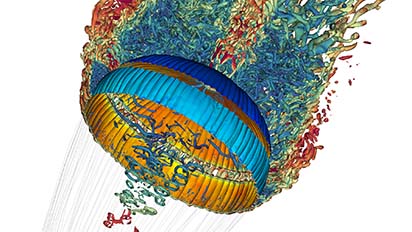
Without high-performance computing clusters, such as the Pleiades and Aitken supercomputers at the NAS facility, these simulations would not be possible. Using optimized compilers and libraries on these systems, the codes developed by the LAVA team can solve for hundreds of millions of degrees-of-freedom in the fluid and structural domains, and perform geometry queries and ray casting on a few million triangles composing the problem geometry very quickly. A typical simulation uses 2,560 Cascade Lake cores and runs for about a week, corresponding to about 0.5 seconds of simulation time. This generates a few dozen terabytes of data per run, which can be visualized and analyzed using NAS visualization software. During a parametric study, a few hundred terabytes of data may be generated, and tens of thousands of cores are required.
What's Next
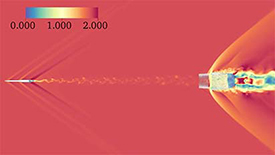
Of the many factors affecting turnaround time, some of the most important may be load balancing and parallel scalability. For these moving body problems, the parachute moves through partitioned volumes of space. More effective dynamic load balancing will ensure that the workload is automatically redistributed throughout the simulation, reducing the wait time during parallel communication. Parallel scalability will also be improved by minimizing and optimizing the parallel communication itself. In addition to these computational improvements, more physical phenomena can be included in the simulations to better represent real-world flights by considering the effect of the suspension lines on the flow field, the deceleration of the capsule and canopy, and more representative soft good material models.
Researchers
-
Jonathan Boustani, NASA Ames Research Center
Please enable Javascript to see email address. - Francois Cadieux, NASA Ames Research Center Please enable Javascript to see email address.
- Michael F. Barad, NASA Ames Research Center Please enable Javascript to see email address.
- Cetin C. Kiris, NASA Ames Research Center Please enable Javascript to see email address.