Preparing the X-59 Quiet Supersonic Transport Aircraft for Flight
Overview
NASA’s X-59 Quiet Supersonic Transport (QueSST), an advanced low-boom aircraft concept developed to emulate and test the noise generated by future supersonic transport vehicles, will be used to perform community response testing across a variety of environments and locations to build a database of noise levels and acceptibility metrics. The Federal Aviation Administration (FAA) and International Civil Aviation Organization (ICAO) will use this database to set noise level requirements for supersonic flight over land, which is currently banned due to the nuisance caused by sonic booms.
The most critical requirement of the X‑59 is that it must fly at supersonic speed without creating an objectionable sonic boom on the ground. Furthermore, it must be able to fly at a target loudness level across a wide range of locations and atmospheric conditions. To achieve this, NASA’s Commercial Supersonic Technologies (CST) project is developing new flight planning software that will tell pilots how to fly the aircraft to achieve a target loudness level. Researchers at NASA’s Ames Research Center are using the agency’s Cart3D and Launch Ascent and Vehicle Aerodynamics (LAVA) flow solvers to build a database of thousands of high-fidelity computational fluid dynamics (CFD) simulations that will be used as the basis for developing the flight planning tool.
Project Details
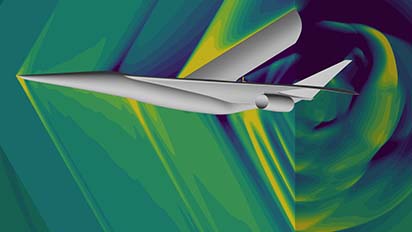
Creating the database requires thousands of complex simulations with hundreds of millions of degrees of freedom, each requiring thousands of processor hours to complete. To help reduce the computational resources needed for these simulations—and thereby reduce the cost of developing the flight planning tool—the LAVA team developed a space marching technique within the LAVA framework that can be coupled to the CFD to significantly reduce the computational domain. The space marching code requires vastly fewer resources compared with CFD; coupling them together reduces the processor hours needed to compute a simulation by half.
In preparation for the X‑59 test flights, the Cart3D team developed new capabilities that address two challenges. First, the team is optimizing the aircraft’s control surfaces to mitigate the noise on the ground. The team worked with their counterparts at NASA Langley to couple the Cart3D optimization framework with the sBOOM atmospheric propagation software. This new optimization capability allows the engineering team to pick a target loudness level and automatically obtain control surface settings that achieve the specified loudness. The second challenge involves uncertainty quantification for the noise signature of the aircraft. Ideally, deviations in the noise on the ground should be small when perturbations in operating and atmospheric conditions are encountered during flight tests. In other words, the design requires a low sensitivity to perturbations in parameters such as flight Mach number, angle of attack, deflection of control surfaces, or deviations from the expected atmospheric conditions. To help address this challenge, the team coupled NASA’s Quantified Uncertainty with Error Bounds Software Toolkit (QUEST) with Cart3D, which enables characterization of the level of uncertainty in ground noise due to uncertainty in input parameters.
The improvements made within the LAVA and Cart3D frameworks will be used to help develop the advanced flight planning software for the X-59, and increase NASA’s understanding of how changes in the flight parameters affect ground-level noise.
Results and Impact
The space marching method developed by the LAVA team was shown to reduce the computational resources required to get a high-fidelity CFD solution by a factor of two. Since the method can be paired with all of NASA’s CFD codes used on this project (LAVA, Cart3D, Fun3D, and USM3D), it will lead to significant cost savings over the large database of cases required for the X‑59 and contribute toward the CST’s goal of improving agreement between different CFD solvers.
By coupling the Cart3D solver with sBOOM, the Cart3D team performed the first fully integrated design optimization of the ground level noise, which provides significant insight into the best ways to manipulate the aircraft’s control surfaces for minimum noise impact on the ground. Also, the importance of uncertainty quantification was demonstrated for validation of CFD solvers—wind tunnel data for low-boom models contains many sources of uncertainty that must be included in the simulations to properly assess model-form errors and explain experimental discrepancy.
Why HPC Matters
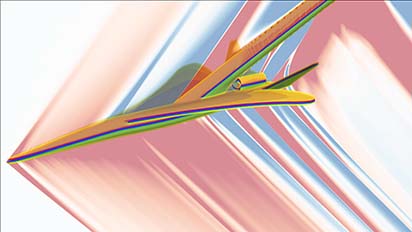
HPC is crucial for simulation-based analysis, design, and uncertainty quantification for the X-59 because all these areas require many high-cost simulations to generate high-fidelity databases. The Pleiades, Electra, Aitken, and Endeavour supercomputers at the NASA Advanced Supercomputing facility were critical for providing fast turnaround. For example, a small uncertainty quantification database for the X‑59 requires about 100 Cart3D-sBOOM simulations, with each simulation requiring 48 cores and approximately three hours of wall-clock time. A typical LAVA simulation, of the hundreds needed for the X-59 database, requires 1,500 cores and eight hours of wall-clock time.
What's Next
The improvements made within the LAVA and Cart3D frameworks will be used to help develop the advanced flight planning software currently under development for the X‑59, as well as increase NASA’s understanding of the relation between changes in the flight parameters and their effect on the ground-level noise.
More Information
Researchers
- James Jensen, NASA Ames Research Center Please enable Javascript to see email address.
- Jeffrey Housman, NASA Ames Research Center Please enable Javascript to see email address.
- Marian Nemec, NASA Ames Research Center Please enable Javascript to see email address.
- Michael Aftosmis, NASA Ames Research Center Please enable Javascript to see email address.
- Cetin Kiris, NASA Ames Research Center Please enable Javascript to see email address.