HECC: Changing to Meet NASA’s Challenges
Overview
The High-End Computing Capability (HECC) Portfolio provides a suite of powerful leading-edge tools to meet NASA's challenging mission to explore space and to understand our planet and its place within the universe. NASA's ability to maintain its premiere position in science and engineering, and provide the nation with optimal solutions to our complex problems, will be heavily impacted by how we can exploit and drive the emerging technologies in hardware and software (physics-based simulations, data analytics, machine learning, and tools) that will increase the effectiveness of our scientists and engineers.
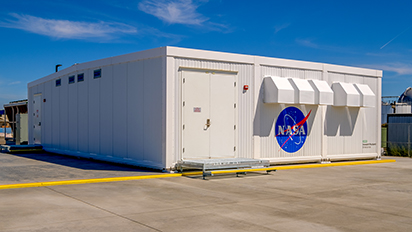
To keep pace with the agency's goals to innovatively apply and extend the most advanced capabilities and knowledge, HECC continues to strive toward providing innovative environments to conduct engineering and research activities. This includes making changes to follow the Department of Energy's (DOE) Exascale Computing Project (ECP) to “deliver exascale simulation and data science innovations and solutions to national problems.”
Project Details
HECC meets NASA's current high-performance computing (HPC) requirements by providing world-class computing architectures both on the cloud and at NASA’s Ames Research Center in California's Silicon Valley. This environment is designed to maximize the agency's return on HPC investment and services that multiply the impacts of those assets. Users have access to a suite of comprehensive, integrated services that include Supercomputing Systems, Application Optimization, Data Publication and Discovery, Visualization, Data Analytics, and Networking.
As we continue to meet the current needs of NASA, HECC will partner with academia, industry, and other government agencies to prepare for a new generation of computers and ensure that future advanced computing technologies provide suitable platforms to support NASA’s engineering and research challenges.
The path to exascale will employ GPU-accelerated nodes, and HECC has begun the difficult and time-consuming work of preparing applications for those new architectures. To stay on the forefront of physics-based simulations and data analytic workload, HECC is now preparing for the paradigm changes that will come in the exascale era and beyond. This effort involves identifying areas that currently limit simulation accuracy and/or time to solution. When other projects, such as the DOE's ECP, are doing research into solutions for these limitations, HECC will partner with the ongoing activity. In other situations, HECC will award contracts to conduct research in the areas of concern.
HECC has begun to organize its activities along the three main technical axes of the ECP organization:
- Application Development: Work with NASA mission directorates to identify their most important applications for the future, and partner with subject matter experts to upgrade the applications now to ensure they will be ready for the exascale era.
- Software Technology: Investigate approaches and packages that facilitate the porting of existing applications or the development of new ones. Work with academia and industry to exploit the power of data analytics to provide better insight into complex datasets.
- Hardware and Integration: Provide access to hardware modeled after DOE exascale systems and programming systems to support the above two areas. HECC will explore arrangements with the other government agencies to get access to their systems, cloud-based resources, or in-house pathfinding systems acquired through the New Technology component of HECC's budget; this area will also focus on evaluating how different exascale computing architectures suit NASA's HPC requirements.
Results and Impact
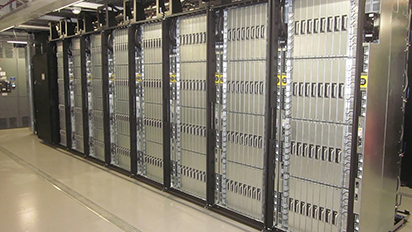
This year, we continued both our support of NASA's science and engineering teams and efforts to plan for future years. We brought online new AMD Rome nodes at our Modular Supercomputing Facility (MSF)—representing the largest single supercomputer expansion at any NASA site. In addition, we added three new filesystems; after retiring two older filesystems, the total Lustre capacity is 86.3 petabytes. Our focus is evolving to handle new workloads, as more and more programs are taking advantage of our data portal capabilities to export scientific and engineering data to a broader set of users around the globe. And several projects are combining work with resources both in the cloud and on premises to optimize their workflow.
What's Next
As we continue to meet the current needs of NASA, HECC will partner with academia, industry, and other government agencies to prepare for a new generation of computers and ensure that future advanced computing technologies provide suitable platforms to support NASA’s engineering and research challenges.
Over the next two years, HECC will install both a new compute module and a data module at the Modular Supercomputing Facility. The addition of the data module will allow HECC to perform facility maintenance on any of our facilities while still maintaining an operational state. We will also increase our storage, compute, and GPU offerings. Cloud computing will continue to be an area of growth and we will work with our users to apply the appropriate mix of services to meet their requirements.
As always, we continue working closely with our users to determine what services are needed on premises and in the cloud to best meet their high-end computing needs.
More Information
- High End Computing Capability (HECC)
- HECC Computing Environment
- HECC Services Overview
- HECC Data Portal
Researchers
- William Thigpen, NASA Ames Research Center Please enable Javascript to see email address.