Galactic Center VR: Bringing Your Neighborhood Supermassive Black Hole into Your Living Room
Overview
With its sharp X-ray vision, NASA’s Chandra X-ray Observatory (one of NASA’s Great Observatories) is ideal for peering through all the dust between Earth and the center of the Milky Way. Chandra, the only high-energy observatory able to resolve structures in the galactic center's inner parsec (approximately 3 light years across), spent nearly three months of total telescope time observing our nearest supermassive black hole (Sgr A*) and its surrounding region. These X-ray observations revealed a reservoir of gas heated to tens of millions of degrees Kelvin near the black hole. To help explain the observations, we developed and ran simulations on NASA’s Pleiades supercomputer.

To disseminate our simulation results to the public, our team developed the “Galactic Center VR” app, which allows you to explore the simulations using virtual reality (VR). VR provides an excellent method of exploring complex multi-dimensional datasets due to the ability to immerse the user within the dataset. This means that Galactic Center VR puts users inside the simulation of the Milky Way galaxy’s core, which contains a supermassive black hole, 25 orbiting stars, and their supersonic winds undergoing 500 years of evolution. The app is freely available to the public.
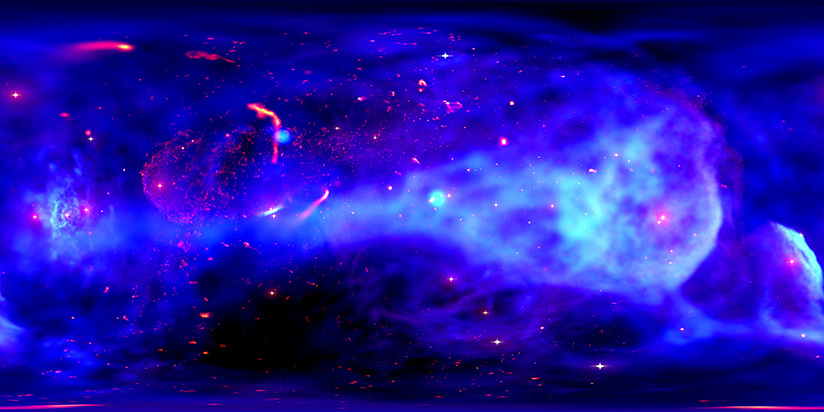
We also made 360-degree videos of the simulations for those without a PC-based VR capability. With a computer, smartphone, or stand-alone VR goggles, you can watch the simulation evolve from the perpective of the supermassive black hole; the stars orbit you, the winds collide with one another all around you, and material flows towards you due to your gravitational dominance.
Project Details
For several decades now, infrared telescopes have observed stars orbiting the supermassive black hole at the center of the Milky Way. In 2020, these observations led to the Nobel Prize in Physics for researchers from two observing teams.
The key stars included in our simulations, called Wolf-Rayet stars, are those that spew the most material into space via their stellar winds. After working backwards in time to figure out where 25 of these stars would have been over a thousand years ago, we start the simulations from this initial configuration. Once the simulation begins, these stars begin orbiting Sgr A*—the supermassive black hole weighing the equivalent of four million suns—while ejecting their stellar winds. These winds flow supersonically until they collide with one another, and the ensuing shocks create the hot gas that Chandra sees. Because all of this happens under the gravitational influence of Sgr A*, a significant portion of the ejected stellar wind material gets pulled toward the black hole.
The long-term storage solutions, the detailed knowledge base, and the excellent technical support provided by NAS experts are the proverbial “icing on the cake,” and NASA HPC will continue to be an essential player in our future work.
Once the simulations reach the present day, we validate them by computing their X-ray emission to compare directly with the Chandra observations. This includes both X-ray spectra and X-ray images.
We then created the Galactic Center VR app to disseminate the simulations in an immersive format. The app includes the black hole, all 25 stars and their orbits, all the ejected stellar winds, and the X-ray emission, which are all the key science components of the simulations. Users have the option to play forward in time, backward in time, or pause the simulation over 500 years of evolution to get an in-depth view with what is happening. The app also provides the option to see all 25 winds at once or just one wind at a time in order to see the influence of each individual stellar wind.
Results and Impact
The latest simulations are in close agreement with the Chandra observations of the region: the reservoir of hot gas is well explained by the winds from the 25 Wolf-Rayet stars orbiting the black hole. This gives us confidence that other results from the simulations that are not directly observable, such as the flow of wind material towards the black hole, are on the right track.
Our team’s public outreach efforts for these galactic center simulations have proven very popular. Two 360-degree videos, powered by NASA/Chandra press releases, have YouTube and Facebook view counts of over 1.3 million and 440 thousand, respectively, and the VR app has been downloaded in over 60 countries.
Why HPC Matters
We have used NASA’s high-performance computing (HPC) resources for 13 years, first for simulations of colliding stellar winds in massive-star binaries, and now for the 25 colliding winds in the galactic center. Currently, we use the Pleiades supercomputer at the NASA Advanced Supercomputing (NAS) facility for all our HPC needs: test simulations, production runs, and analysis tasks. We also construct our 8K 360-degree videos and reformat our output files for VR on Pleiades, making NASA HPC essential to our workflow. The long-term storage solutions, the detailed knowledge base, and the excellent technical support provided by NAS experts are the proverbial “icing on the cake.” NASA HPC will continue to be an essential player in our future work.What's Next
Our team was recently awarded funding from the Chandra program to add approximately 65 more stars and their winds to the simulations, as well as to upgrade our X-ray calculations to include the Doppler shift of the hot gas. The results should be the most complete picture to date of how the massive stars orbiting Sgr A* feed the black hole via their stellar winds—which in turn will predict what future X-ray telescopes (both NASA and others) will observe at the galactic center through improved X-ray detectors and optics.
We will also update the simulations in the Galactic Center VR app and create new 360-degree videos to share these results with the public. Once public health conditions allow, we also aim to take our VR setup to outreach events for in-person demos of Galactic Center VR.
More Information
- SC21 Virtual Presentation
- Galactic Center VR app (free download on Steam)
- Galactic Center VR app (free download on VIVEPORT)
- A New Galactic Center Adventure in Virtual Reality (NASA press release)
- Chandra X-Ray Observatory
- NASA’s Great Observatories
Researchers
- Christopher Russell, Catholic University of America and University of Delaware Please enable Javascript to see email address.
- Jorge Cuadra, Universidad Adolfo Ibañez Please enable Javascript to see email address.
- Baltasar Luco, Pontificia Universidad Católica de Chile Please enable Javascript to see email address.
- Miguel Sepúlveda, Universidad de Chile