Identifying Stellar Flare Progenitors Before They Breach the Surface
Overview
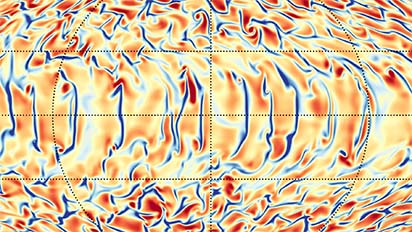
In recent years, NASA’s space-based missions Kepler, K2, and Transiting Exoplanet Survey Satellite (TESS) and ground-based observatories have produced an explosion of data on distant stars and their planetary systems. At these great distances, thousands of light years away, our ability to directly measure structures and processes occurring beneath the stellar surface is almost nonexistent; therefore, the study of stellar interiors, where convection-driven dynamo action generates and shapes a star’s magnetic fields, is the domain of theory and simulation. The portion of a star’s magnetic field that breaches the surface is one of the primary ways it can interact with its environment, sometimes quite violently; it is therefore critically important to understand from first principles how these fields are formed and maintained, to provide context for interpreting observations.
Project Details
As ever-increasing high-performance computing (HPC) resources start to make sufficiently turbulent simulations more common, we hope that the availability of this new tool will enable widespread study of magnetic flux rope formation and dynamics in coming years.
Using the open-source code Rayleigh, we ran high-resolution global 3D magnetohydrodynamics (MHD) simulations of the stellar interiors of 0.4 solar mass stars, to study the sensitivities of their dynamo action with respect to various stellar and simulation parameters. Classified as M-dwarf stars, smaller and far less luminous than the Sun, these stars’ convection zones extend far deeper into the interior—and yet for unknown reasons, they can produce magnetic events far more violent and energetic than any seen on the Sun. Our simulations allow us to capture the interplay of turbulent convective flows, strong latitudinal and radial differential rotation, including a shear layer at the base of the convection zone known as the tachocline, and the powerful, intricate magnetic fields they combine to produce.
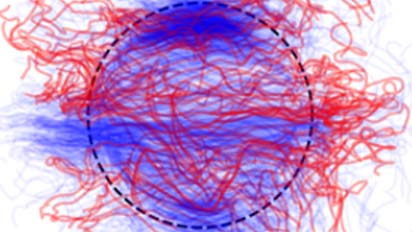
We are also developing a suite of machine learning tools to isolate, identify, and track in time compact magnetic structures known as flux ropes. The buoyant rise of these structures to the stellar surface is thought to be responsible for the formation of sunspots and starspots, which are themselves the seats of violent magnetic events such as flares and coronal mass ejections.
Results and Impact
Our work has provided a crucial backbone of computational results in a region of parameter space—high-mass early M-dwarf stars—that has been mostly neglected in computational studies. We found that the presence of a tachocline in these stars, which is absent in even slightly less massive stars, can help explain their apparently much shorter magnetic lifetime compared to the less massive stars. The tachocline enhances the emergent magnetic field components that contribute the most to stellar spin-down—the process that gradually ends the active period of a star’s magnetic life. We also found an abundance of asymmetric single-hemisphere dynamo states, which are wildly different from those we typically see in more massive stars. Recently, we identified a new dynamo process driven by longitudinally-modulated convection, which could more broadly explain observations of active longitudes—persistent regions of greatly increased magnetic activity—on the Sun and other stars.
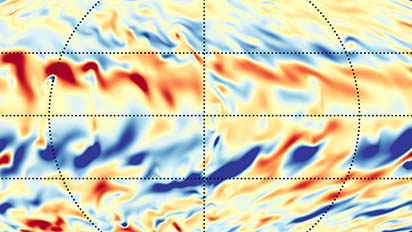
We also identified a collection of rising magnetic flux ropes in one of our models. Due to the highly turbulent conditions typically needed to produce these structures, and the great investment of time needed to isolate them, very few global dynamo simulations have ever been verified to contain them. We are using our identified flux ropes to develop and train a neural network pipeline that can isolate, identify, and track these structures in simulations of any stellar type.
Why HPC Matters
Stellar convection and dynamo action occur over a wide range of spatial and temporal scales, requiring large, high-resolution computational domains to capture in their entirety. The many simulations involved in this project required around 20 million CPU hours to complete, and dozens of terabytes of storage—capabilities that are only available to us via the resources at the NASA Advanced Supercomputing (NAS) facility. Additionally, the workflow for the training of our neural networks has been greatly enhanced by the availability of the NAS facility’s GPU clusters, reducing the training times required by our deepest networks from what would be days to mere hours.
Researchers
- Connor Bice, University of Colorado Boulder Please enable Javascript to see email address.
- Juri Toomre, University of Colorado Boulder Please enable Javascript to see email address.