CFD Analysis of the Transonic Truss-Braced Wing Aircraft
Overview
The Boeing Transonic Truss-Braced Wing (TTBW) concept, which originated from a joint NASA/Boeing effort, contains advancements in technology that have the potential to improve fuel efficiency of commercial aircraft. Due to its unconventional configuration, initial best practices for Reynolds-Averaged Navier-Stokes (RANS)-based computational fluid dynamics (CFD) analysis of the TTBW were not sufficient to reliably asses its performance. To overcome this challenge, the Advanced Air Transport Technology Project within NASA’s Aeronautics Research Mission Directorate launched a collaborative multi-center effort to develop new methods for simulating the TTBW in order to better predict its performance and that of similar truss-braced wing configurations.
Project Details

Researchers in the NASA Advanced Supercomputing (NAS) Division’s Computational Aerosciences Branch are simulating the Mach 0.8 configuration of the TTBW for validation purposes and to develop best practices in their CFD simulations. A model of this configuration has been assessed experimentally in the NASA Ames Unitary Plan 11- by 11-foot Transonic Wind Tunnel. This experimental data is being used to validate the CFD simulations, with a goal to accurately reproduce experimental results using CFD.
Some initial simulations by the Launch Ascent and Vehicle Aerodynamics (LAVA) team at NAS involved increasing the fidelity of the computational modeling by including a wind tunnel representation. Their most recent efforts involve using a variety of turbulence models such as Spalart-Allmaras (SA) and k-ω Shear Stress Transport (SST), grids, and solvers to determine overall best practices and to evaluate CFD capabilities and reliability. The LAVA team is working in close collaboration with colleagues in the Configurations Aerodynamics Branch at NASA’s Langley Research Center for code-to-code comparison between LAVA and Langley’s USM3D to validate results and determine accuracy.
Since flow seperation and recirculation regions are present on the upper surface of the wing, HPC resources will be crucial for running scale-resolving simulations that are necessary to capture these unsteady physics.
Results and Impact
Through comparison with several solvers, grids, and turbulence models, the researchers successfully demonstrated the agency’s capability for RANS-based CFD for the TTBW design. Additionally, the results from these efforts show the relative strengths and weaknesses of the SA and SST turbulence models. The SA model is not only more robust in terms of ease of use and improved numerical stability—particularly after shock-induced separation seen at the higher angles of attack—it also has lower computational costs than SST. However, the SST model was able to better predict the lift coefficient throughout the majority of the angle of attack sweep and—most importantly—near the cruise conditions. Due to the difficulty in achieving good convergence with the SST model, various studies were initiated that helped NASA teams develop a better understanding of how to optimize SST simulations. The limitations of both models at off-design angles of attack reinforces the need for higher fidelity simulations.
Why HPC Matters
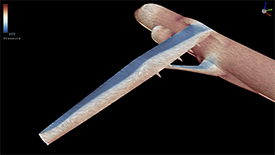
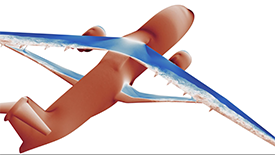
NASA high-performance computing (HPC) resources have already made it possible to run the initial SA simulations within a short turnaround time. After the introduction of the SST simulations and inclusion of more solvers and studies to determine best practices, HPC has continued to show its immense value. Initial LAVA SST simulations required 37 times the amount of resources that were required for SA simulations, yet these solutions could still be obtained within a week. After optimizing the numerics and bringing down the cost of the SST simulations, a single angle of attack case still required 8-12 hours on 4,000 cores to get a converged solution. Quick turnaround speed for these simulations is important, as there can be hundereds of cases that are required to fully assess aircraft performance. Efficient throughput also facilitates quick decision-making and accelerates the distribution of knowledge and information. Finally, since flow seperation and recirculation regions are present on the upper surface of the wing (as seen in the video on the right), HPC resources will be crucial for running scale-resolving simulations that are necessary to capture these unsteady physics.
What's Next
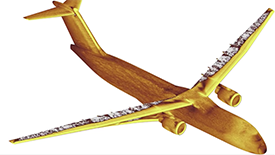
Future work will be looking into higher fidelity CFD analyses, which includes scale-resolving simulations (hybrid-RANS and wall-modeled large eddy simulations), laminar to turbulent boundary-layer transition, and buffet analysis. Meshing best practices will also better support these efforts and incorporate what was learned during the SST turbulence model studies. Due to the mentioned unsteady effects of shock-boundary layer interaction seen in the solutions, as well as the fact that the TTBW features a high-span high-aspect ratio wing, aeroelasticity and fluid structure interaction analyses will also be done.
More Information
Researchers
- Daniel Maldonado, NASA Ames Research Center Please enable Javascript to see email address.
- Jeffrey Housman, NASA Ames Research Center Please enable Javascript to see email address.
- Michael Piotrowski, NASA Ames Research Center Please enable Javascript to see email address.
- Cetin Kiris, NASA Ames Research Center Please enable Javascript to see email address.