Simulating a Mars Supersonic Retropropulsion Concept Vehicle
Overview
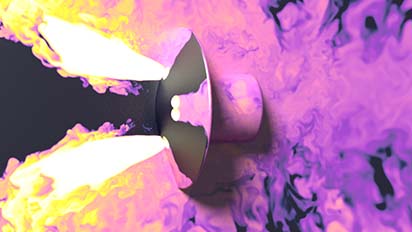
Supersonic retropropulsion (SRP) is a deceleration technology that could enable larger payloads—and potentially, humans—to safely land on the surface of Mars. Previous Mars entry, descent, and landing (EDL) systems made use of a bluff body capsule to decelerate the vehicle to roughly twice the speed of sound, and then deployed parachutes to further decelerate to a safe landing velocity. SRP concepts do away with supersonic parachutes and instead use the thrust from rocket motors pointed in the direction of travel to decelerate. Accurate and reliable computational fluid dynamics (CFD) predictions are needed to help design future Mars EDL concepts with SRP technology as an alternative to the high cost and limitations of wind tunnel tests. Typical CFD approaches struggle at points along the Mars EDL trajectory where the SRP motor plumes are over-expanded (due to high altitude and Mach number) because of the chaotic and dynamic interactions between the turbulent plumes and the bow shock. These interactions occur over a wide range of scales from immediately upstream of the nozzles to several vehicle diameters upstream—significantly increasing the cost of CFD simulations. There is an urgent need to develop new best practices so that CFD can be relied upon to design EDL systems, including these difficult trajectory points, and thus reduce the need for comparatively costly wind tunnel tests.
Project Details
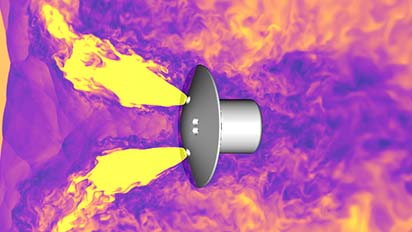
The goal of our work was to conduct scale-resolving simulations of a conceptual Mars EDL vehicle using SRP, leveraging the agency’s high-performance computing resources at the NASA Advanced Supercomputing (NAS) facility at NASA’s Ames Research Center. The Launch Ascent and Vehicle Aerodynamics (LAVA) team at Ames, drawing from recent successes with Orion launch abort simulations, used the LAVA Cartesian solver to simulate the concept vehicle at three different trajectory points with over-expanded plumes, where previous CFD results showed the most disagreement (Mach 2.4, 2.52, and 2.78). We also performed a grid convergence study for the most dynamic case (Mach 2.4) with four different mesh resolutions. The goal was to demonstrate that accurate and reliable CFD predictions can be obtained for time-averaged drag on the vehicle (discounting the thrust generated by its eight SRP rocket motors) using relatively modest computing resources in a short-enough turnaround time to potentially affect future engineering design decisions for the vehicle.
With further code optimization and numerical method improvements, the turnaround time and overall computational cost could be reduced by half, making this methodology potentially usable in the later stages of the engineering design cycle.
Results and Impact
Our campaign of six scale-resolving simulations was completed in roughly five weeks. It demonstrated that high-order shock capturing methods on Cartesian adaptive mesh refinement grids can provide accurate and reliable time-averaged aerodynamic loads on the Mars EDL concept for the challenging flow regime when the SRP motors are in use and the plumes are overexpanded. We obtained greater than second order convergence in the time-averaged drag across the three finest mesh resolutions simulated for Mach 2.4, and the estimated converged uncertainty was smaller than the unsteady standard deviation in drag—demonstrating the accuracy and reliability of the method. Although computationally costly, this approach can yield a higher confidence in time-averaged drag than previously obtained in a reasonable turnaround time, and is within reach for a few points in the trajectory.
Why HPC Matters
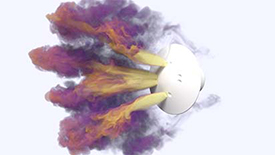
The simulations were performed with an adapted Cartesian mesh ranging from 144 million (coarse) to 1.62 billion (extra fine) cells, with the nominal fine mesh at 856 million cells, which gave time-averaged drag within 2% of the extra fine. In most cases, each simulation completed many hundreds of thousands of time steps that corresponded to more than one second of real time. The three fine mesh cases (Mach 2.4, 2.52, and 2.78) utilized 6,032 Intel Broadwell cores on the Electra and Pleiades supercomputers at NAS over seven days, and produced more than 50 terabytes of surface, cut plane, and volume data. LAVA’s hybrid MPI-OpenMP parallelization allowed us to make use of the newly commissioned AMD Rome nodes on the Aitken system and simulate one second of the extra fine mesh in just under eight days using 12,800 cores. Previous computing resource estimates to obtain similar quality data for a single case were approximately nine times greater, so this represents an important new capability for the agency and demonstrates an alternate to graphics processing units for high-performance computing.
What's Next
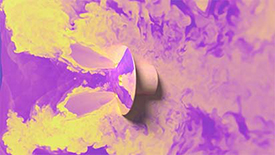
Although the computational cost to simulate one second of time of this full-scale conceptual Mars EDL vehicle using SRP with the LAVA flow solver is substantial, we demonstrated that performing such simulations for a subset of trajectory points is within reach. With further code optimization and numerical method improvements, the turnaround time and overall computational cost could be reduced by half, making this methodology potentially usable in the later stages of the engineering design cycle. We expect to further develop this capability within our new LAVA Cartesian infrastructure and continue to add relevant physical models like wall-modeled large-eddy simulation to better capture viscous effects near the vehicle’s surface.
More Information
Researchers
- Francois Cadieux, NASA Ames Research Center Please enable Javascript to see email address.
- Scott Neuhoff, NASA Ames Research Center Please enable Javascript to see email address.
- Michael F. Barad, NASA Ames Research Center Please enable Javascript to see email address.
- Cetin Kiris, NASA Ames Research Center Please enable Javascript to see email address.