Increasing Aircraft Fuel Efficiency with Boundary-Layer-Ingesting Tail-Cone Thrusters
Overview
In recent years, NASA has developed numerous aircraft concepts that apply boundary layer ingestion (BLI) technology, which analysis has shown can significantly increase fuel efficiency and advance the development of green aviation concepts. In most configurations, the benefit of BLI is obtained through engines that are embedded into the airframe at the rear of the aircraft fuselage, where the propulsors “ingest” the low-momentum boundary layer air that develops around the fuselage during flight. The result is an overall decrease in the power required for flight in comparison with conventional aircraft configurations, with an increase in propulsive efficiency and a decrease in overall drag. NASA’s Advanced Air Transport Technology (AATT) project is investing in BLI research to assess its benefits through a combined experimental and analytical approach. As part of a cross-center collaboration between NASA’s Ames, Glenn, and Langley Research Centers, researchers in the NASA Advanced Supercomputing (NAS) Division at Ames ran high-fidelity computational fluid dynamics (CFD) simulations that have played a key role in analyzing BLI performance, validated by experimental results.
Project Details

Using the NAS-developed Launch Ascent and Vehicle Aerodynamics (LAVA) curvilinear flow solver, the researchers computed metrics such as aerodynamic loads, inlet flow distortion, and many others using steady Reynolds-Averaged Navier-Stokes (RANS) analysis to inform design choices and confirm BLI benefits. The research was divided into multiple phases. First, to establish confidence that CFD can capture relevant physics for a BLI configuration, realistic flight conditions were simulated for the National Transonic Facility Common Research Model (NTF-CRM), for which upcoming wind tunnel experiments will be used to validate the CFD predictions. This work required simulating about 240 aircraft flight conditions, from which flow angularity, inlet flow distortion, aerodynamic loads, and boundary layer profiles near the tail-cone thruster (TCT) engine—which serves as the BLI propulsor—were extracted.
Simulations of standalone propulsors are also crucial to quantify performance gains of the BLI engine and distortion tolerant fan (DTF). For one such analysis, the team modeled the W8 Single Stage Axial Compressor and Fan Facility at NASA Glenn, in which a BLI propulsor was subjected to realistic boundary layer inflow conditions. This work involves quantifying the effects of tunnel hardware and ensuring the resulting profile ingested by the engine test article is adequately captured. As a result of this analysis, BLI propulsor and fan performance can be quantified, providing information necessary for implementation on a full aircraft configuration.
High-fidelity CFD modeling of boundary layer ingestion (BLI) concepts, databases, and trade studies would not be possible without high-performance parallel computing. Our analyses will inform experimental approaches, measure and confirm benefits, and refine aircraft designs that employ BLI technology.
Results and Impact
These high-fidelity BLI analyses will serve to inform experimental approaches, measure and confirm benefits, and refine aircraft designs that employ BLI technology. The NTF-CRM analysis established confidence in the ability to make predictions for unpowered BLI-type configurations, while the W8 tunnel analysis ensures wind tunnel and powered propulsors can be adequately modeled. Preliminary CFD simulations have shown that properties such as mass flow rate and total pressure measurements could be predicted within 7% and 3%, respectively, relative to the measured data. These figures are expected to improve even further once an improved representation of the wind tunnel geometry is simulated. In addition, new models designed to mimic upstream screen losses have also been implemented into the LAVA solver, providing the capability to model induced pressure losses. Ultimately, fan performance data gathered in the W8 facility and BLI configuration vehicle performance will be used to compute an overall system-level benefit relative to a conventional aircraft configuration.
Why HPC Matters
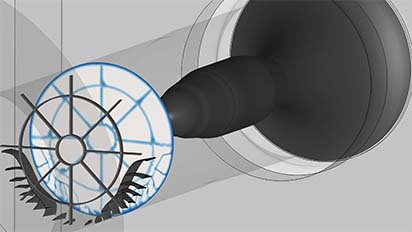
High-fidelity CFD modeling of BLI concepts, databases, and trade studies would not be possible without high-performance parallel computing. All simulations were performed on NASA’s Pleiades supercomputer, with resource requirements varying for each phase of analysis. For the NTF-CRM database analysis, all steady RANS simulations required ten Intel Skylake nodes for about 30 minutes per simulation, totalling about 48,000 core hours. Meanwhile, W8 tunnel simulations required 40 Intel Skylake nodes for four hours per simulation, or about 6,400 core hours.
What's Next
The W8 wind tunnel analyses will resume in the coming months, with simulations that utilize the implementation of screen loss models to create realistic BLI inflow conditions. Upcoming simulations will also focus on implementing BLI technology on a realistic application to assess power-saving benefits relative to a conventional baseline aircraft. Results from standalone BLI engine analyses will serve to mature design choices with regard to the DTF, airframe geometry, and engine sizing, all of which will provide a feasible BLI engine necessary for optimal system-level performance.
Researchers
- Jared Duensing, NASA Ames Research Center Please enable Javascript to see email address.
- Leonardo Machado, NASA Ames Research Center Please enable Javascript to see email address.
- Luis Fernandes, NASA Ames Research Center Please enable Javascript to see email address.
- Cetin Kiris, NASA Ames Research Center Please enable Javascript to see email address.