
System-Level Assessment of New Technologies to Reduce Airframe Noise
Overview
Diminishing the adverse environmental impact of aircraft noise on population centers near airports is a high priority for NASA's Aeronautics Research Mission Directorate. During landing, noise generated by the airframe—an aircraft's wings, fuselage, tail assembly, and landing gear—can exceed that produced by the engines. Until now, system-level development and evaluation of viable airframe noise reduction technologies in a relevant environment could only be achieved with full-scale flight tests.
Researchers supporting the Environmentally Responsible Aviation (ERA) project are working to advance and accelerate the development of simulation-based, system-level airframe noise prediction tools. Creating these tools will help promote a paradigm shift in aircraft design from the current time-consuming and costly cut-and-try approach to a physics-based virtual design environment, in which the aeroacoustic evaluation of a noise reduction concept and its subsequent optimization can take place in an integrated fashion.
Project Details
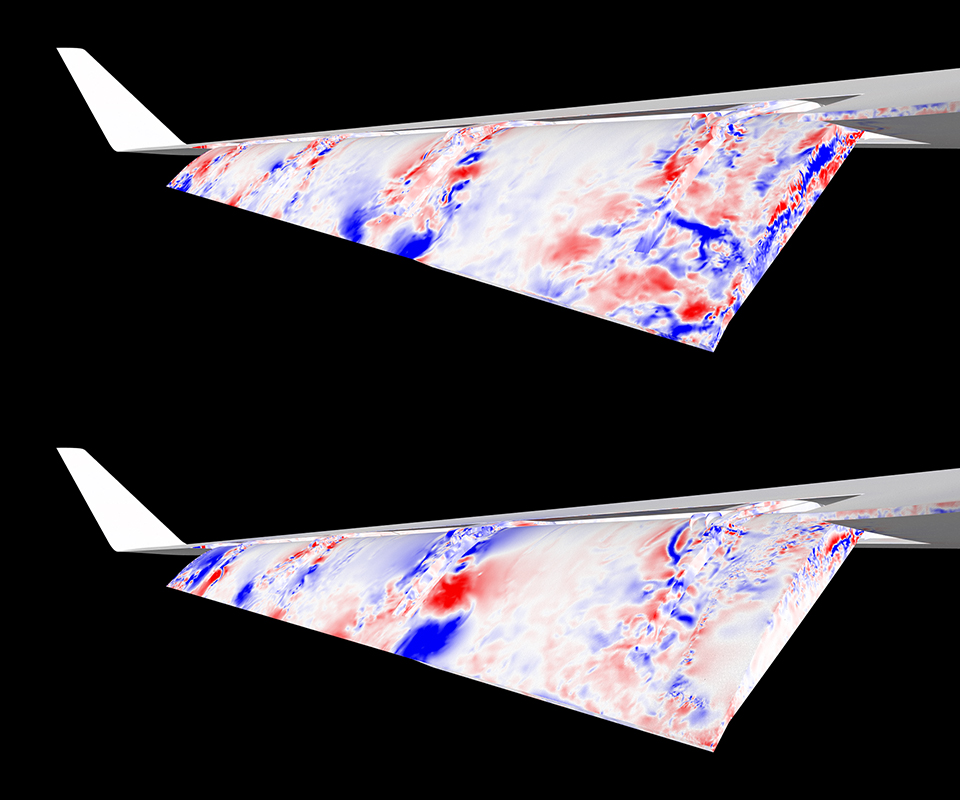
As a continuation of our previous work, which was based on a full-span, full-scale baseline Gulfstream aircraft in landing configuration (with wing flaps deflected 39 degrees and the main landing gear deployed), we have simulated the same configuration with noise reduction (NR) technologies applied to the flaps and main landing gear. To assess the performance of the applied technologies and the ensuing noise abatement benefits, we designed our simulations to accurately resolve the local flow fields at three locations: the flap tips, the regions near the main landing gear, and the interaction zones between these two areas.
To date, we have completed coarse- and medium-resolution computations; fine-resolution results are in progress. We used Exa Corporation's PowerFLOW Lattice-Boltzmann flow solver to perform these time-accurate simulations. Depending on the geometric complexity of the NR technology being evaluated, our medium-resolution simulations required two to four billion volumetric cells to discretize the space surrounding the aircraft surfaces.
Results and Impact
Simulations of this kind present numerous challenges due to extreme geometric complexities and the wide range of spatio-temporal resolution required. Through direct comparison with acoustic measurements obtained during a 2006 flight test, our previous results for the baseline full-scale aircraft helped validate the accuracy of these computations. As far as we know, the simulations performed for this study constitute the first attempt to evaluate, on a system-level basis, airframe noise abatement technologies applied to a full-scale aircraft in landing configuration with most of the geometrical details included. Our study will help NASA introduce aeroacoustic requirements into the aircraft design process at the conceptual level, bringing closer the ultimate goal of confining aircraft noise within airport boundaries.
Why HPC Matters
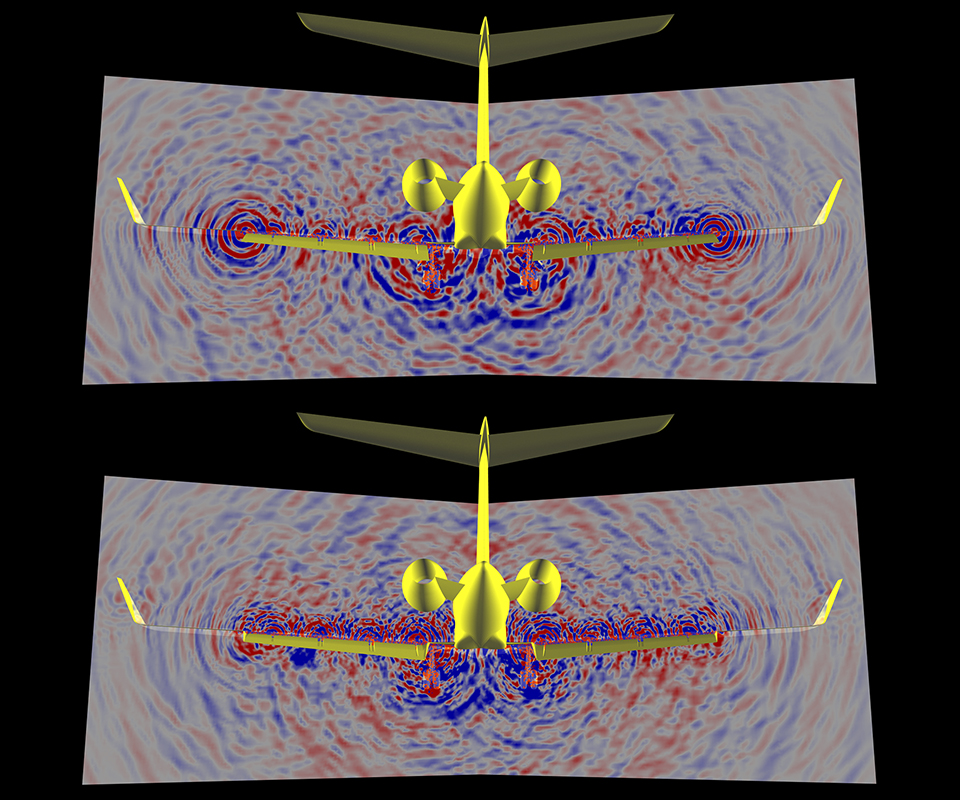
All computations for this study were performed on NASA's Pleiades supercomputer. Our medium-resolution simulations required approximately 4,000 to 8,000 processors and 275,000 to 2 million processor-hours, and generated 40–50 terabytes of data per case. Rendering and visualization of these large datasets were made possible by the NASA Advanced Supercomputing (NAS) Division's visualization team.
What's Next
In the near term, we will apply the same flap and landing gear noise reduction technologies to a full-scale Gulfstream III (G-III) aircraft. We will also evaluate additional concepts to reduce noise from landing gear cavities on this aircraft. These simulations will complement and guide the planned flight test of these concepts on NASA's G-III testbed aircraft.
Mehdi R. Khorrami, NASA Langley Research Centermehdi.r.khorrami@nasa.gov