
A Dual Path to Adaptive Mesh Refinement Visualizations
Overview
Adaptive mesh refinement (AMR) techniques are rapidly growing in use for a wide range of computational fluid dynamics (CFD) problems of interest to scientists who use NASA's high-performance computing (HPC) systems. With the increasing use of AMR solver codes comes the need for visualization and analysis tools that can efficiently process the simulation results. The visualization team at the NASA Advanced Supercomputing (NAS) Division has developed an approach that works with the dual of the AMR mesh hierarchy to achieve continuous interpolation and visualization results comparable to those based on traditional meshing schemes. Unlike some similar techniques, our approach works even in cases where the AMR data have refinement ratios other than two. We have applied our technique to data from a variety of CFD solvers, including Cart3D, PowerFLOW, LAVA, and Enzo. These solvers are producing results key to achieving many NASA mission objectives.
Project Details
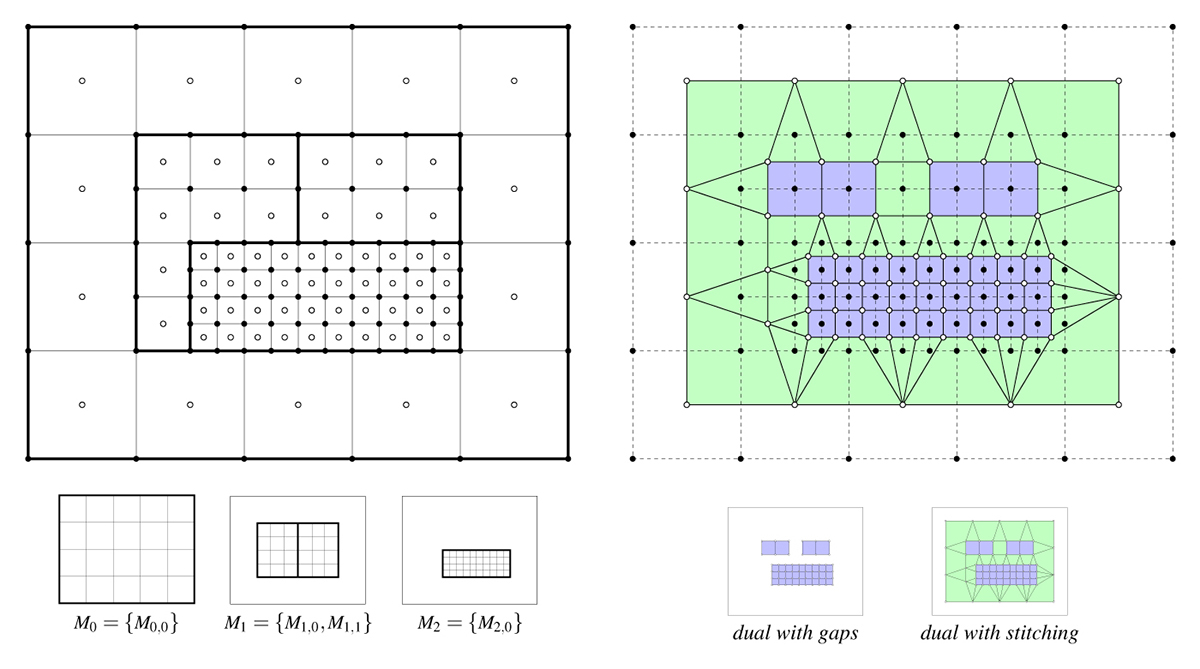
The rapid growth in the use of AMR-based flow solvers has created new challenges in CFD visualization. Initially, we used reformatting and resampling techniques in order to convert the AMR data into a form that would work with existing tools. This was not a satisfactory long-term solution because the conversions introduced additional demands on NAS resources and slowed the analysis process. In particular, when analyzing results from simulations that were already pushing the envelope of what the systems were capable of, we wanted analysis techniques that were also capable of handling such demanding data without exceeding the limits of the system. In response, we developed a dual-mesh technique for AMR data that can work with the data “as is” and still produce visualizations comparable to those based on more traditional meshing schemes. Our approach does not require significant pre-processing or additional memory usage. Initially, we developed our technique to work with galaxy-formation data from Enzo, a hydrodynamic astrophysics simulation code. Over time we have ported our technique to work with data from two NASA-developed codes (Cart3D and LAVA) and one commercially available code: Exa Corporation's PowerFLOW.
Results and Impact

Visualizations based on our dual-mesh analysis techniques have been featured by computational scientists in a variety of venues, including conference presentations, academic publications, and industry journals such as Aviation Week. We anticipate that AMR-based codes will continue to account for a significant portion of the usage of NASA's Pleiades supercomputer, and therefore the demand for visualizations of AMR data will remain high.
For Cart3D data analysis, we have developed stand-alone applications that enable project scientists to quickly visualize their data and produce presentation-quality results on their own. One application in particular, raycart, produces ray cast, volume-rendering images, including images similar to those produced by experimental Schlieren techniques. This application has been enthusiastically adopted for use in support of a variety of projects, including analyses related to the development of NASA's Space Launch System (SLS) and the modeling of meteors.
Why HPC Matters
Many of the studies conducted on supercomputing systems such as Pleiades are only feasible on large HPC systems. These studies tend to push the boundaries of what the system is capable of, not only in processing power, but also memory and network capability. Visualizing the results from such studies is also very demanding, and our dual-mesh technique enables us to successfully meet many of those challenges.
Patrick Moran, NASA Ames Research Centerpatrick.moran@nasa.gov