
Unlocking the Secrets of Solar Storms
Overview
Solar storms, including flares and coronal mass ejections (CMEs), are large explosive events on the Sun that are capable of ejecting billions of tons of magnetized, million-degree plasma into space. When these storms reach Earth, they can disrupt radio transmissions, damage satellites, and severely impact power transmission grids, leading to extended large-scale power outages. Predicting such eruptions and their trajectories is a major goal of NASA's Heliophysics Research Program. Understanding the storms' underlying magnetic/plasma structure and evolution is vital for developing predictive capabilities. Our group is engaged in several avenues of research towards this goal.
Project Details
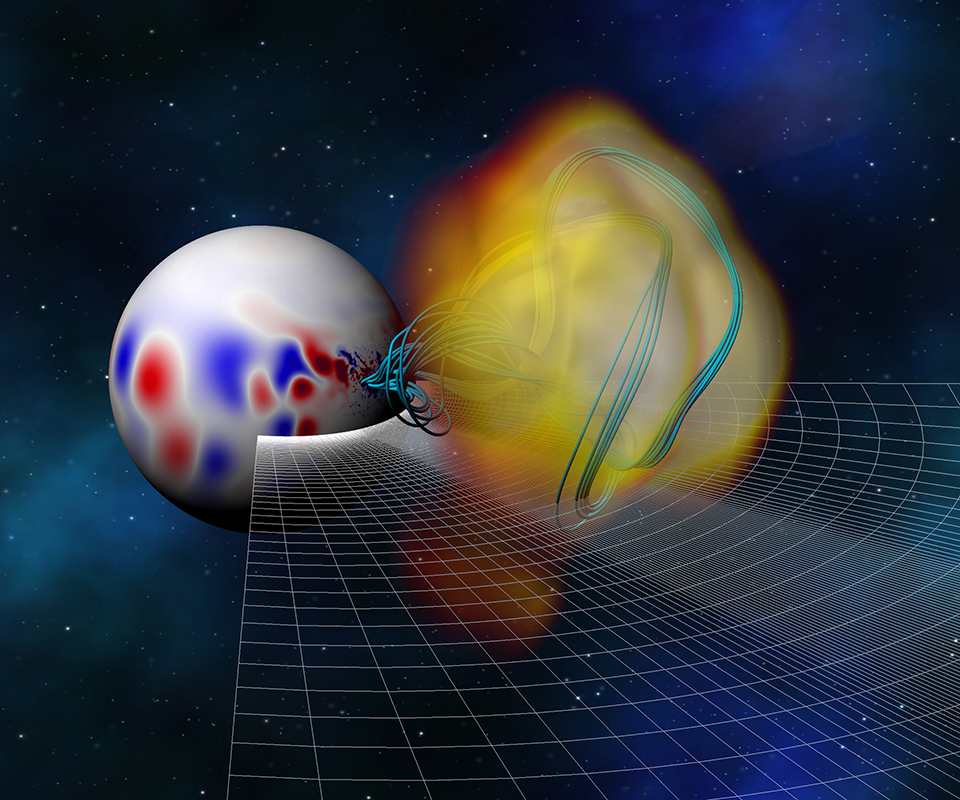
We use a sophisticated 3D magnetohydrodynamic (MHD) model, called Magnetohydrodynamic Algorithm outside a Sphere (MAS), to improve our understanding of the initiation and propagation of solar storms. MAS has been used for over a decade to explore the structure of the global corona and solar wind, including models of active regions, coronal heating, and theoretical models of CME initiation. We have also enabled researchers to run simulations online using the MAS code via NASA's Community Coordinated Modeling Center (CCMC).
For this project, we used MAS to study the initiation and propagation of solar storms. The model enables us to perform CME event studies using detailed observations as inputs, including observed magnetic fields. We can then produce simulations that can be directly compared with observations, including white-light images and extreme ultraviolet and X-ray emissions.
Results and Impact
We developed innovative methods for producing energized pre-eruptive magnetic field structures in our simulations, including the use of analytic flux-rope models embedded in observed magnetograms, together with the ability to trigger eruptions. In addition, we designed sophisticated post-processing techniques to analyze the topological structure of magnetic fields, providing a deeper understanding of the characteristics of solar eruptions. We simulated in detail the Bastille Day event of July 14, 2000—one of the largest solar storms ever recorded—which produced a fast CME exceeding 1,700 kilometers per second, and a very large X5.7 flare. Our simulations successfully reproduced some of the key observed features of this storm.
Results of simulations like these greatly contribute to a more complete understanding of the dynamics and structure of solar eruptions—a key step towards developing predictive capabilities.
Why HPC Matters
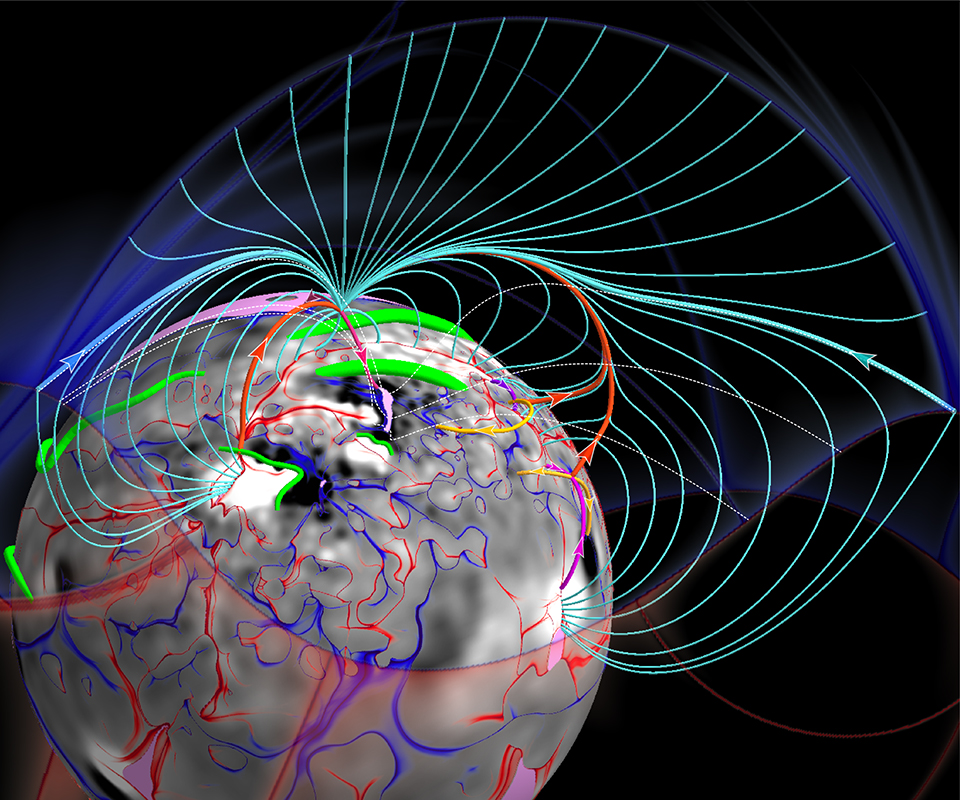
The critical importance of direct simulation results to the study of solar storms makes the use of high-performance computing essential. Our MHD simulations require grids of 50 million cells or more, and must integrate time-dependent equations for millions of cycles, necessitating the use of massively parallel computations. Each simulation run for this project used thousands of processors and took several days to complete on NASA's Pleiades supercomputer.
More Media
See additional images/videos related to this demo in our media gallery.
caplanr@predsci.com Zoran Mikić, Predictive Science Inc.
mikicz@predsci.com