
Virtual Earth Observing: The Globe in 1-Mile Segments
Overview

The Global Modeling and Assimilation Office (GMAO) maintains the Goddard Earth Observing System (GEOS-5) atmospheric model as a near-real-time operational analysis and forecast model, and also regularly produces retrospective reanalyses of the satellite era (from 1979 to the present). The GEOS-5 software is continually developed to meet the demands of future assimilation systems and computing environments. One aspect of this preparation is to run early versions of our most advanced modeling systems on existing computer platforms, but at resolutions currently not affordable for operational work. GMAO scientists recently used GEOS-5 to produce a global atmospheric simulation with more than 200 million grid cells just 1 mile wide (a circa year 2030 forecast model) on the Discover supercomputer at the NASA Center for Climate Simulation (NCCS).
Project Details
Today's global models routinely produce high-quality predictions of the evolving weather and climate. By exploring the limits of computational capacity, pioneering GEOS-5 simulations become massive numerical missions producing virtual observations that connect neighborhoods around the globe to regional and global events influencing local weather and climate. GEOS-5 provides a cohesive picture of the Earth's atmosphere at the resolution of most modern satellite observing systems. These simulations include many physical and dynamical quantities not observable with existing satellite platforms.
Results and Impact
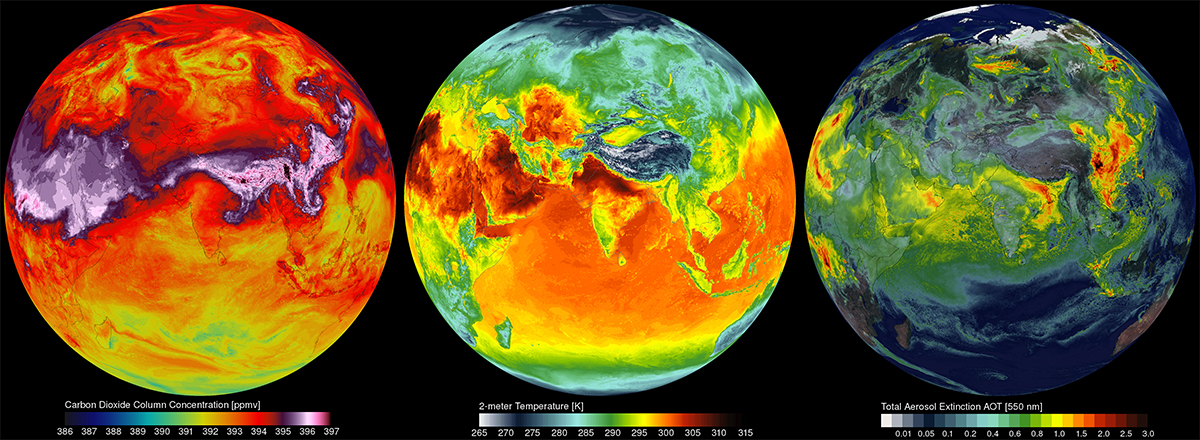
The pioneering GEOS-5 simulations produce stunning looks at the future of weather and climate modeling at local scales within the global Earth system:
- Surface temperatures reveal the complexity of the global topography.
- Large thunderstorm complexes develop over-shooting cloud tops indicative of severe, tornado-producing storms.
- A sea of intricate stratocumulus clouds blankets the oceans.
- Fine particles stream from industrial plants and fires around the globe.
- Waves of carbon dioxide drift from their sources and engulf the world.
Why HPC Matters
With just a small fraction of the computing power truly needed to simulate the Earth's atmosphere in 1-square-mile segments, the GMAO and NCCS completed the massive global atmospheric simulation at a rate of one simulated day per wall-clock day on the Discover supercomputer. Using just 1,080 28-core Intel Haswell nodes (30,240 cores), GMAO scientists and software engineers were able to efficiently trim the memory footprint of GEOS-5 to fit more than 5 terabytes of global data into the 128 gigabytes of available memory per node. The 4-day simulation produced nearly 15 terabytes of output each day for a total of 60 terabytes. These computational endeavors with GEOS-5 ultimately create a more efficient and robust modeling capability to meet the demands of NASA's current and future Earth science missions.
William Putman, NASA Goddard Space Flight Centerwilliam.m.putman@nasa.gov